Can I raise my VO2max, and does it even matter?
Yes, but after the quick first gains, slowly. On a bike, your VO2max, the most oxygen your body can use flat out, is set mostly by how much blood your heart can pump, and a bigger pump takes seasons to build. And it matters less than the number suggests, because riders with the same VO2max can ride very differently.
The video version, 4:27, narrated by a synthetic voice. Watch on YouTube · Watch the Short
Two riders, one ceiling
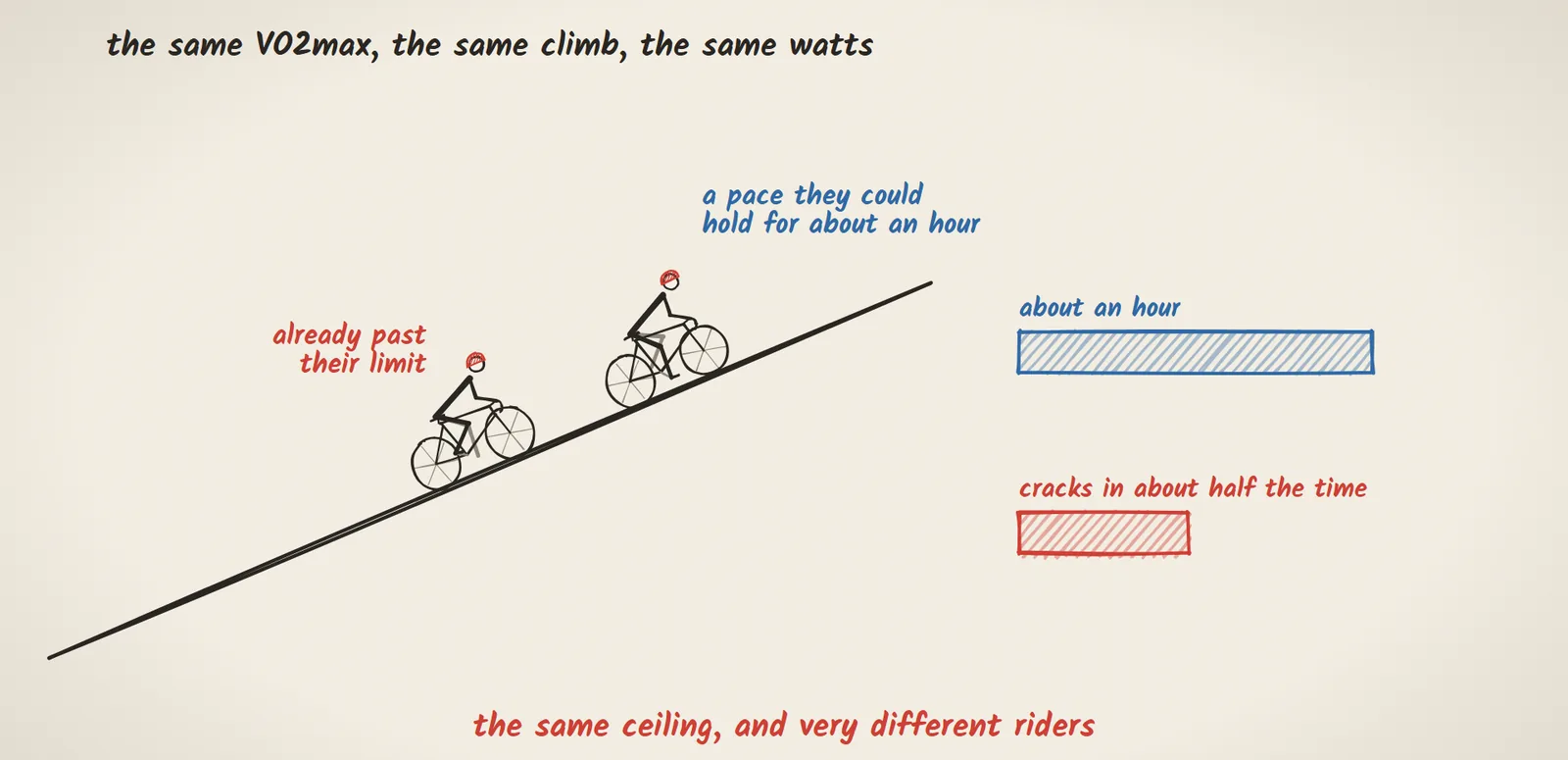
If your watch or bike computer gives you a VO2max, it’s an estimate from your heart rate and your riding, not a measurement of the oxygen you breathe. I’ve never had mine measured in a lab. But it’s easy to read that number as the size of your engine, the thing that decides how good you can get. Now picture two riders with the same number, on the same long climb at the same watts. For one of them, it’s a pace they could hold for about an hour. The other is already past their limit and will crack in about half the time. They have the same ceiling, and they’re very different riders.
What sets the ceiling
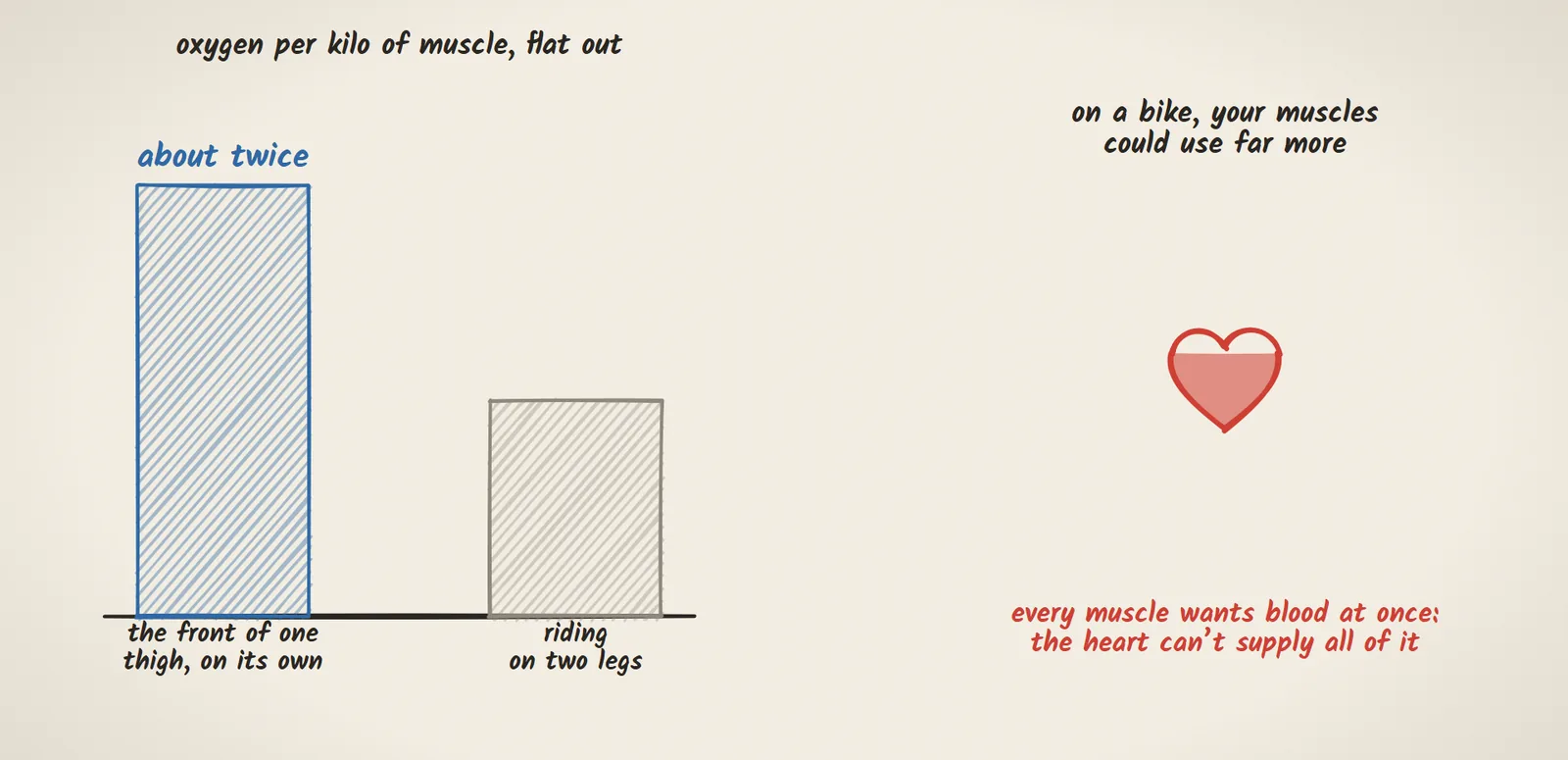
Here’s what sets the ceiling. The oxygen your muscles use is the blood your heart sends them, times how much of the oxygen in that blood they take out. So a higher ceiling means more blood, or more taken out of it. Taking more out does improve with training, but it runs out of room: flat out, your working legs already pull most of the oxygen from the blood that reaches them. The bigger limit is delivery. When researchers had people work just the muscles at the front of one thigh as hard as they could, with the rest of the body at rest, those muscles took up about twice as much oxygen per kilo as they do when you ride flat out on two legs. So on a bike, your muscles could use far more. When every muscle you ride with wants blood at once, your heart can’t supply all of it.
How the heart pumps more
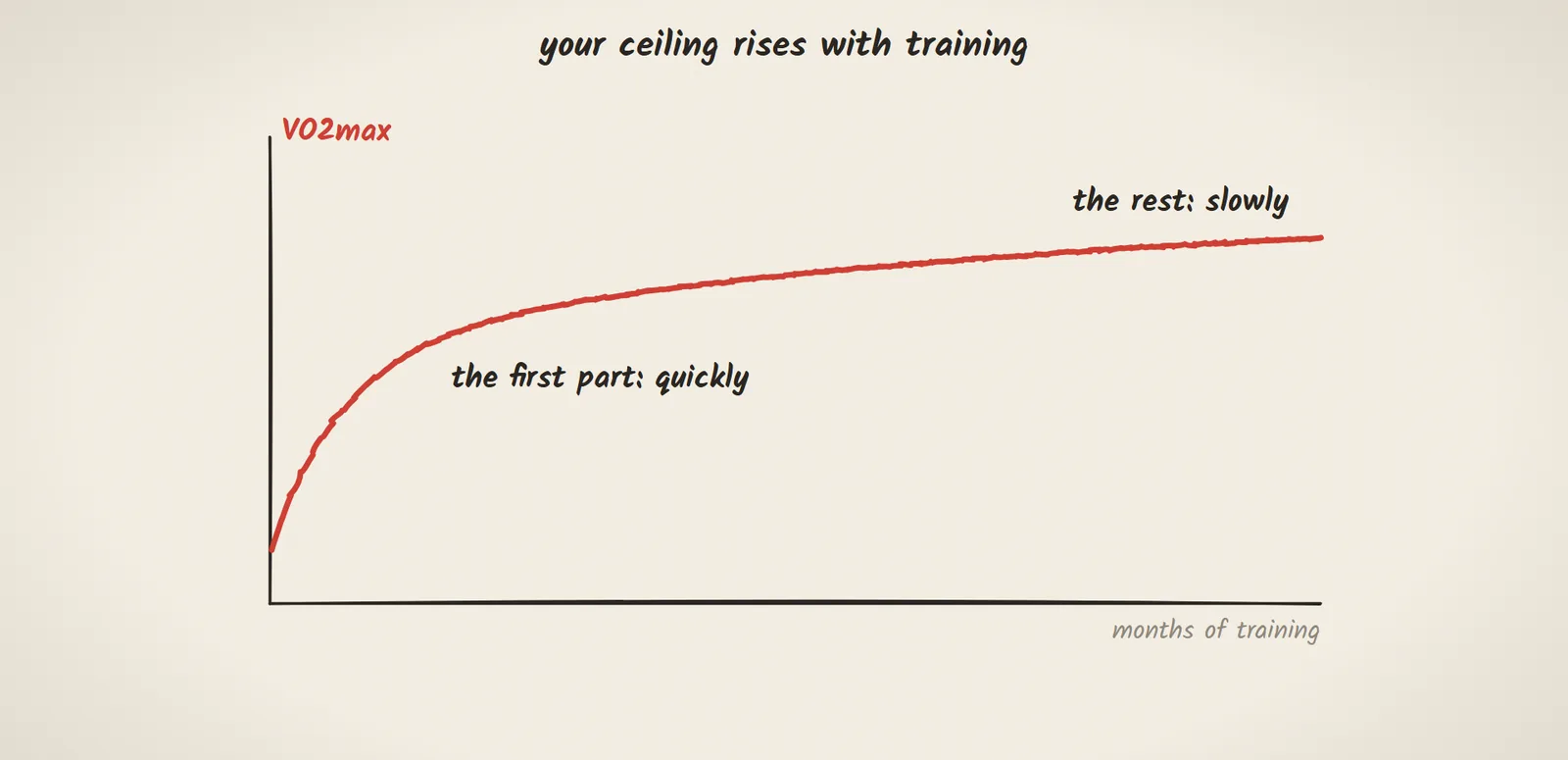
Your heart has two ways to pump more: beat faster, or push out more blood with each beat. Training doesn’t raise your maximum heart rate: it’s set mostly by your age and your genes. That leaves the size of each beat. Part of that comes quickly: within days of starting to train consistently, you carry more blood plasma, so the heart fills more fully and each beat pushes out more. The rest is the heart itself remodelling, its main chamber growing larger, and that keeps building across seasons. So yes, your ceiling rises with training: the first part quickly, and the rest slowly.
Not all up to you
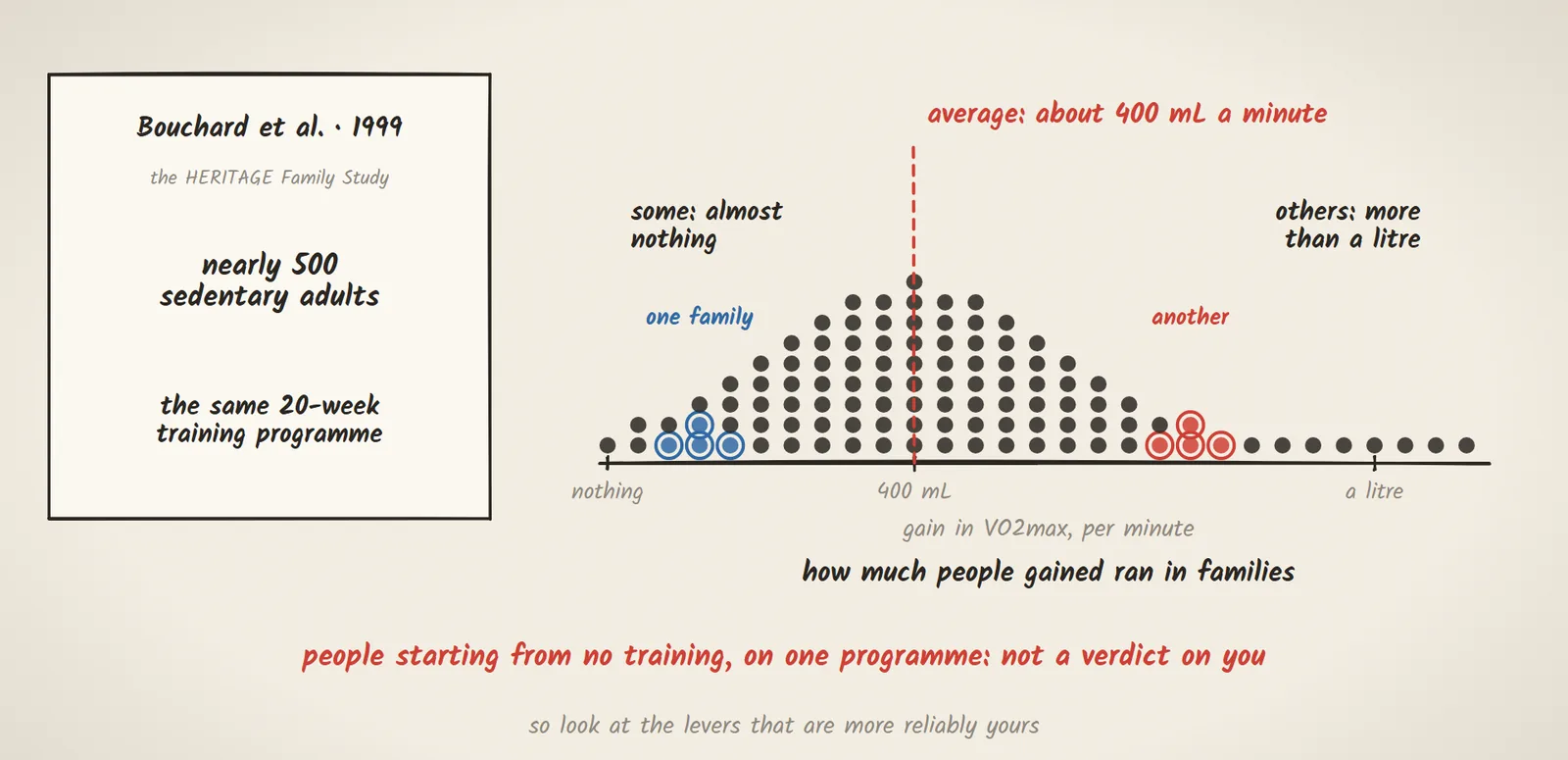
And how much yours rises isn’t entirely up to you. In one large study, nearly 500 sedentary adults did the same 20-week training programme. Their VO2max rose by about 400 mL a minute on average, but some gained almost nothing and others more than a litre, and how much people gained ran in families. That’s people starting from no training, on one programme, so it isn’t a verdict on you. But it’s a reason to put your attention on the levers that are more reliably yours.
The experiment
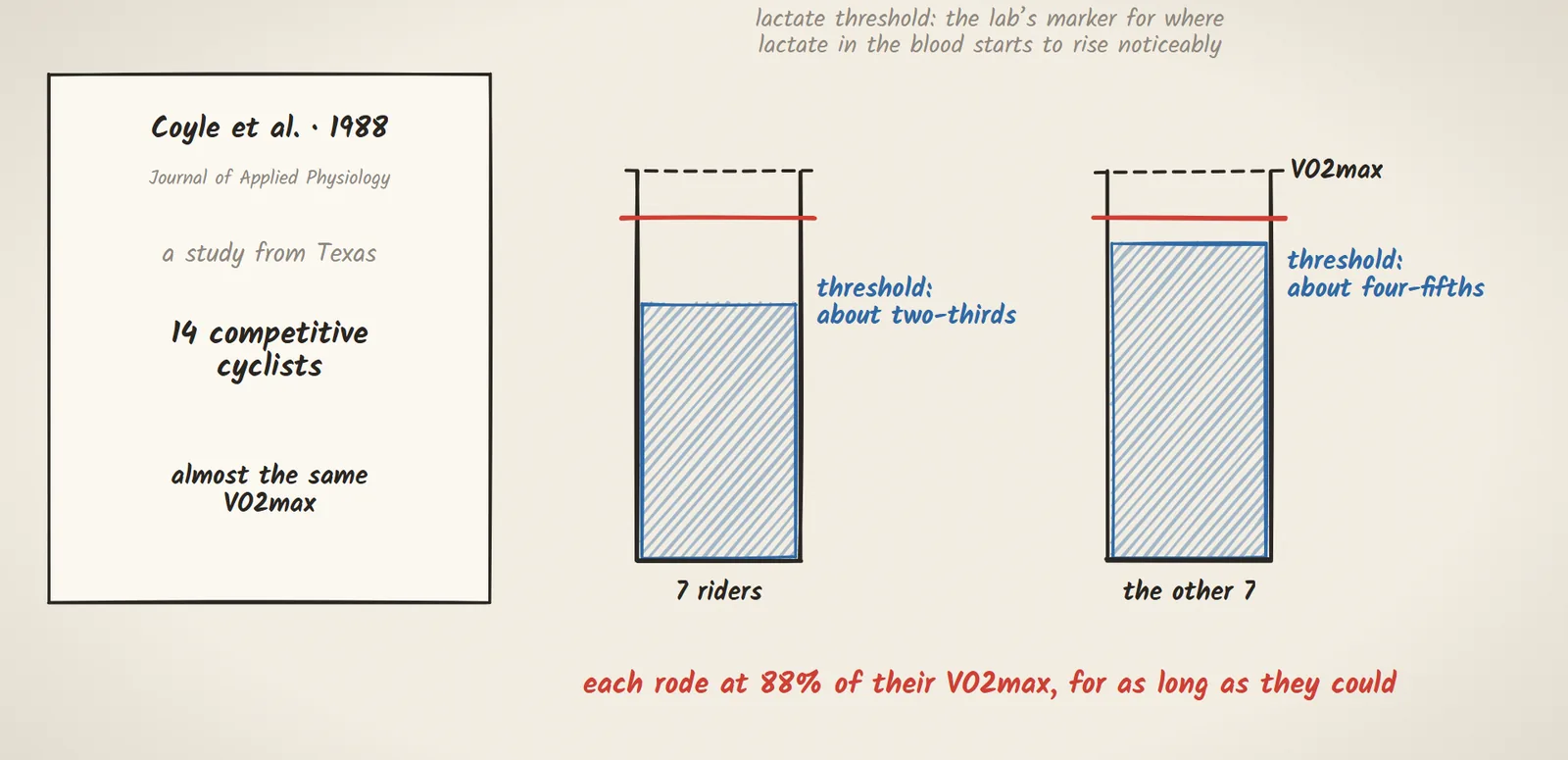
So does the ceiling decide the ride? In one study from Texas, 14 competitive cyclists all had almost the same VO2max. Seven of them reached their lactate threshold, the lab’s marker for where lactate in the blood starts to rise noticeably, at about two-thirds of their VO2max. The other seven didn’t reach it until about four-fifths. And each of them rode at 88% of their VO2max for as long as they could.
What they found
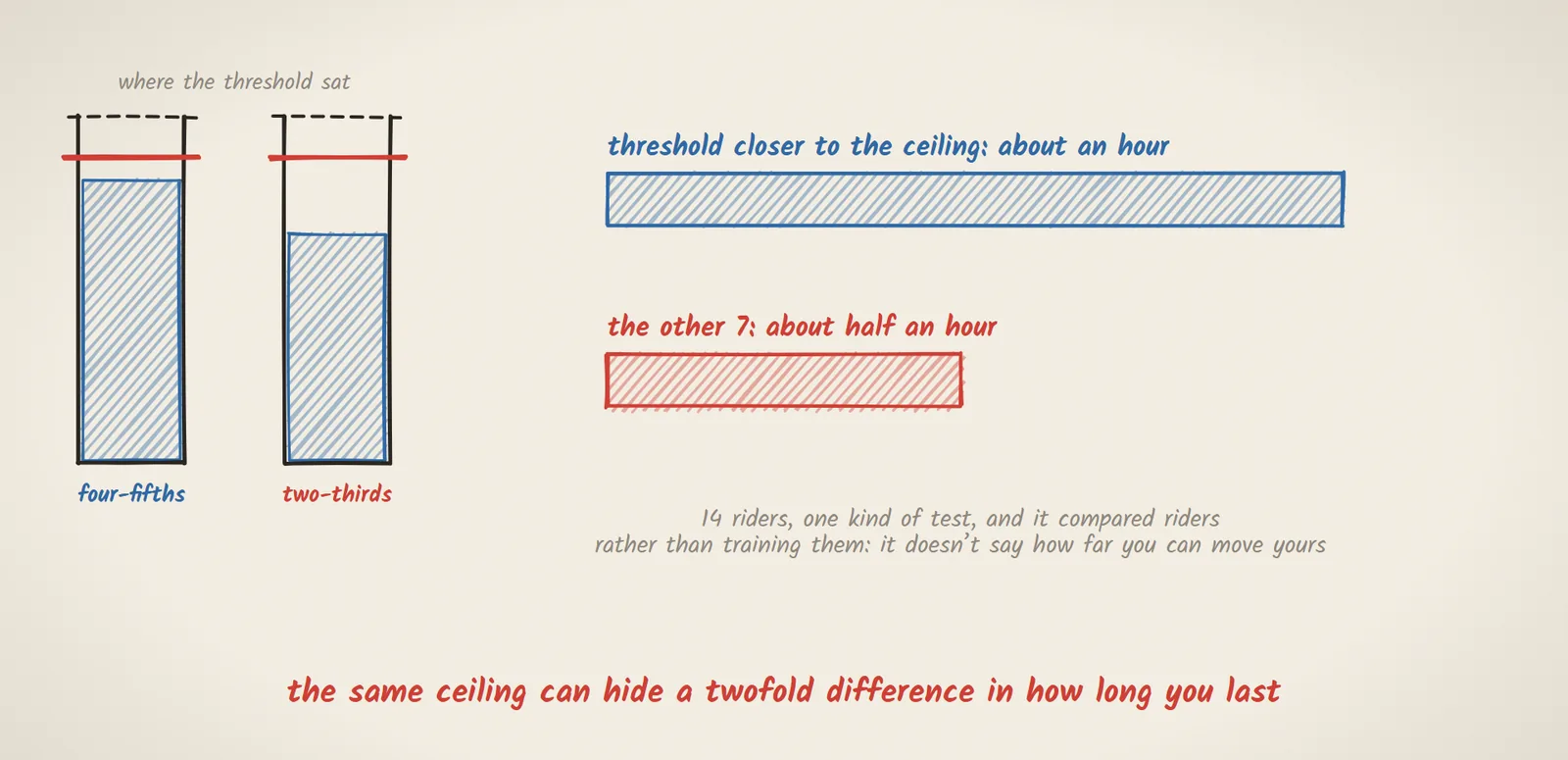
The seven whose threshold sat closer to their ceiling lasted about an hour. The other seven lasted about half an hour. It’s 14 riders and one kind of test, and it compared riders rather than training them, so it doesn’t tell you how far you can move yours. But it shows that the same ceiling can hide a twofold difference in how long you last.
What it means for you
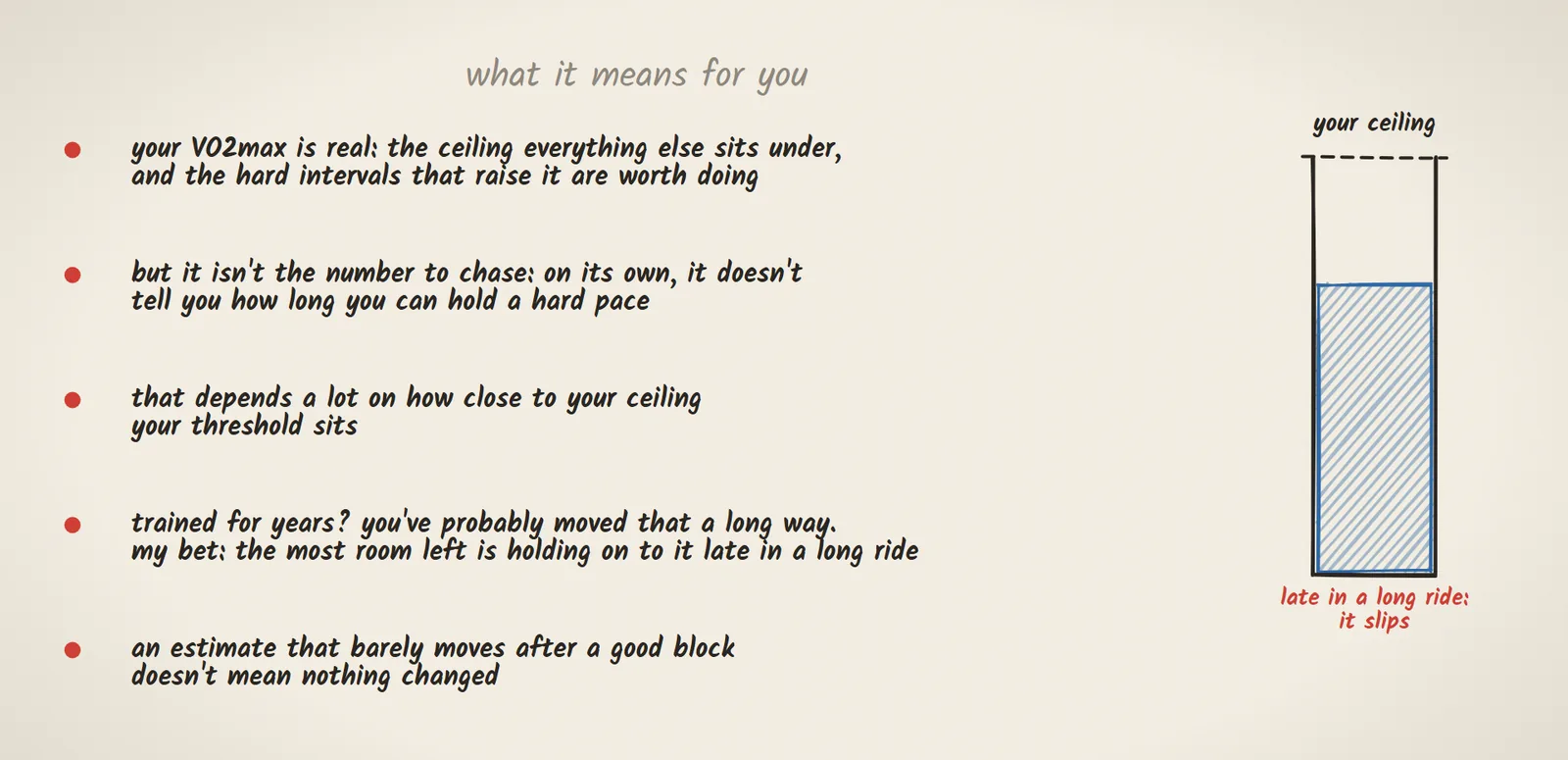
So what does this mean for you? Your VO2max is real, it’s the ceiling everything else sits under, and the hard intervals that raise it are worth doing. But it isn’t the number to chase: on its own, it doesn’t tell you how long you can hold a hard pace. That depends a lot on how close to your ceiling your threshold sits. If you’ve been training for years, you’ve probably moved that a long way already, and my bet is that the part with the most room left is holding on to it late in a long ride, when it starts to slip. And if the estimate on your watch barely moves after a good block, that doesn’t mean nothing changed.
That’s what’s underneath the watts.
Sources
The study
- Coyle EF, Coggan AR, Hopper MK, Walters TJ. Determinants of endurance in well-trained cyclists. J Appl Physiol. 1988;64(6):2622-2630. doi.org/10.1152/jappl.1988.64.6.2622
Also in this article
- The same 20 weeks of training, very different gains: Bouchard C, An P, Rice T, Skinner JS, Wilmore JH, Gagnon J, Pérusse L, Leon AS, Rao DC. Familial aggregation of VO(2max) response to exercise training: results from the HERITAGE Family Study. J Appl Physiol. 1999;87(3):1003-1008. doi.org/10.1152/jappl.1999.87.3.1003
- One thigh on its own against two legs: Andersen P, Saltin B. Maximal perfusion of skeletal muscle in man. J Physiol. 1985;366:233-249. doi.org/10.1113/jphysiol.1985.sp015794
- Boushel R, Saltin B. Ex vivo measures of muscle mitochondrial capacity reveal quantitative limits of oxygen delivery by the circulation during exercise. Int J Biochem Cell Biol. 2013;45(1):68-75. doi.org/10.1016/j.biocel.2012.09.024
- Maximum heart rate and training: Zavorsky GS. Evidence and possible mechanisms of altered maximum heart rate with endurance training and tapering. Sports Med. 2000;29(1):13-26. doi.org/10.2165/00007256-200029010-00002
- How long the heart takes to remodel: Arbab-Zadeh A, Perhonen M, Howden E, Peshock RM, Zhang R, Adams-Huet B, Haykowsky MJ, Levine BD. Cardiac remodeling in response to 1 year of intensive endurance training. Circulation. 2014;130(24):2152-2161. doi.org/10.1161/CIRCULATIONAHA.114.010775
Written and researched by Yarin Podoler, a cyclist who wanted to know what’s underneath the watts.