Does keto or fat adaptation make me faster?
So far, not reliably. It does make your body burn far more fat. But in elite race walkers, 3 weeks of hard training on keto didn’t make them any faster in a race, and in one study of cyclists, 6 days of high-fat eating, even with a day of carbohydrate loading after it, left their one-kilometre sprints weaker.
The video version, 4:34, narrated by a synthetic voice. Watch on YouTube · Watch the Short
My long rides, and the idea behind keto
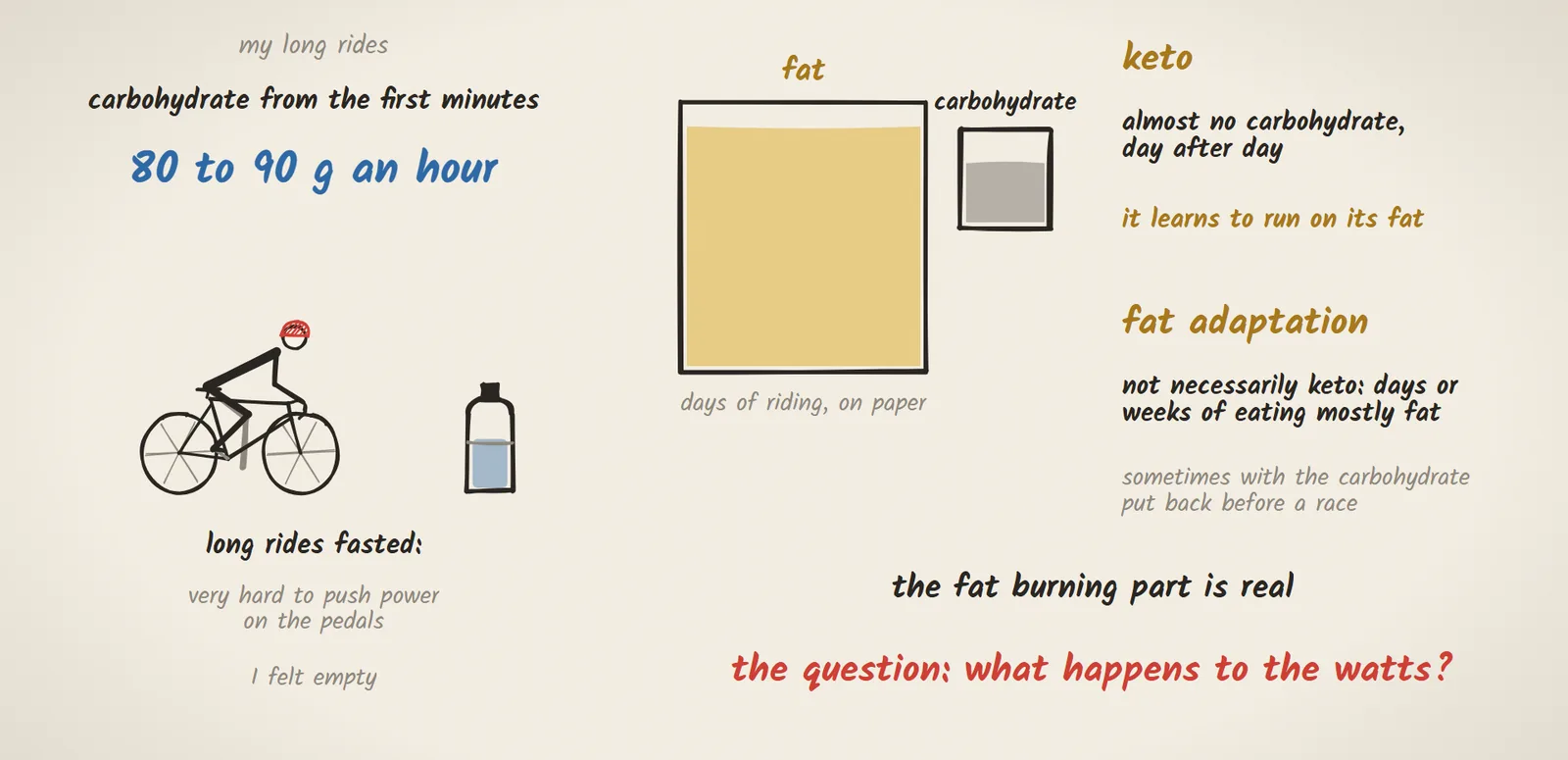
On my long rides I start taking carbohydrate in the first minutes, 80 to 90 grams an hour. I’ve also done long rides fasted, and what I remember is that it was very hard to push power on the pedals, and I felt empty. The idea behind keto is that the body can be taught to need far less carbohydrate. Eat almost none, day after day, and it learns to run on its fat, a tank that on paper holds days of riding. Fat adaptation is a related idea, but not necessarily keto: days or weeks of eating mostly fat, sometimes with the carbohydrate put back before a race. The fat burning part is real. The question is what happens to the watts.
Two fuels, two pipes
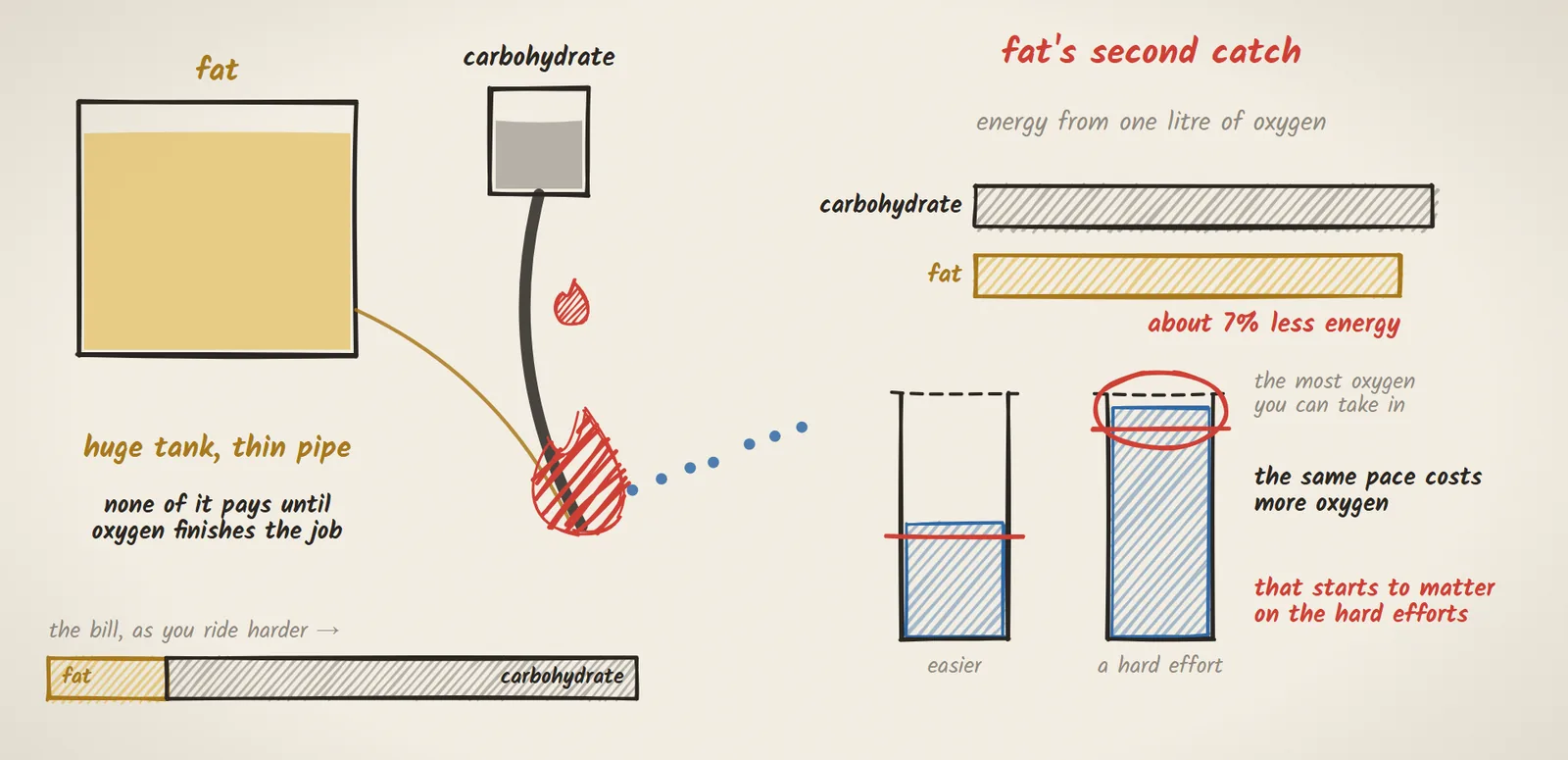
Start with the two fuels. Carbohydrate is a small tank with a wide pipe: it can be burned fast, and part of its energy comes out before oxygen is even involved. Fat is a huge tank with a thin pipe, and none of it pays until oxygen finishes the job. So the harder you ride, the more of the bill carbohydrate pays. Fat has a second catch: per litre of oxygen, it releases about 7% less energy than carbohydrate. So the more of the bill fat pays, the more oxygen the same pace costs, and that starts to matter on the hard efforts, close to the most oxygen you can take in.
What happens to the wide pipe
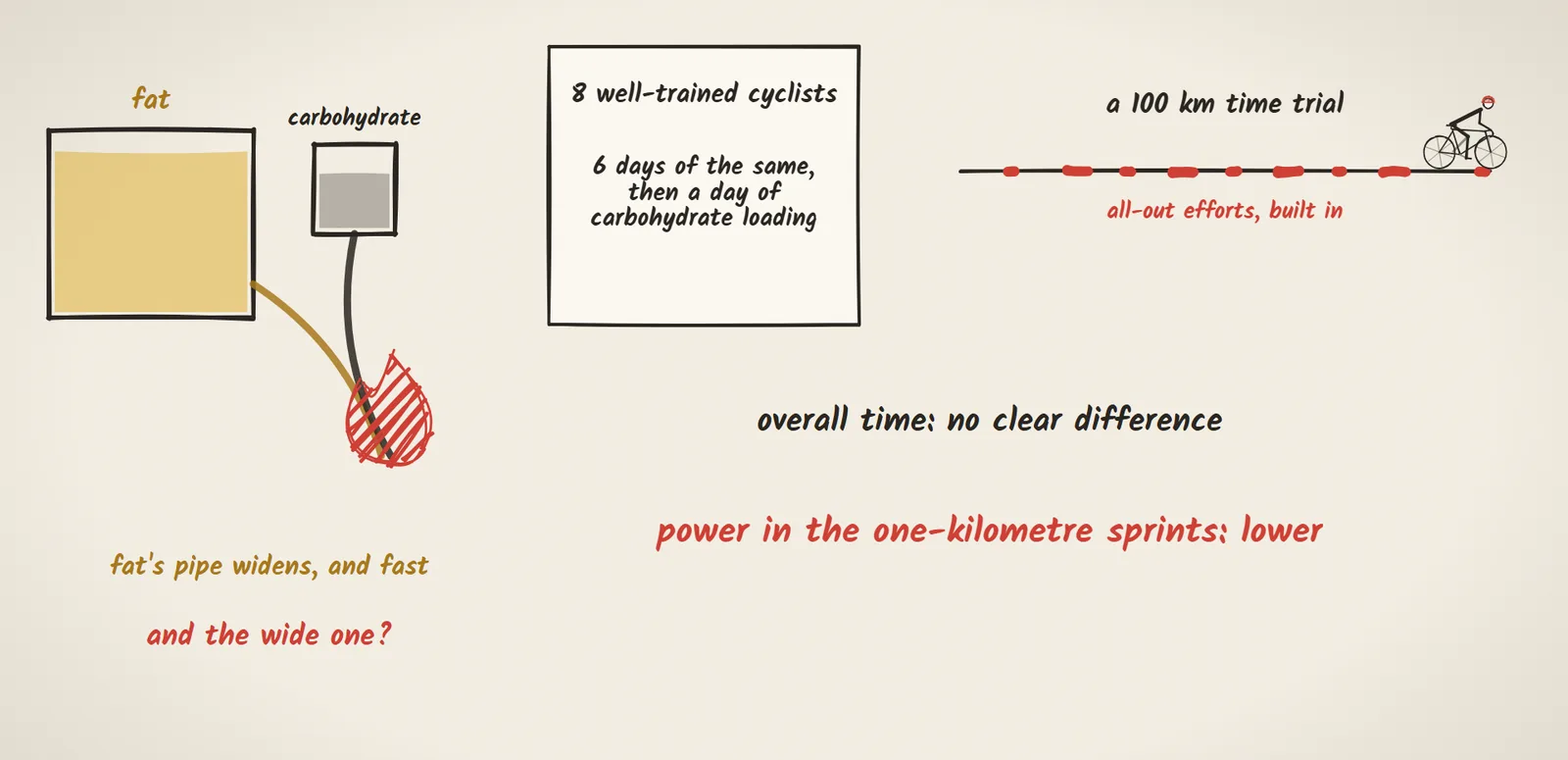
Eating mostly fat widens the thin pipe, and fast. The trouble is what happens to the wide one. In one study, 7 male cyclists ate mostly fat for 5 days while training, then had a day of carbohydrate, which filled their glycogen back up to the same level as a high-carbohydrate diet did. The fuel was there. But the gate for burning carbohydrate in the mitochondria was less active, and in a hard one-minute effort at a set power, their muscles broke glycogen down more slowly. In another study, 8 well-trained cyclists ate the same way for 6 days, loaded carbohydrate for one, and rode a 100 km time trial with all-out efforts built into it. There was no clear difference in their overall time, but their power in the one-kilometre sprints was lower.
The experiment
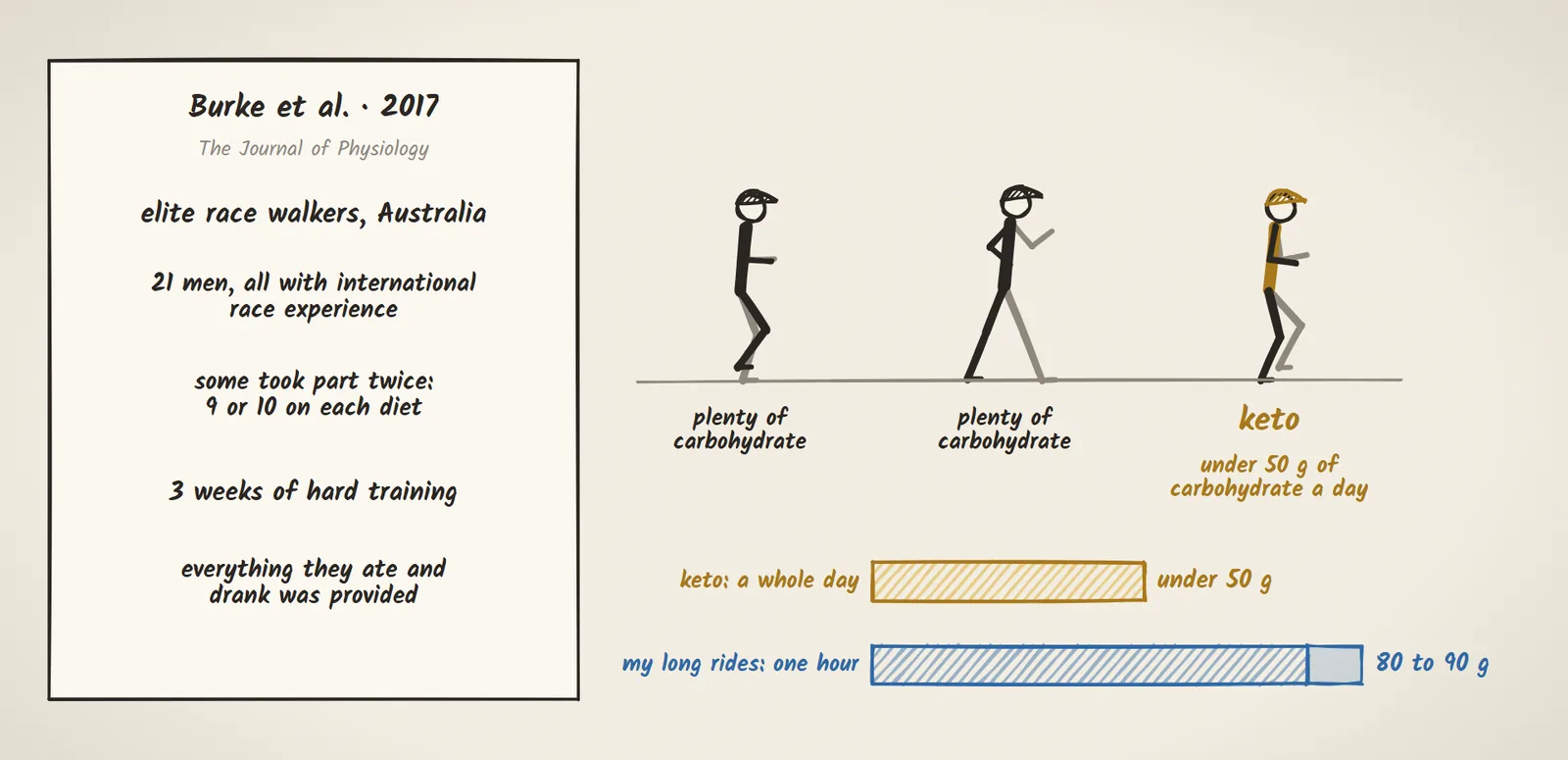
How do we know what keto does to a whole block of training? One study tested exactly that, on elite race walkers in Australia: 21 men, all with international race experience. Some took part twice, so each diet had 9 or 10. For 3 weeks of hard training, everything they ate and drank was provided. Two groups ate plenty of carbohydrate. The third ate keto: under 50 g of carbohydrate a day, less than I take in during an hour of a long ride.
What they found
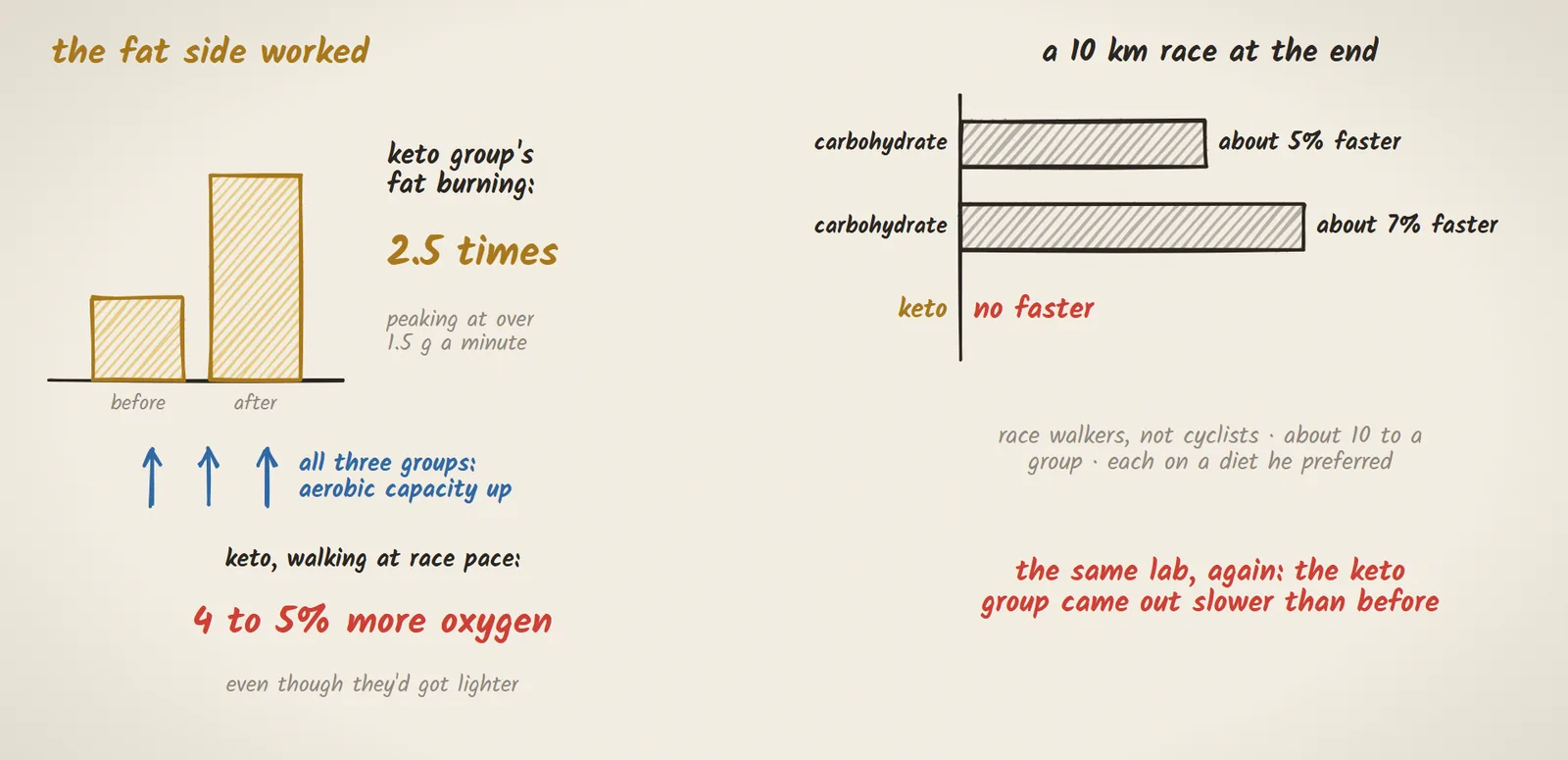
The fat side worked. The keto group’s fat burning rose 2.5 times, peaking at over 1.5 g a minute, and all three groups raised their aerobic capacity. But walking at race pace now cost the keto group 4 to 5% more oxygen, even though they’d got lighter. And in a 10 km race at the end, the two carbohydrate groups were about 5 and 7% faster than before. The keto group was no faster. Race walkers, not cyclists, about 10 to a group, and each on a diet he preferred. But when the same lab ran the study again, the keto group came out slower than before.
What it means for you
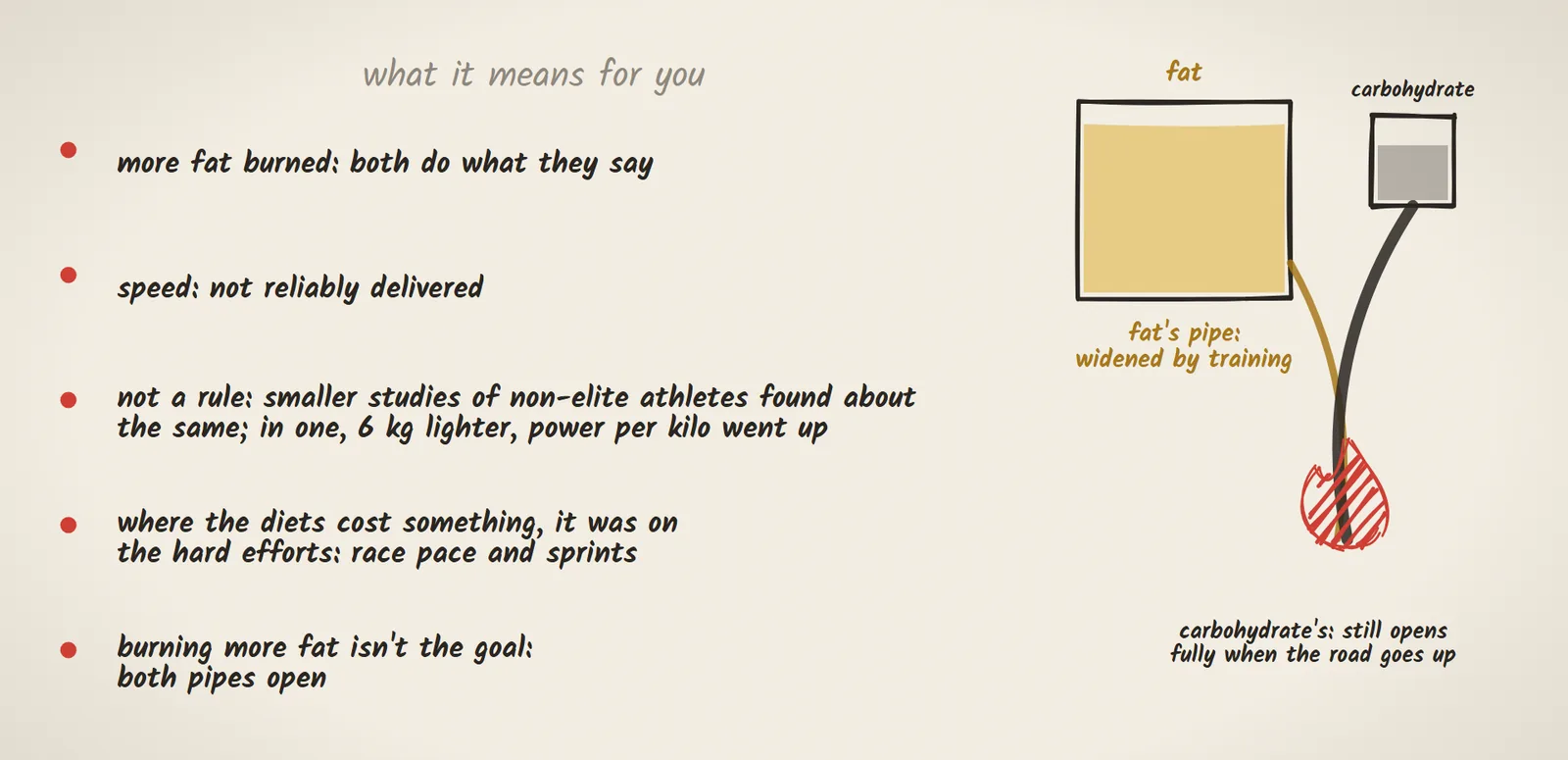
So what does this mean for you? Keto and fat adaptation both do what they say on the fat side: you’ll burn far more of it. What they haven’t reliably delivered is speed. A few smaller studies of non-elite athletes found performance about the same on keto, hard efforts included. In one, where the keto group lost about 6 kg, power per kilo went up. So this isn’t a rule that it always slows you down. But in the tests I’ve described, where the diets cost something, it was on the hard efforts: race pace and sprints. So burning more fat isn’t the goal in itself. What you want is both pipes open: a fat pipe widened by training, which makes fat pay more at the same watts by building a bigger aerobic engine in your muscles, and a carbohydrate pipe that still opens fully when the road goes up.
That’s what’s underneath the watts.
Sources
The study
- Burke LM, Ross ML, Garvican-Lewis LA, Welvaert M, Heikura IA, Forbes SG, Mirtschin JG, Cato LE, Strobel N, Sharma AP, Hawley JA. Low carbohydrate, high fat diet impairs exercise economy and negates the performance benefit from intensified training in elite race walkers. J Physiol. 2017;595(9):2785-2807. doi.org/10.1113/jp273230
Also in this article
- The same lab, repeating the study: Burke LM, Sharma AP, Heikura IA, Forbes SF, Holloway M, McKay AKA, Bone JL, Leckey JJ, Welvaert M, Ross ML. Crisis of confidence averted: Impairment of exercise economy and performance in elite race walkers by ketogenic low carbohydrate, high fat (LCHF) diet is reproducible. PLoS One. 2020;15(6):e0234027. doi.org/10.1371/journal.pone.0234027
- Glycogen topped back up, but broken down more slowly (7 male cyclists): Stellingwerff T, Spriet LL, Watt MJ, Kimber NE, Hargreaves M, Hawley JA, Burke LM. Decreased PDH activation and glycogenolysis during exercise following fat adaptation with carbohydrate restoration. Am J Physiol Endocrinol Metab. 2006;290(2):E380-E388. doi.org/10.1152/ajpendo.00268.2005
- The 100 km time trial and its one-kilometre sprints (8 well-trained cyclists): Havemann L, West SJ, Goedecke JH, Macdonald IA, St Clair Gibson A, Noakes TD, Lambert EV. Fat adaptation followed by carbohydrate loading compromises high-intensity sprint performance. J Appl Physiol. 2006;100(1):194-202. doi.org/10.1152/japplphysiol.00813.2005
- Smaller studies of non-elite athletes, performance about the same on keto: Prins PJ, Noakes TD, Welton GL, et al. High rates of fat oxidation induced by a low-carbohydrate, high-fat diet, do not impair 5-km running performance in competitive recreational athletes. J Sports Sci Med. 2019;18(4):738-750. pubmed.ncbi.nlm.nih.gov/31827359/
- Prins PJ, Noakes TD, Buga A, et al. Low and high carbohydrate isocaloric diets on performance, fat oxidation, glucose and cardiometabolic health in middle age males. Front Nutr. 2023;10:1084021. doi.org/10.3389/fnut.2023.1084021
- Prins PJ, Noakes TD, Buga A, et al. Carbohydrate ingestion eliminates hypoglycemia and improves endurance exercise performance in triathletes adapted to very low- and high-carbohydrate isocaloric diets. Am J Physiol Cell Physiol. 2025;328(2):C710-C727. doi.org/10.1152/ajpcell.00583.2024
- The keto group that lost about 6 kg, with power per kilo up (the athletes chose their diet): McSwiney FT, Wardrop B, Hyde PN, Lafountain RA, Volek JS, Doyle L. Keto-adaptation enhances exercise performance and body composition responses to training in endurance athletes. Metabolism. 2018;81:25-34. doi.org/10.1016/j.metabol.2017.10.010
Written and researched by Yarin Podoler, a cyclist who wanted to know what’s underneath the watts.