60, 90 or 120 g of carbs an hour: how much do I actually need?
Those numbers mostly reflect how fast your body can take in and use a drink, not how much carbohydrate your legs are burning. What you burn rises with your watts, so the harder you ride, the more your own carbohydrate has to cover. And in a study that tested it, drinking more didn’t measurably lower how much of their own the riders burned.
The video version, 4:32, narrated by a synthetic voice. Watch on YouTube · Watch the Short
Four hours, one headline number
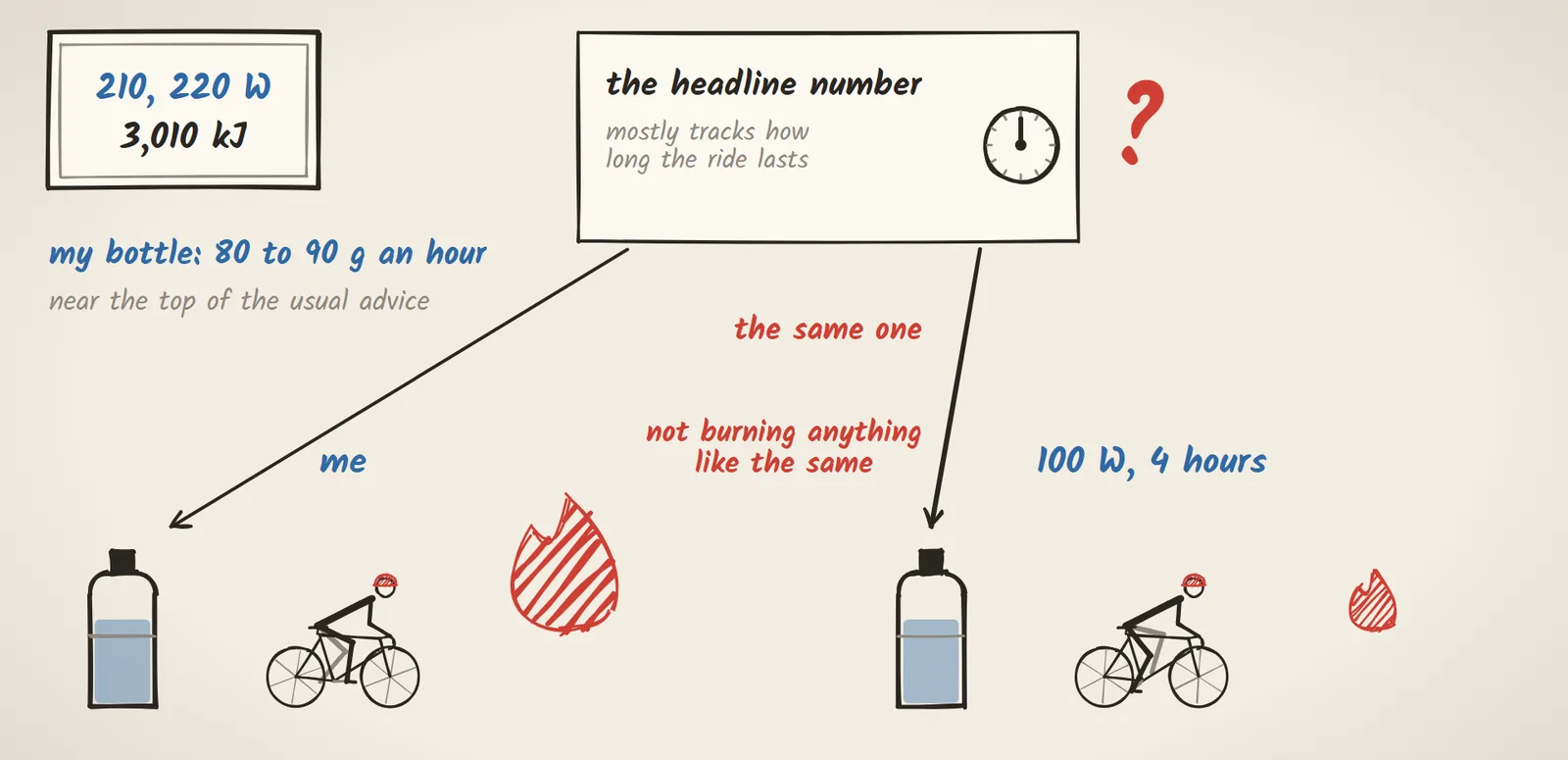
My long rides start very early, with not much eaten beforehand, and the bottle going from the first minutes: 80 to 90 grams of carbohydrate an hour, near the top of the usual advice. Four hours on the flats at 210, 220 W, and the kilojoules on the screen tick past 3,000. By any guideline, it’s a well-fuelled ride. But the headline number mostly tracks how long the ride lasts. A rider holding 100 W for 4 hours hears the same one, and the two of us aren’t burning anything like the same amount. So which of us is that number for?
Where the numbers come from
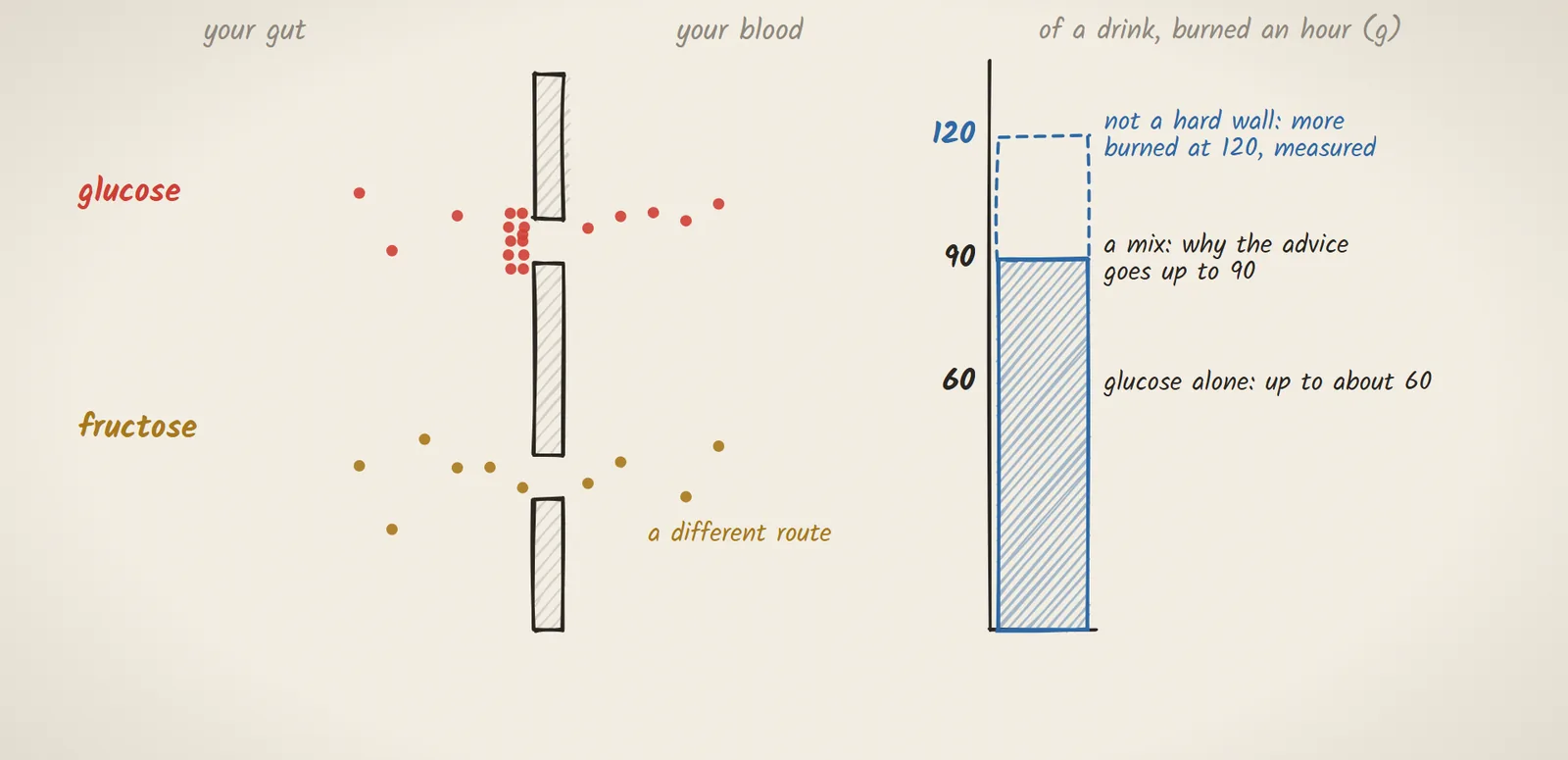
Start with where the numbers come from. Before sugar can be burned, it has to cross the wall of your gut, and it crosses through carriers built for particular sugars. Glucose has one route, and with glucose alone, the body burns a drink at up to about 60 g an hour. Fructose crosses by a different route, so mixing the two raises that rate, and that’s a big part of why the advice goes up to 90 for long rides. So the headline numbers lean on how fast a drink can be taken in and burned, and they rise with the length of the ride, not with your body weight or your fitness. They aren’t a hard wall, either: some riders now train their gut to take more, and studies have measured more being burned at 120 g an hour.
What your legs burn
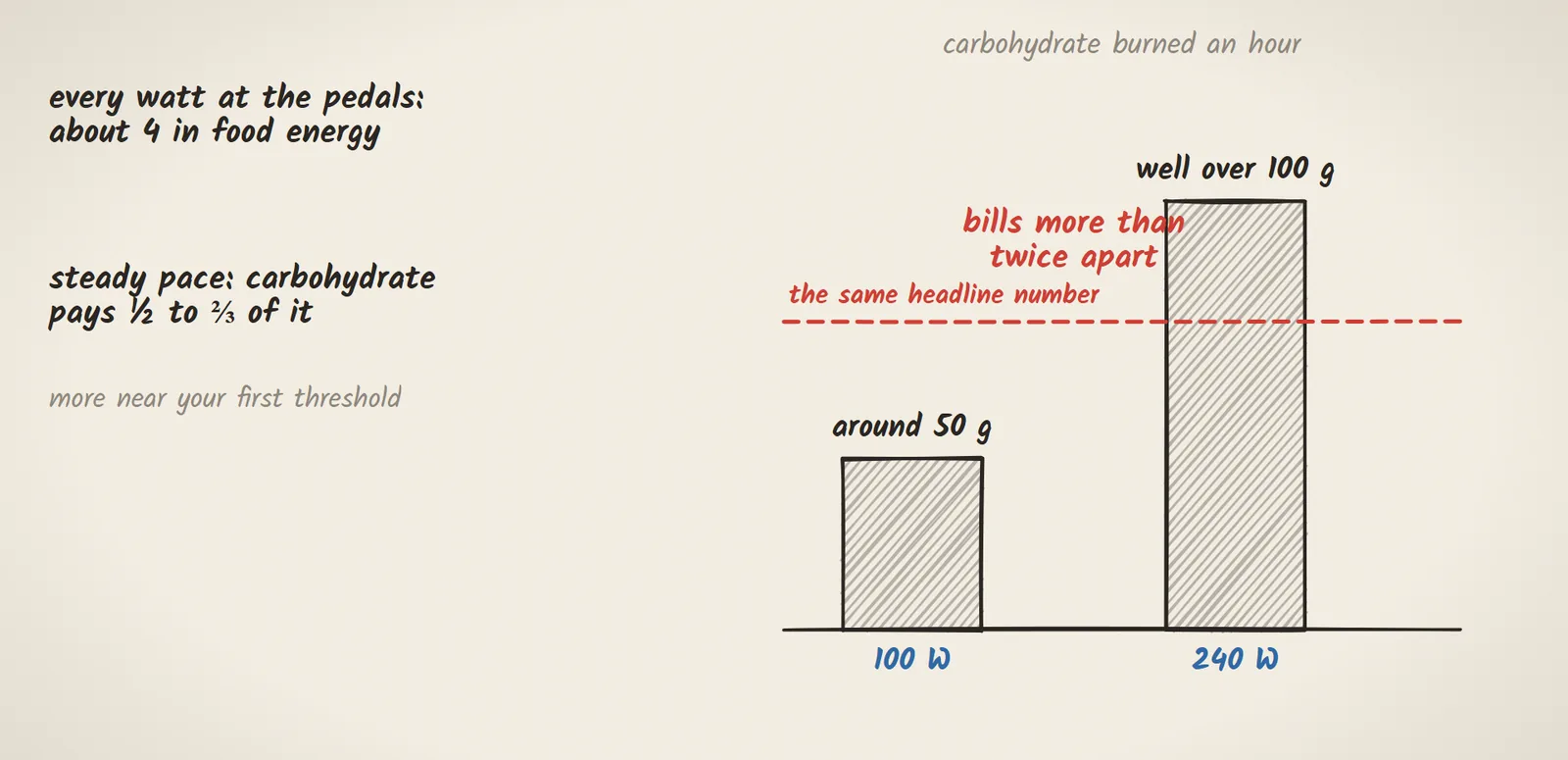
Now the other side: what your legs burn. Every watt at the pedals costs about four in food energy, so the bill climbs fast with your power. At a steady, moderate pace, carbohydrate pays something like half to two-thirds of it, and more as you get close to your first threshold. In rough numbers, a rider holding 100 W burns around 50 g of carbohydrate an hour, and a rider holding 240 burns well over 100. The same headline number, and bills more than twice apart.
The gap
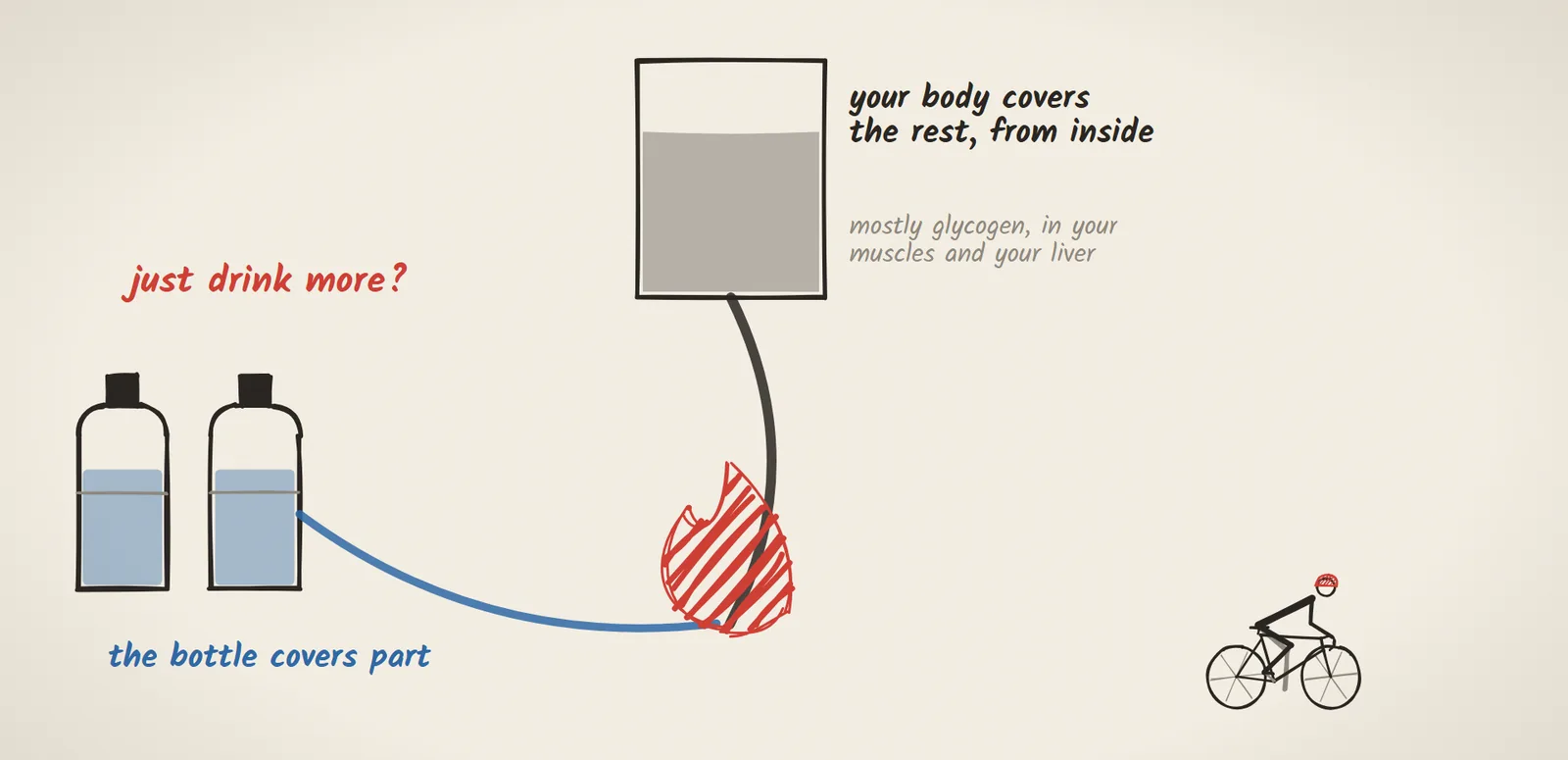
So at higher watts, the bottle covers part of the carbohydrate bill, and your body covers the rest from inside, mostly from the glycogen stored in your muscles and your liver. The obvious fix is just to drink more.
The experiment
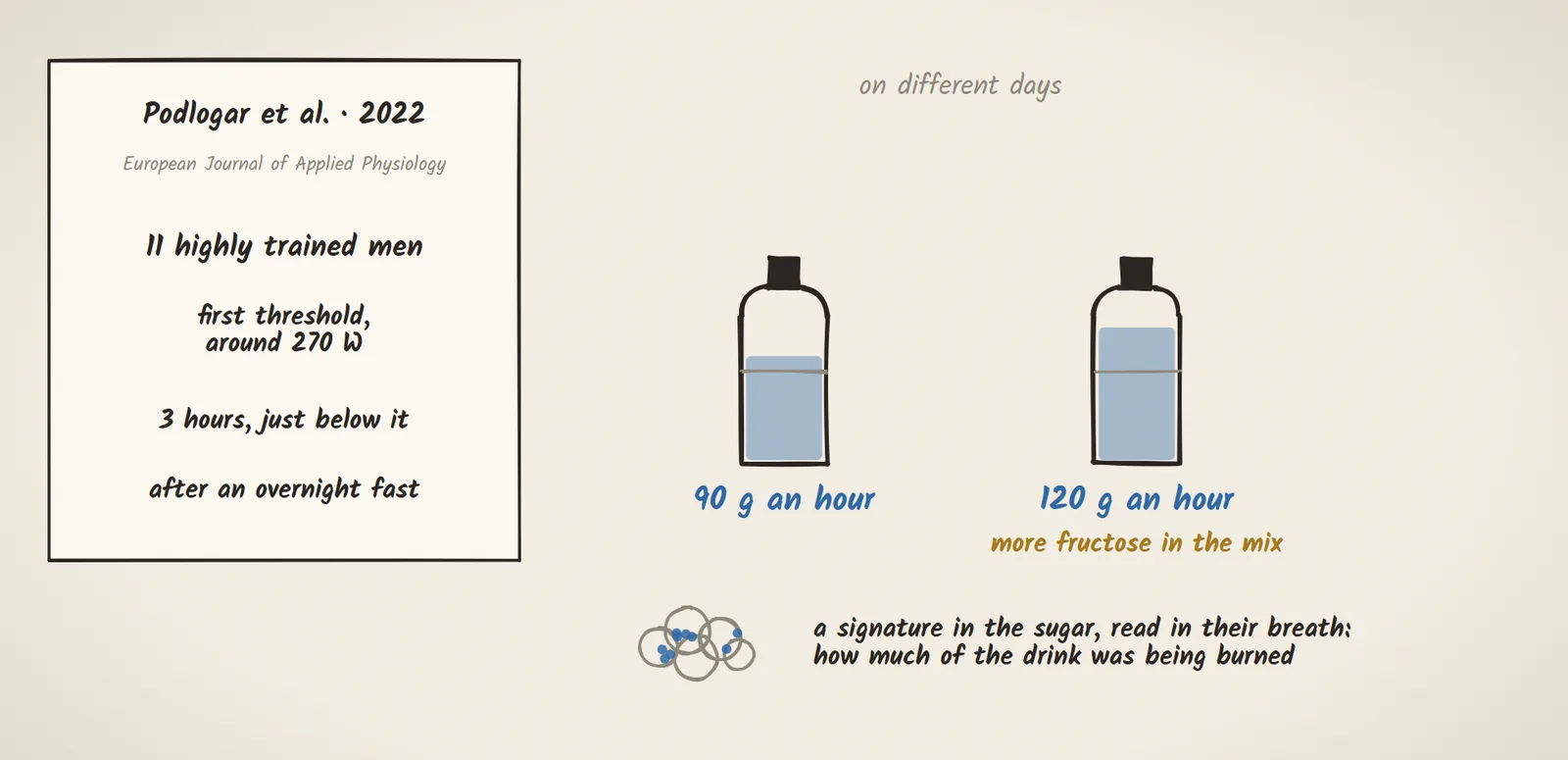
Does that close the gap? One study tested exactly that. Eleven highly trained men, with a first threshold, measured from their breathing, of around 270 W, rode for 3 hours just below it, after an overnight fast. On different days, they drank 90 or 120 g of carbohydrate an hour, the bigger dose with more fructose in the mix. A natural chemical signature in the sugar, read in their breath, showed how much of the drink was being burned.
What they found
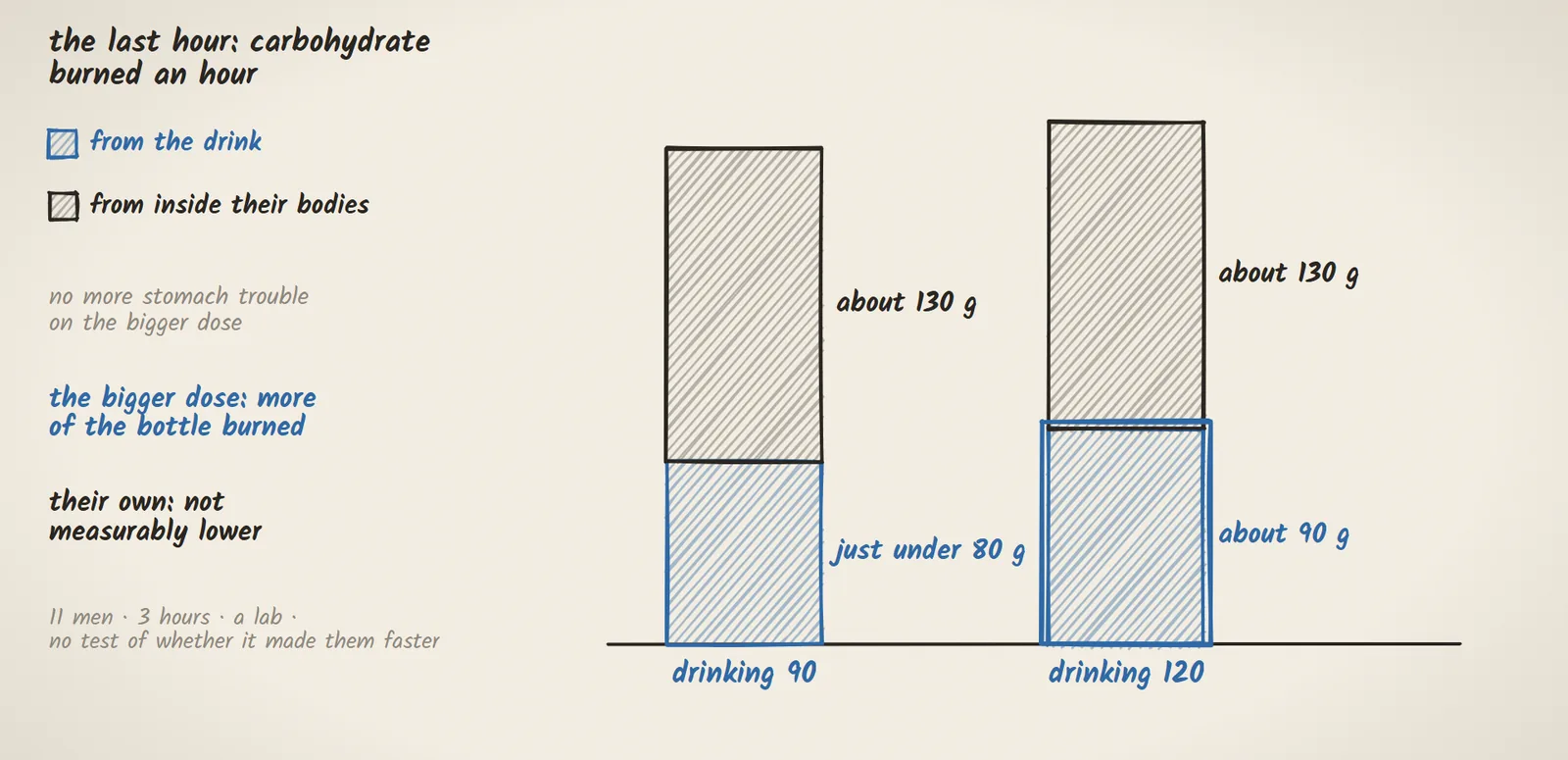
In the last hour, the riders were burning just under 80 g an hour of the drink on 90, and about 90 on 120, with no more stomach trouble on the bigger dose. But either way, about 130 g an hour of the carbohydrate they burned still came from inside their own bodies. The bigger dose raised how much of the bottle got burned. It didn’t measurably lower how much of their own carbohydrate they burned. Eleven men, 3 hours in a lab, and nobody tested whether the extra made them faster.
What it means for you
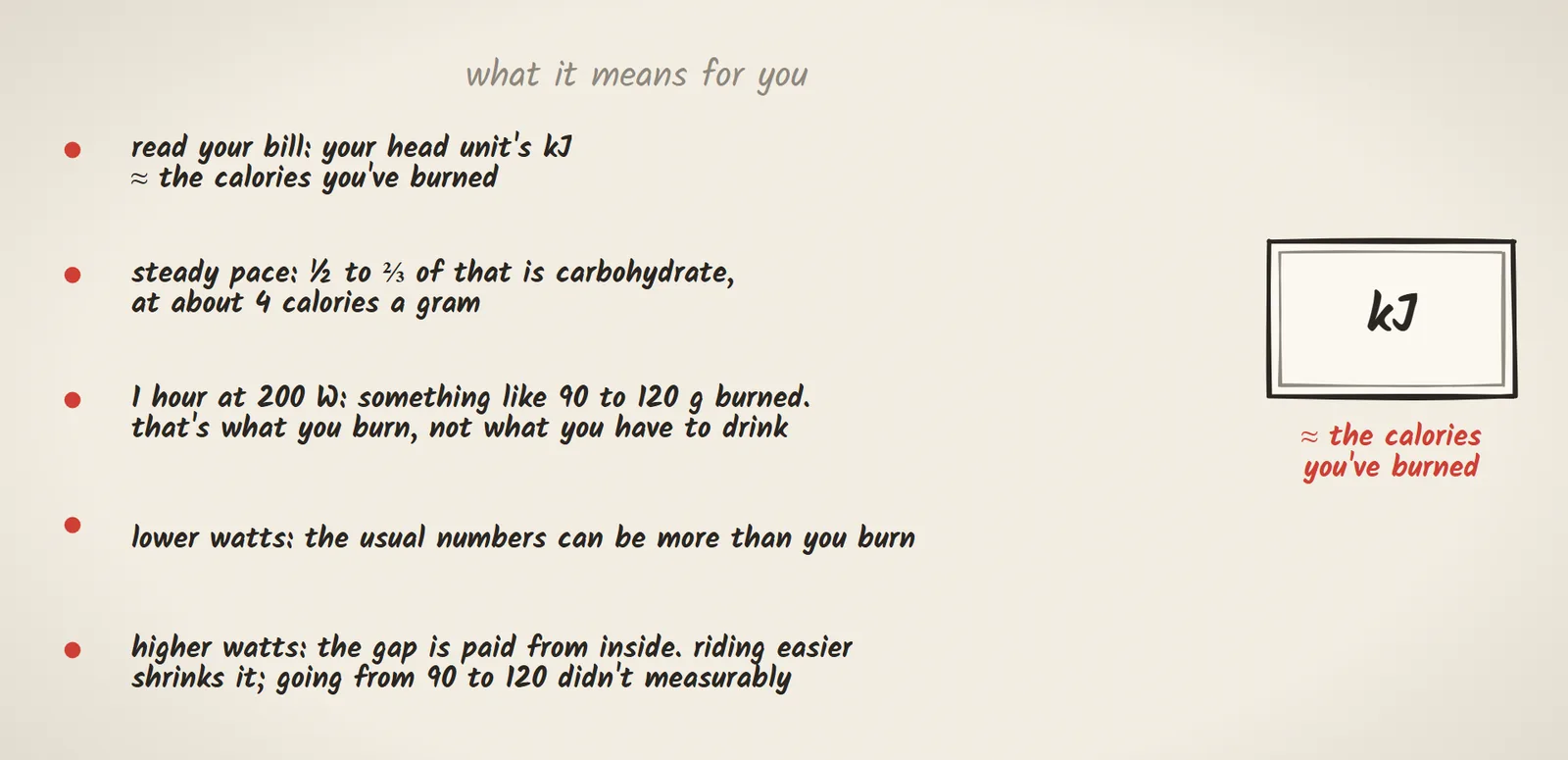
So what does this mean for you? Start by reading your own bill. The kilojoules on your head unit come out at roughly the calories you’ve burned, because of that 4-to-1 cost, and because the calorie on a food label is about 4 kJ. At a steady, moderate pace, count half to two-thirds of that as carbohydrate, at about 4 calories a gram, so an hour at 200 W burns something like 90 to 120 g. That’s what you burn, not what you have to drink. If you ride at lower watts, the usual numbers can be more than you burn, and the advice itself says they can come down. If you ride higher, the gap is paid from inside, and once you’re at the usual doses, riding easier shrinks it. In that study, going from 90 to 120 didn’t measurably shrink it.
That’s what’s underneath the watts.
Sources
The study
- Podlogar T, Bokal Š, Cirnski S, Wallis GA. Increased exogenous but unaltered endogenous carbohydrate oxidation with combined fructose-maltodextrin ingested at 120 g h-1 versus 90 g h-1 at different ratios. Eur J Appl Physiol. 2022;122(11):2393-2401. doi.org/10.1007/s00421-022-05019-w
Also in this article
- Where the 60 and 90 come from, and why the advice can come down when the power is low: Jeukendrup A. A step towards personalized sports nutrition: carbohydrate intake during exercise. Sports Med. 2014;44(Suppl 1):S25-S33. doi.org/10.1007/s40279-014-0148-z
- More burned at 120 g an hour, in trained riders: Hearris MA, Pugh JN, Langan-Evans C, Mann SJ, Burke L, Stellingwerff T, Gonzalez JT, Morton JP. 13C-glucose-fructose labeling reveals comparable exogenous CHO oxidation during exercise when consuming 120 g/h in fluid, gel, jelly chew, or coingestion. J Appl Physiol. 2022;132(6):1394-1406. doi.org/10.1152/japplphysiol.00091.2022
Written and researched by Yarin Podoler, a cyclist who wanted to know what’s underneath the watts.