Is a sprint really anaerobic?
Less than the name says. Your aerobic engine works through every all-out effort, and the longer the effort, the bigger its share of the bill: very little over a few seconds, but by 30 seconds, about a quarter of the energy.
The video version, 4:17, narrated by a synthetic voice. Watch on YouTube · Watch the Short
The town-sign sprint
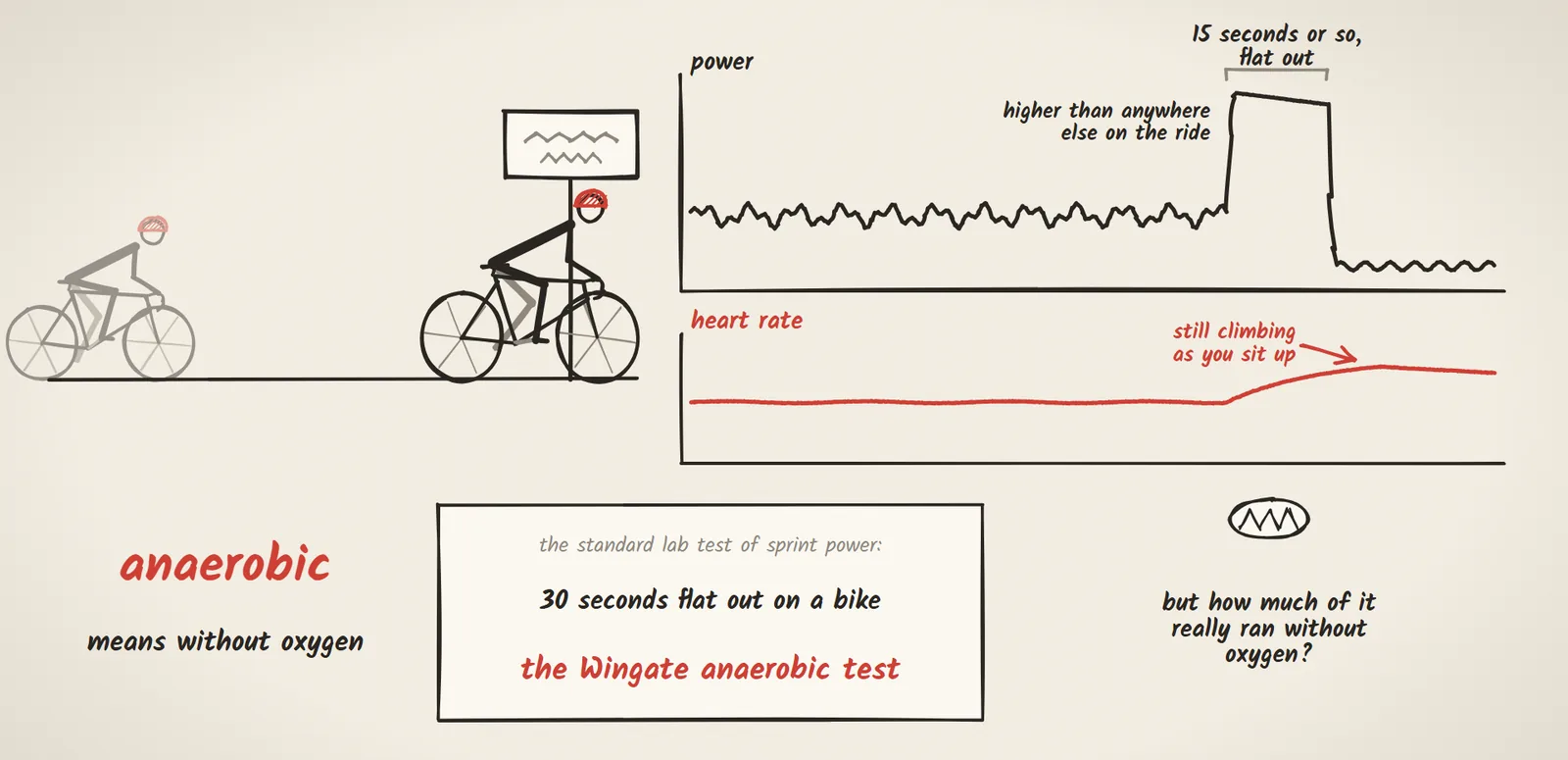
Picture the sprint for the town sign at the end of a group ride. You jump out of the saddle and go flat out for 15 seconds or so. The power on your screen spikes higher than anywhere else on the ride, and your heart rate is still climbing as you sit up. Efforts like this get called anaerobic, which means without oxygen, and the standard lab test of sprint power, 30 seconds flat out on a bike, is even named the Wingate anaerobic test. So it’s easy to file the sprint as the one part of the ride your aerobic engine has nothing to do with. But how much of it really ran without oxygen?
Three ways to pay for it
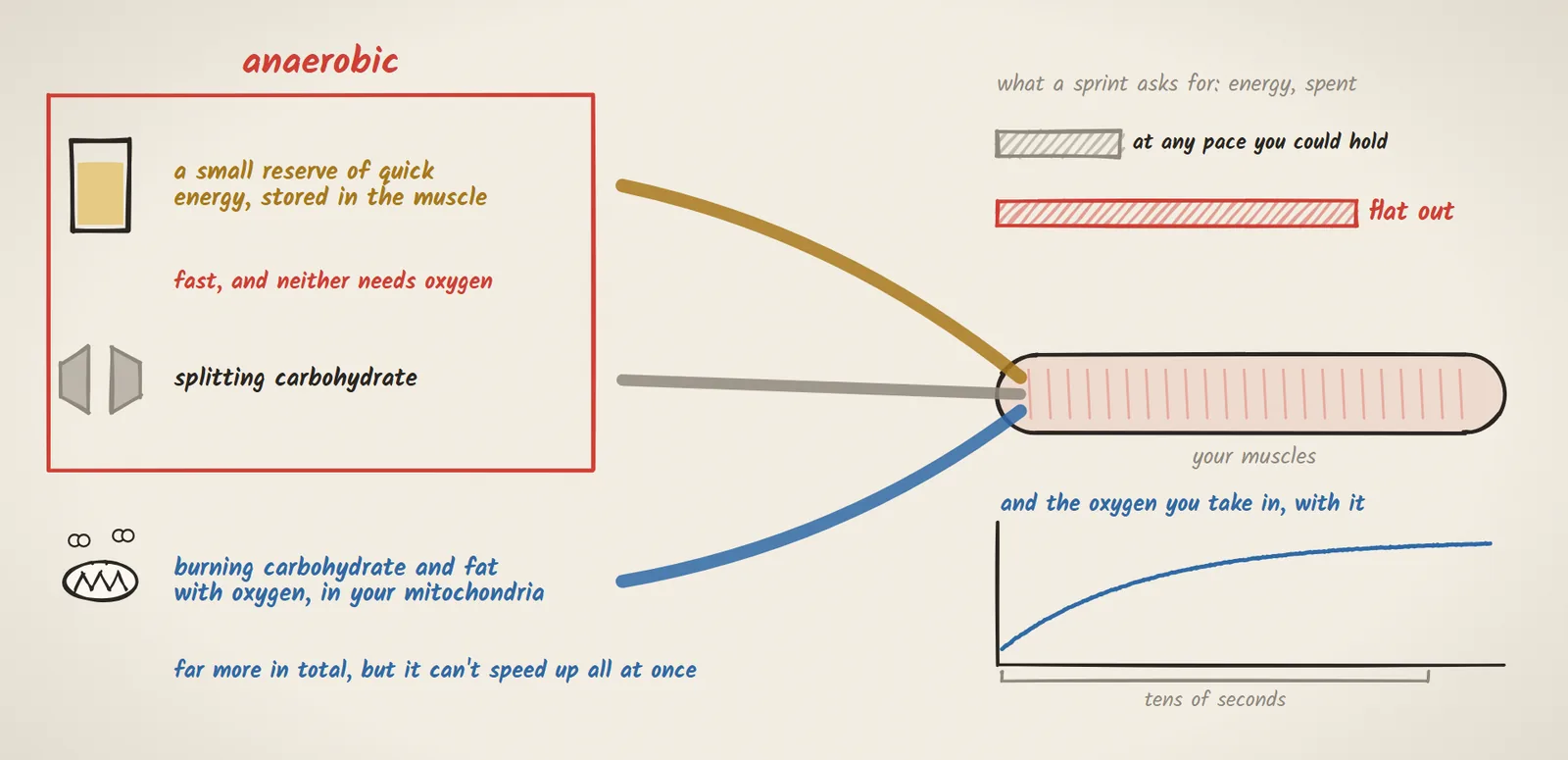
Start with what a sprint asks for. Flat out, your muscles spend energy far faster than at any pace you could hold, and they have three ways to make more of it: a small reserve of quick energy stored in the muscle, splitting carbohydrate, and burning carbohydrate and fat with oxygen in your mitochondria. The first two are fast, and neither needs oxygen to work, which is where the word anaerobic comes from.
The third can supply far more in total, but it can’t speed up all at once: the machinery in your mitochondria takes tens of seconds to come up to speed, and the oxygen you take in climbs with it.
Not a relay
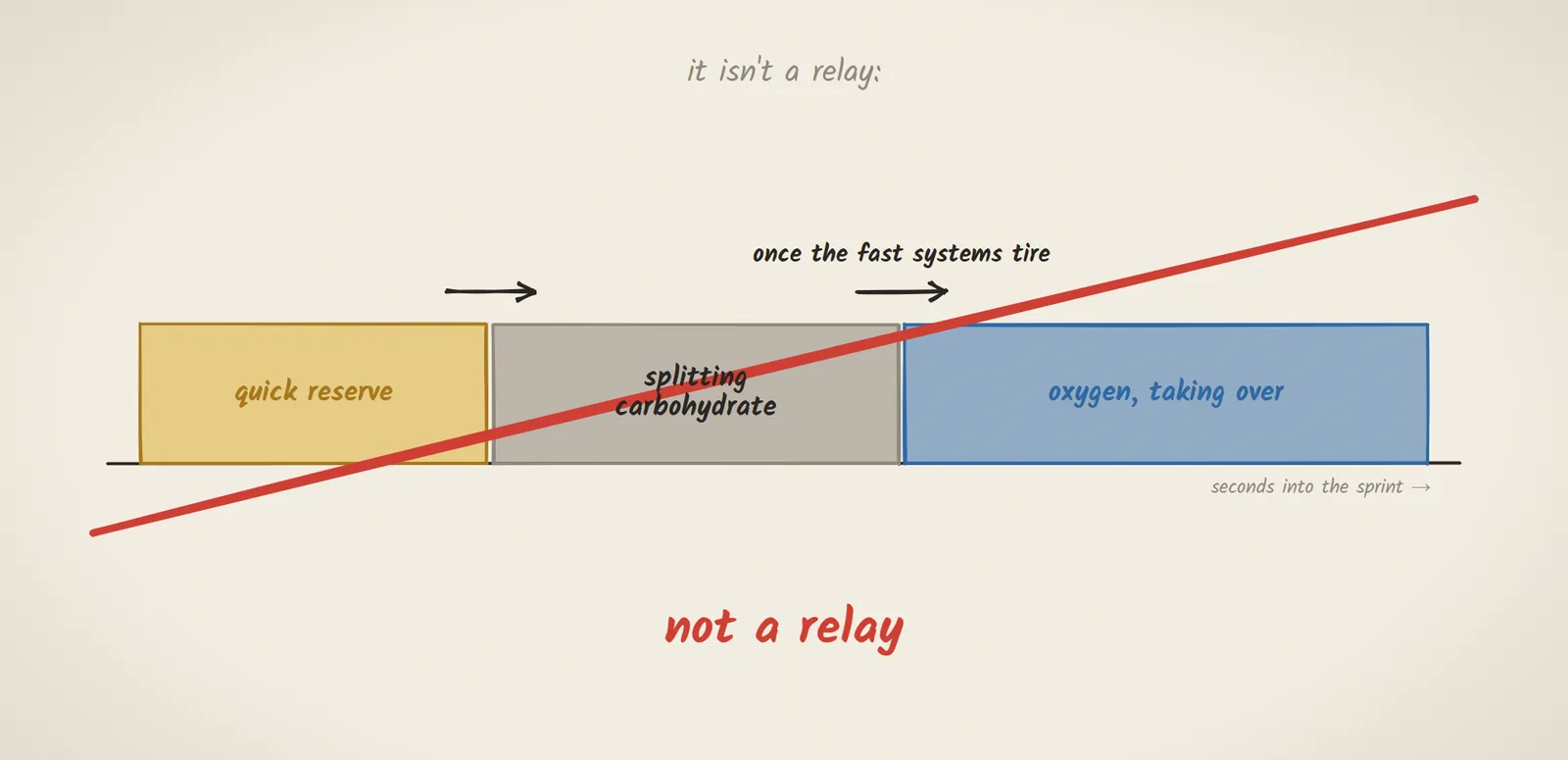
But it isn’t a relay, with oxygen taking over once the fast systems tire.
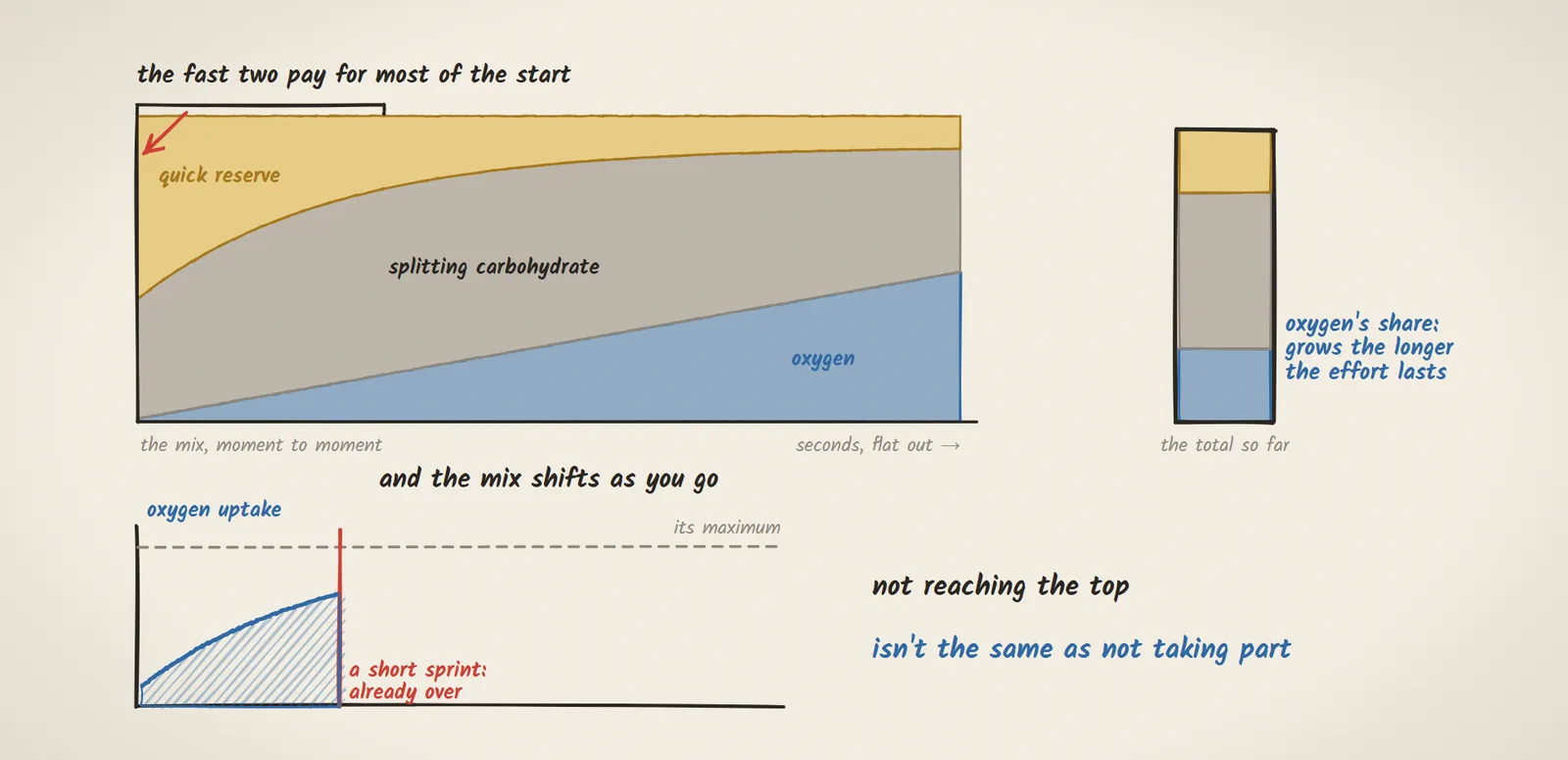
All three are working from the first pedal stroke, like three teams pulling at once, and the mix shifts as you go: the fast two pay for most of the start, and oxygen’s share of the total grows the longer the effort lasts. A short sprint is over before your oxygen uptake can reach its maximum, but not reaching the top isn’t the same as not taking part.
Not a fixed fraction
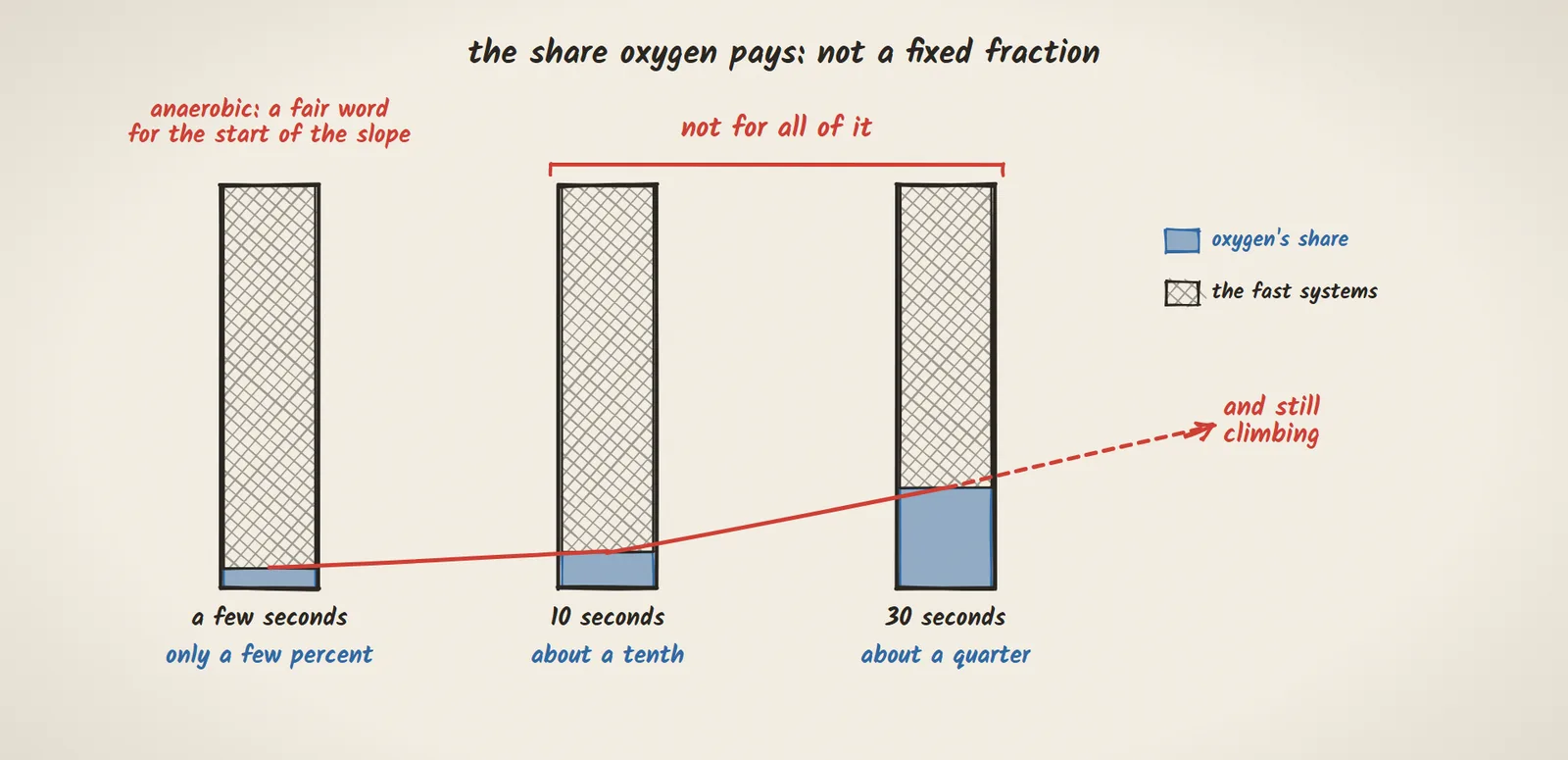
So the share that oxygen pays isn’t a fixed fraction. Over a jump of a few seconds, it’s only a few percent; over 10 seconds, something like a tenth; and by 30 seconds, about a quarter, and still climbing. Anaerobic is a fair word for the start of that slope, not for all of it.
The experiment
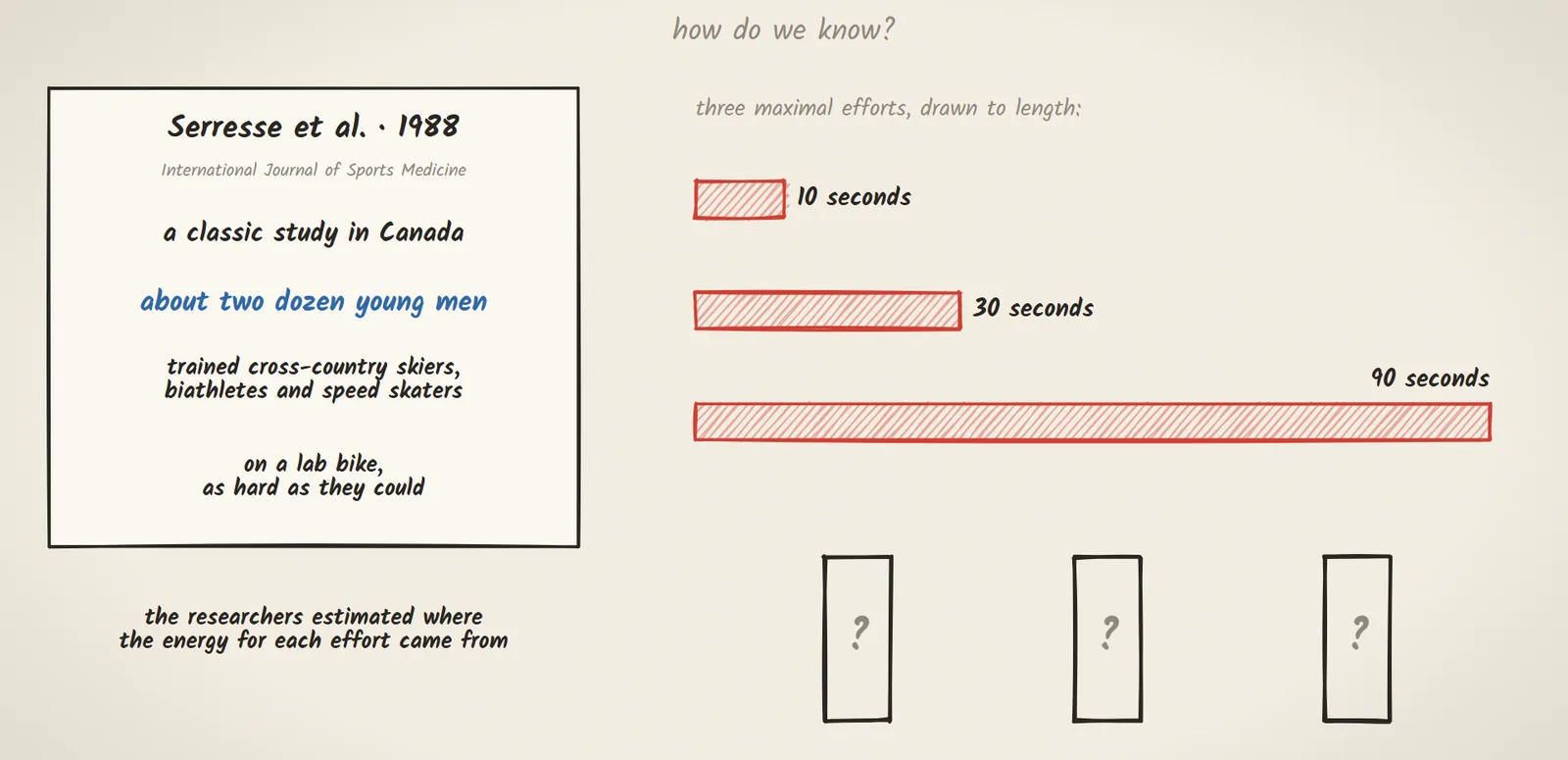
How do we know? In a classic study in Canada, about two dozen young men, trained cross-country skiers, biathletes and speed skaters, rode a lab bike as hard as they could for 10 seconds, for 30, and for 90, and the researchers estimated where the energy for each effort came from.
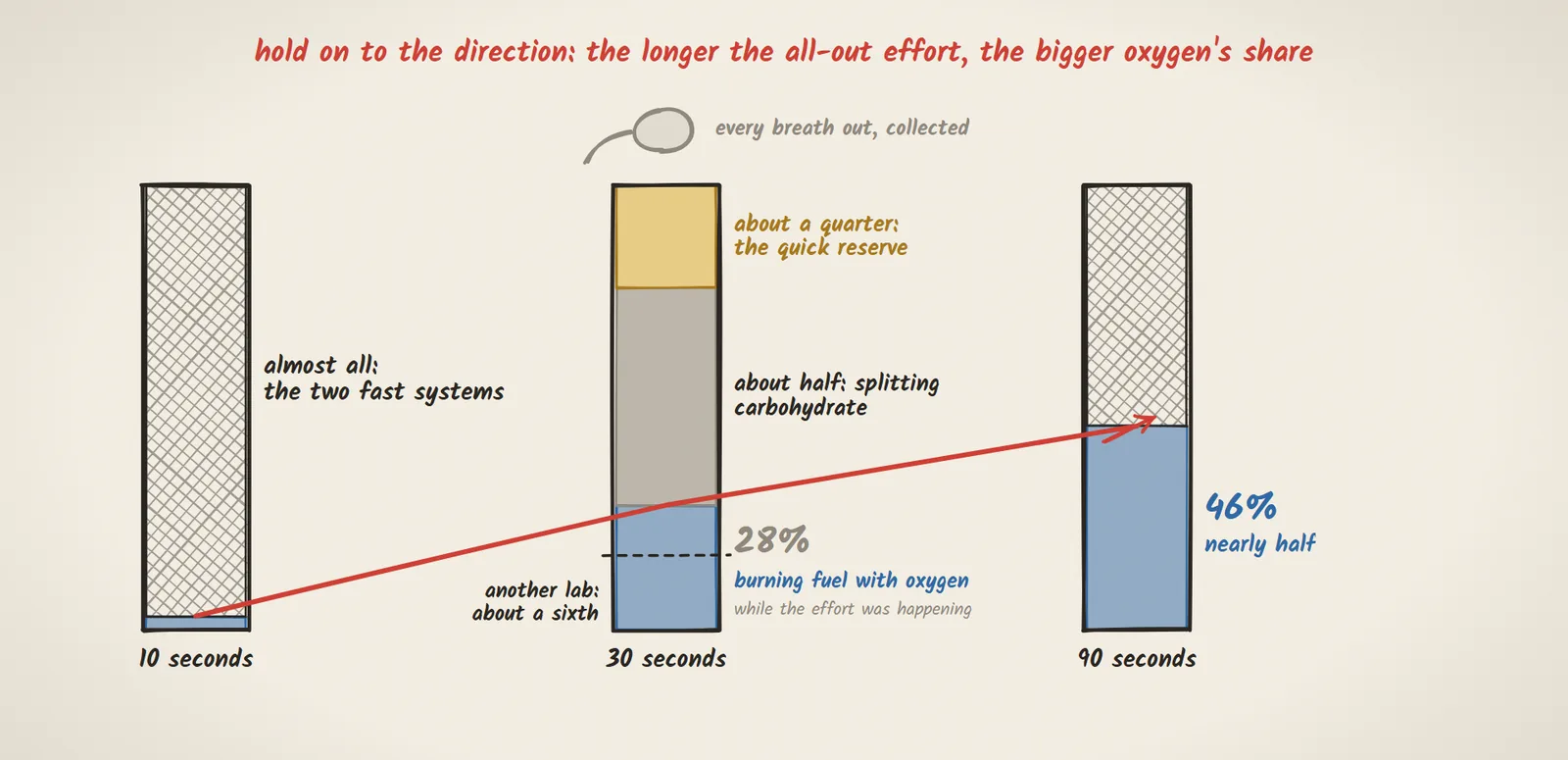
In the 10-second effort, almost all of it came from the two fast systems. In the 30-second one, where they collected every breath the riders breathed out, about a quarter came from the quick reserve, about half from splitting carbohydrate, and 28% from burning fuel with oxygen, while the effort was happening. And over 90 seconds, oxygen paid 46%, nearly half. The exact numbers depend on the method, and another lab put the 30-second share at about a sixth, so don’t hold on to 28. Hold on to the direction: the longer the all-out effort, the bigger oxygen’s share.
What it means for you
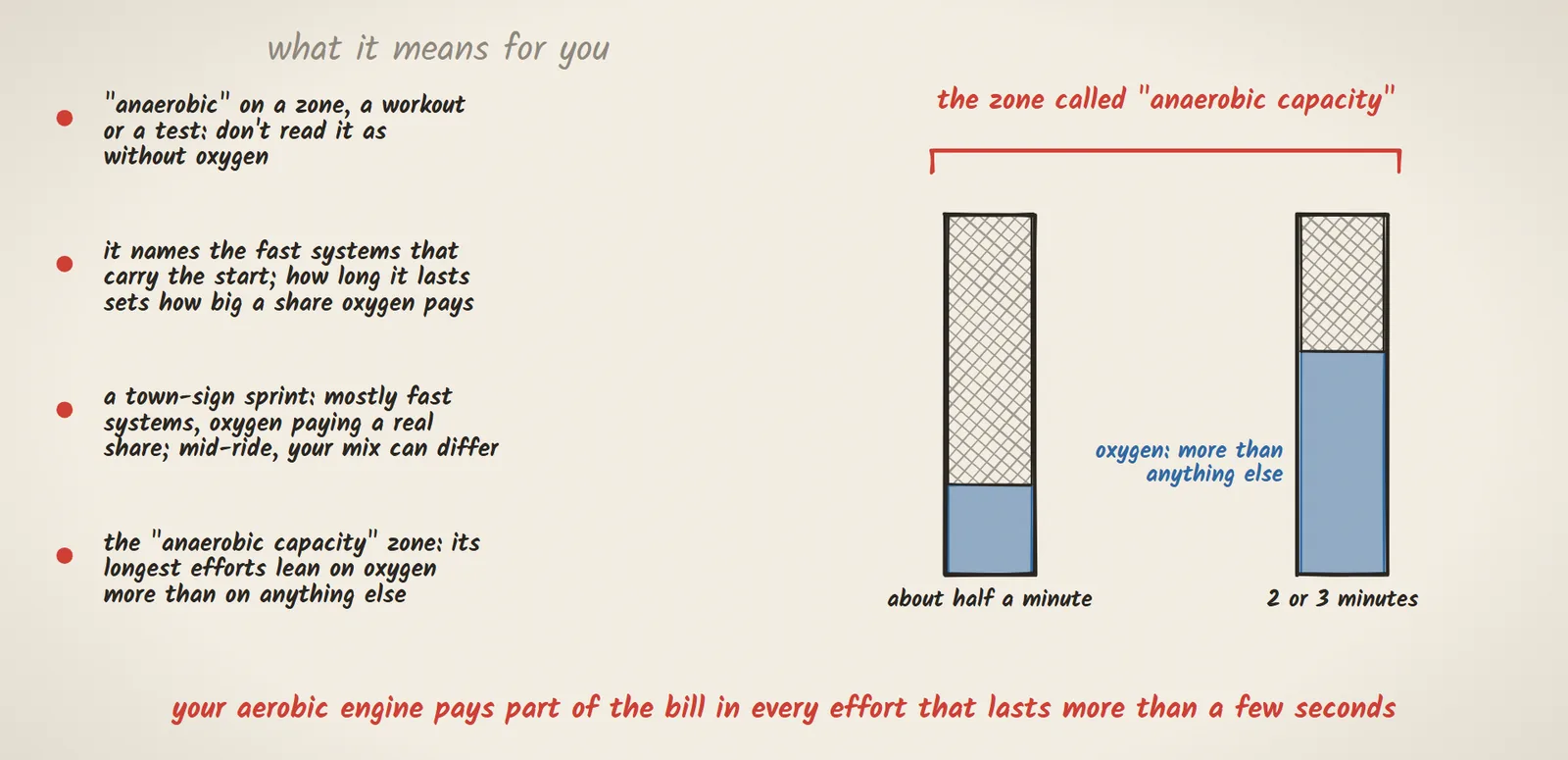
So what does this mean for you? When a zone, a workout or a test is called anaerobic, don’t read it as without oxygen. The word names the fast systems that carry the start of a hard effort, and how long the effort lasts tells you how big a share oxygen pays. Your town-sign sprint, at 15 seconds or so, is mostly fast systems, with oxygen paying a real share. The numbers here come from single maximal efforts, though, and you start yours mid-ride, with your aerobic engine already working, so your own mix can be different. And the power zone usually called anaerobic capacity covers efforts from about half a minute to 2 or 3 minutes, and the longest of those lean on oxygen more than on anything else. So your aerobic engine doesn’t sit out your hard efforts: it pays part of the bill in every one that lasts more than a few seconds.
That’s what’s underneath the watts.
Sources
The study
- Serresse O, Lortie G, Bouchard C, Boulay MR. Estimation of the contribution of the various energy systems during maximal work of short duration. Int J Sports Med. 1988;9(6):456-460. doi.org/10.1055/s-2007-1025051
Also in this article
- Another lab’s accounting of the same 30-second test: 16% from aerobic sources, 16-24% across efficiency values (6 healthy men): Smith JC, Hill DW. Contribution of energy systems during a Wingate power test. Br J Sports Med. 1991;25(4):196-199. doi.org/10.1136/bjsm.25.4.196
- The aerobic share of maximal efforts of every length, pooled from 102 studies (about 5% over 5 seconds, 9% over 10, 25% over 30, 42% over 60, 62% over 120); the video’s “a few percent”, “a tenth” and “a quarter” come from here: Gastin PB, Suppiah HT. Anaerobic and aerobic energy system contribution during maximal exercise: a systematic review. Sports Med. 2026;56(7):1723-1747. doi.org/10.1007/s40279-026-02414-7
Written and researched by Yarin Podoler, a cyclist who wanted to know what’s underneath the watts.