Is zone 2 a waste of time?
No, but probably not for the reason you’ve heard. Session for session, intervals add about as much to the mitochondria in your legs as a steady ride does, in fewer hours. The case for zone 2 is that it’s hours you can recover from, so you can stack far more of them, and what you’re really training is the season, not the session.
The video version, 4:47, narrated by a synthetic voice. Watch on YouTube · Watch the Short
Both sides of the argument
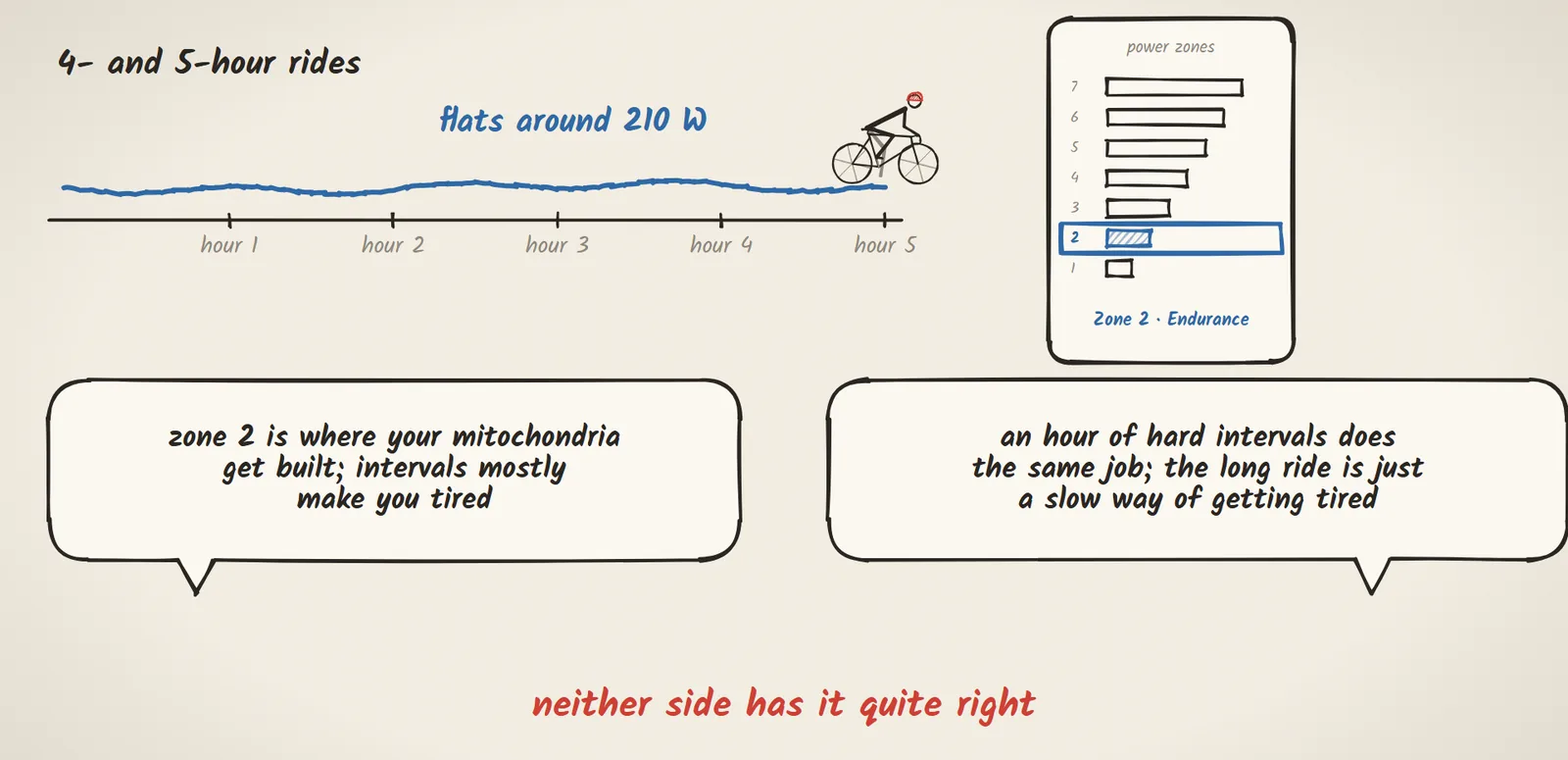
Four- and five-hour rides are a normal part of my training, with the flats at around 210 W, which is what most apps call zone 2: easy, steady riding. You’ve probably heard both sides of the argument about it. One says zone 2 is where your mitochondria get built, and intervals mostly make you tired. The other says an hour of hard intervals does the same job, and the long ride is just a slow way of getting tired. As it turns out, neither side has it quite right.
What’s being built
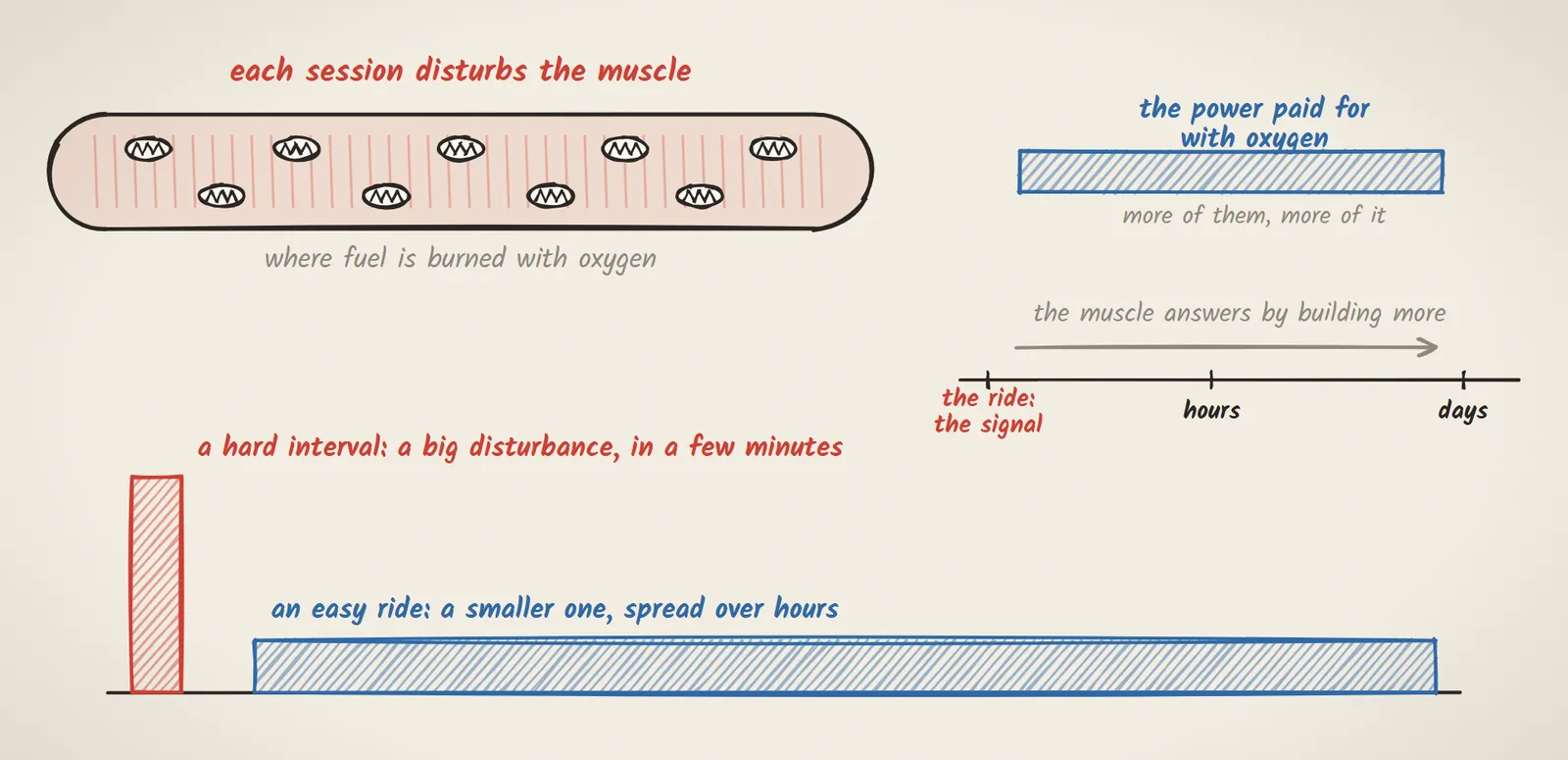
Here’s what’s being built. A big part of your endurance lives in the mitochondria in your leg muscles, the parts of each muscle cell that burn fuel with oxygen. The more of them you have, the more of your power the muscle can pay for with oxygen. Each session disturbs the muscle, and the muscle answers by building more: the ride sends the signal, and much of the building happens in the hours and days after. A hard interval packs a big disturbance into a few minutes. An easy ride spreads a smaller one over hours.
Hundreds of studies
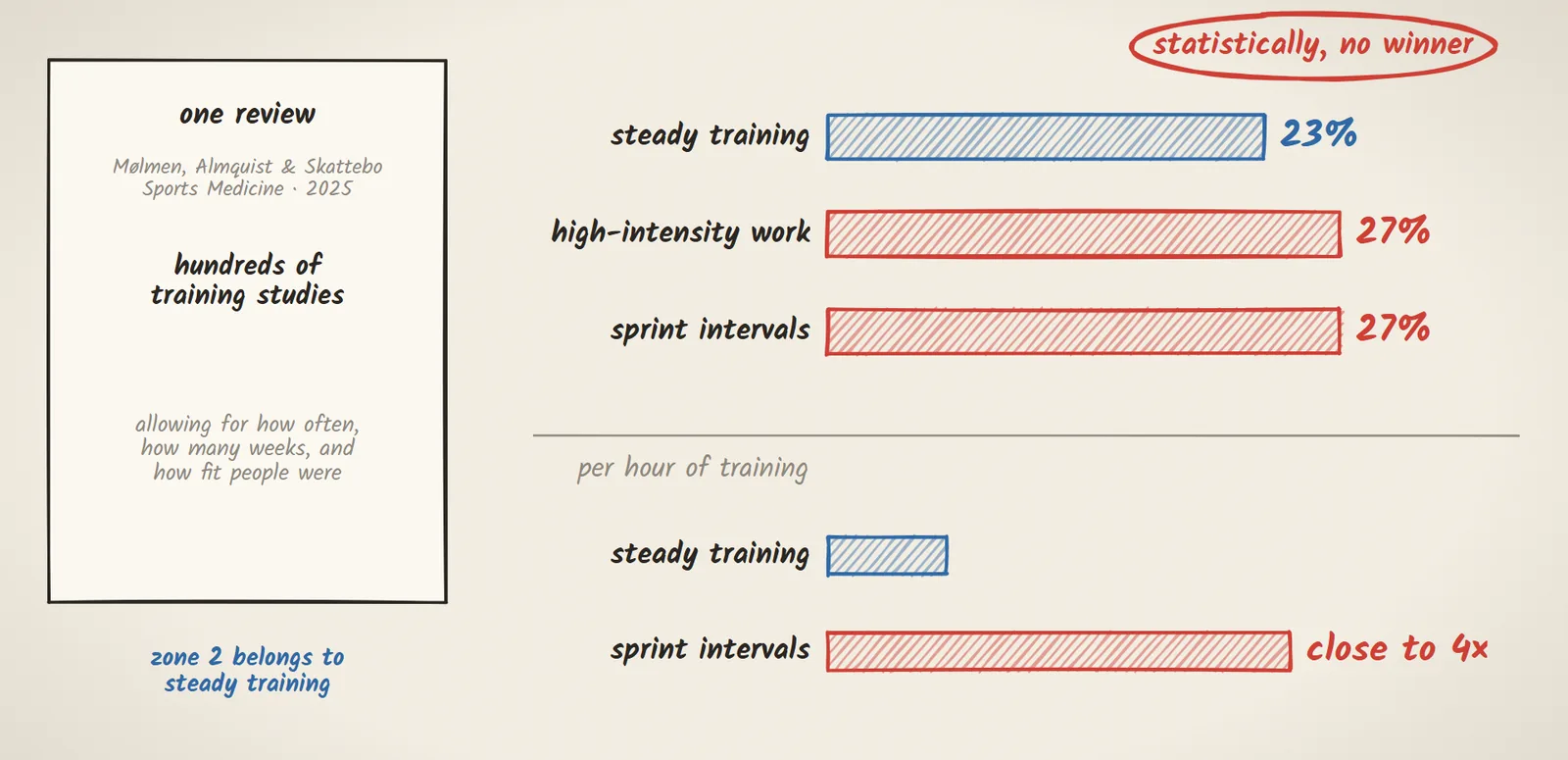
So which adds more? A review that pooled hundreds of training studies compared steady endurance training, the easy-to-moderate kind that zone 2 belongs to, with high-intensity work and sprint intervals. Once it allowed for how often and for how many weeks people trained, and how fit they were to start, steady training raised the amount of mitochondria in the muscle by about 23%, the two harder kinds by about 27, and statistically, there was no winner. Per hour, though, it’s lopsided: sprint intervals did close to 4 times as much as steady training.
The total load
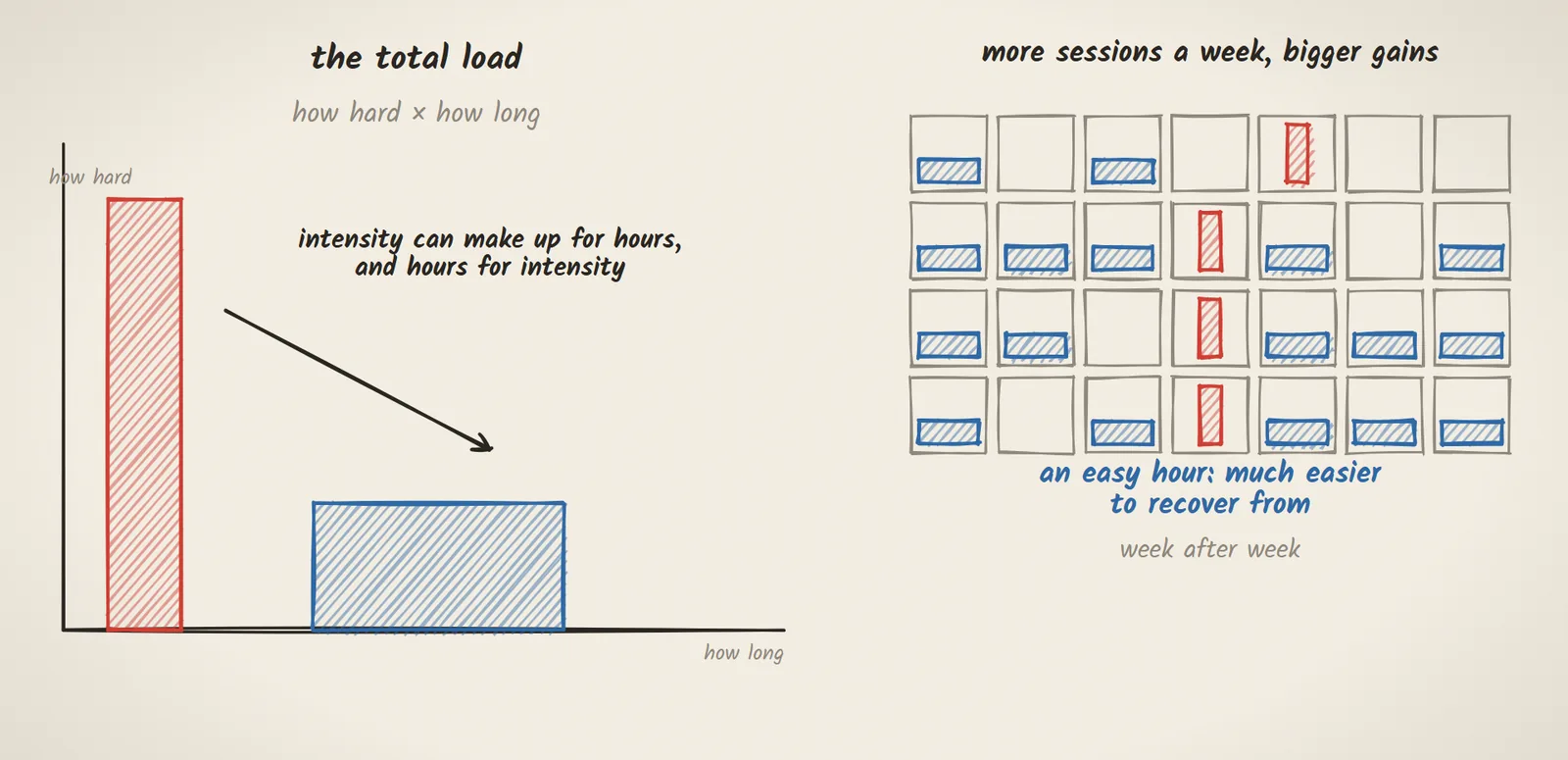
So for mitochondria, intervals get you about as far in less time. In that same review, what tracked the gains was the total load, how hard times how long, so intensity can make up for hours, and hours for intensity. More sessions a week went with bigger gains, too. That’s where an easy hour earns its place: it’s much easier to recover from than an hour of intervals, so you can ride many more of them, week after week.
The experiment
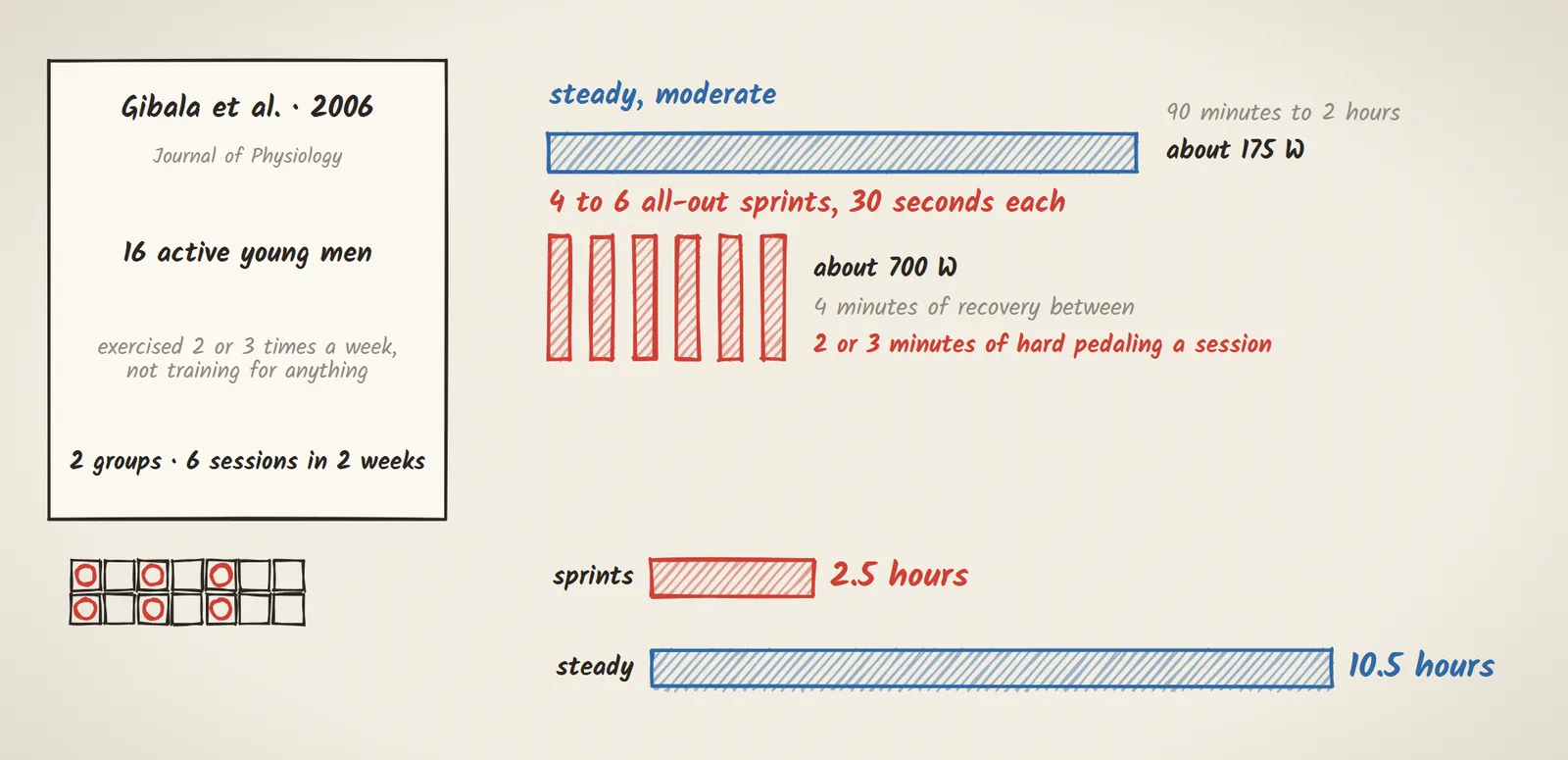
How do we know an interval session isn’t just a shortcut that feels productive? In one study from Canada, 16 active young men, students who exercised 2 or 3 times a week but didn’t train for anything, were split into two groups. Over 2 weeks, each group did 6 sessions. One rode at a steady, moderate pace, about 175 W, for 90 minutes to 2 hours. The other did four to six 30-second all-out sprints at about 700 W, with 4 minutes of recovery between them, which is 2 or 3 minutes of hard pedaling a session. That’s 2.5 hours of training against 10.5.
What it found
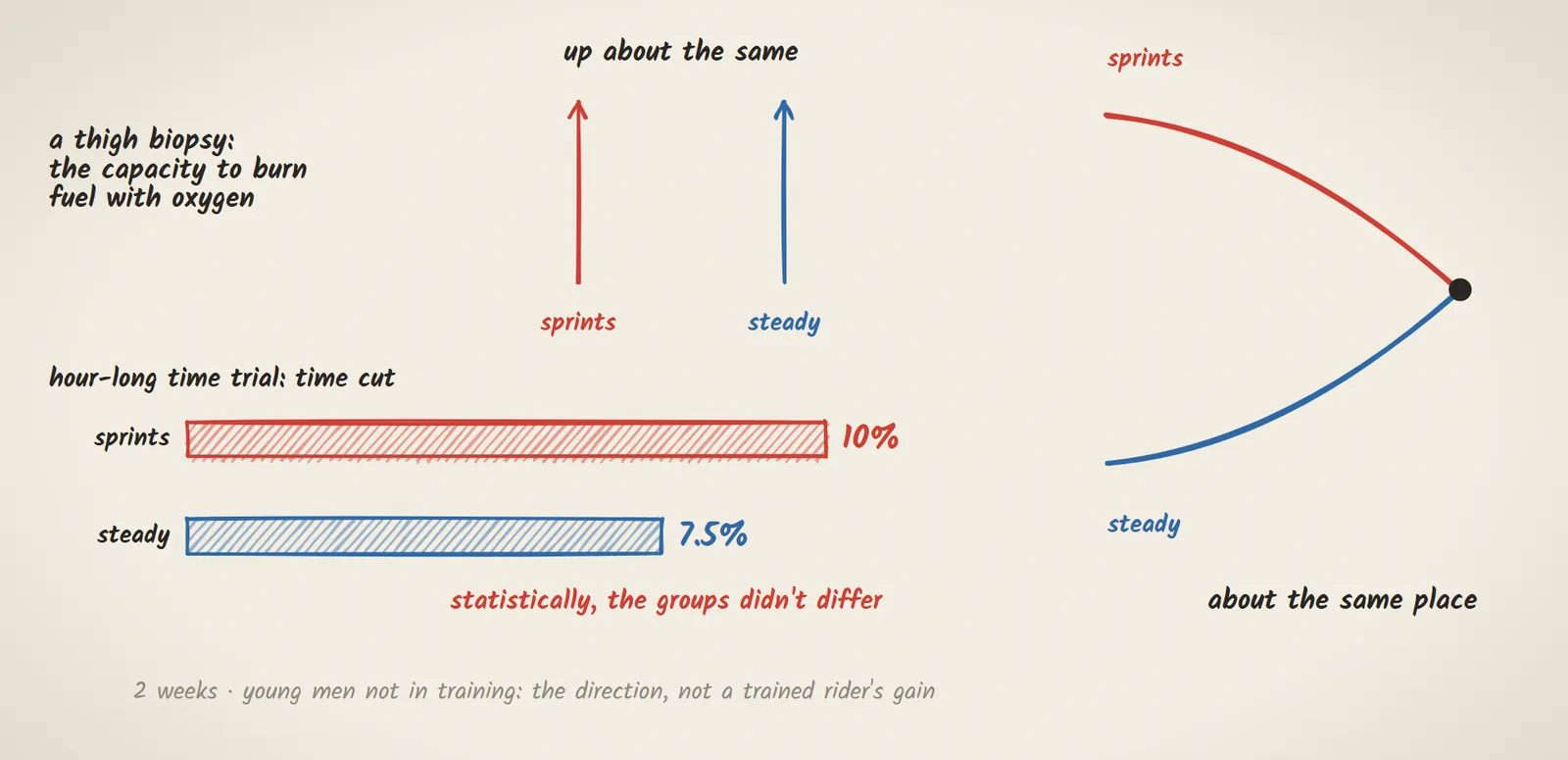
Afterwards, a biopsy from the thigh showed the muscle’s capacity to burn fuel with oxygen up by about the same in both groups. Both groups also finished an hour-long time trial faster, cutting their time by about 10% after the sprints and 7.5 after the steady rides, and statistically, the groups didn’t differ. It was 2 weeks, in young men who weren’t in training, so it shows the direction, not what a trained rider would gain. But it puts the two routes side by side, and on both measures, they ended up in about the same place.
What it means for you
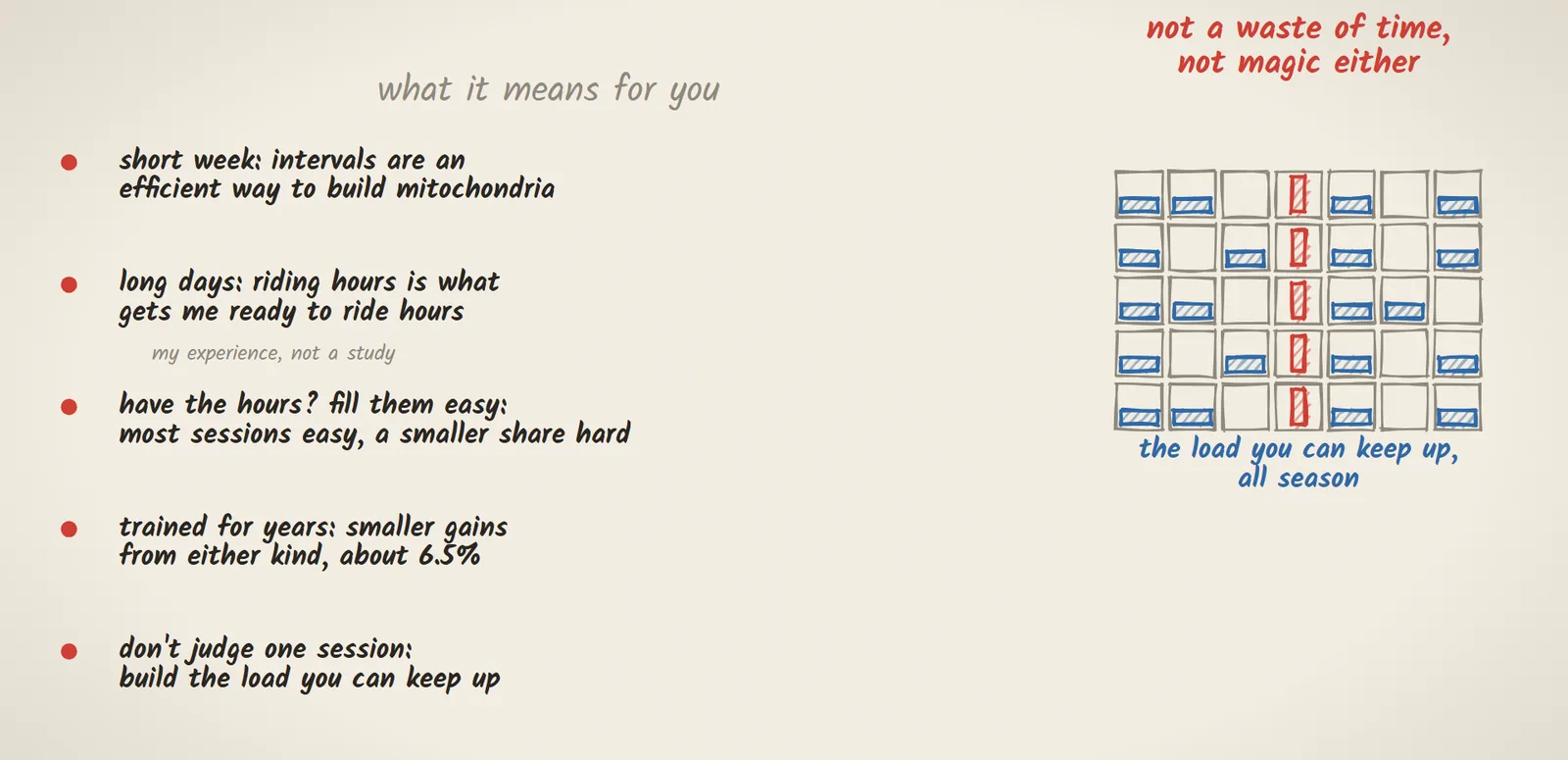
So what does this mean for you? Zone 2 isn’t a waste of time, and it isn’t magic either. If your week is short, intervals are an efficient way to build mitochondria. For long days, though, my own experience is that riding hours is what gets me ready to ride hours: if I want to ride well after 3,000 kJ, I want to have ridden that far in training first. That’s experience, not a study, but no one-hour session teaches you to pace, eat and sit through a day that long. If you have the hours, easy riding is how you fill them without digging yourself a hole, and it’s how elite endurance athletes train: their logs show most of their sessions easy, with a smaller share hard. If you’ve trained for years, expect smaller gains from either kind: in well-trained people, that review found about 6.5%. So don’t judge one session against another. What you’re building is the load you can keep up for the whole season.
That’s what’s underneath the watts.
Sources
The study
- Gibala MJ, Little JP, van Essen M, Wilkin GP, Burgomaster KA, Safdar A, Raha S, Tarnopolsky MA. Short-term sprint interval versus traditional endurance training: similar initial adaptations in human skeletal muscle and exercise performance. J Physiol. 2006;575(Pt 3):901-911. doi.org/10.1113/jphysiol.2006.112094
The review
- Mølmen KS, Almquist NW, Skattebo Ø. Effects of exercise training on mitochondrial and capillary growth in human skeletal muscle: a systematic review and meta-regression. Sports Med. 2025;55(1):115-144. doi.org/10.1007/s40279-024-02120-2
Also in this article
- The same result over six weeks: Burgomaster KA, Howarth KR, Phillips SM, Rakobowchuk M, Macdonald MJ, McGee SL, Gibala MJ. Similar metabolic adaptations during exercise after low volume sprint interval and traditional endurance training in humans. J Physiol. 2008;586(1):151-160. doi.org/10.1113/jphysiol.2007.142109
- Easy hours recover faster: Seiler S, Haugen O, Kuffel E. Autonomic recovery after exercise in trained athletes: intensity and duration effects. Med Sci Sports Exerc. 2007;39(8):1366-1373. doi.org/10.1249/mss.0b013e318060f17d
- How elite endurance athletes train: Seiler KS, Kjerland GØ. Quantifying training intensity distribution in elite endurance athletes: is there evidence for an “optimal” distribution? Scand J Med Sci Sports. 2006;16(1):49-56. doi.org/10.1111/j.1600-0838.2004.00418.x
Written and researched by Yarin Podoler, a cyclist who wanted to know what’s underneath the watts.