What do mitochondria actually do when I ride?
They run an electrical machine. They take the electrons out of your food and let them fall to the oxygen you breathe, and the fall charges a membrane, which drives a tiny motor that makes ATP, the energy currency your muscles spend. And training mostly changes how much of that machine you have, not how much it gets out of each breath.
The video version, 4:42, narrated by a synthetic voice. Watch on YouTube · Watch the Short
The first minutes of an effort
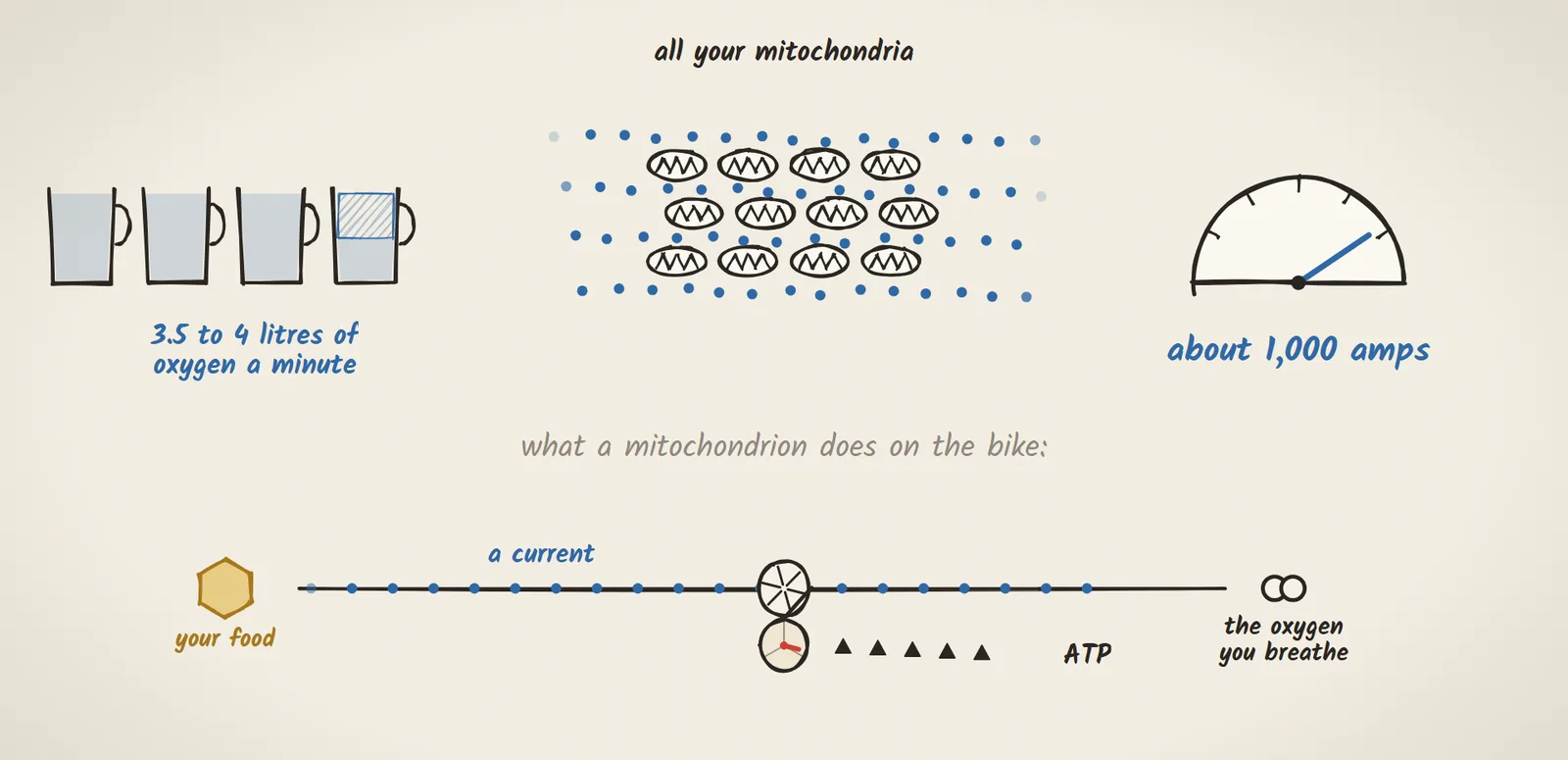
In late October, inside a 4-hour ride, I did two 30-minute efforts outside at 270 W. Think about the moment the first one began. I’d been riding steadily, and then I lifted the power. The watts were there within a second, because my legs brought in more muscle fibers and drove them harder. My breathing took longer: it climbed for a minute or two before it settled. Inside the muscle, oxygen use was rising too, and until it caught up, fast backups covered the gap. A typical rider holding 270 W is using something like 3.5 to 4 litres of oxygen a minute. So where does all that oxygen go, and where does the carbon dioxide you breathe out come from?
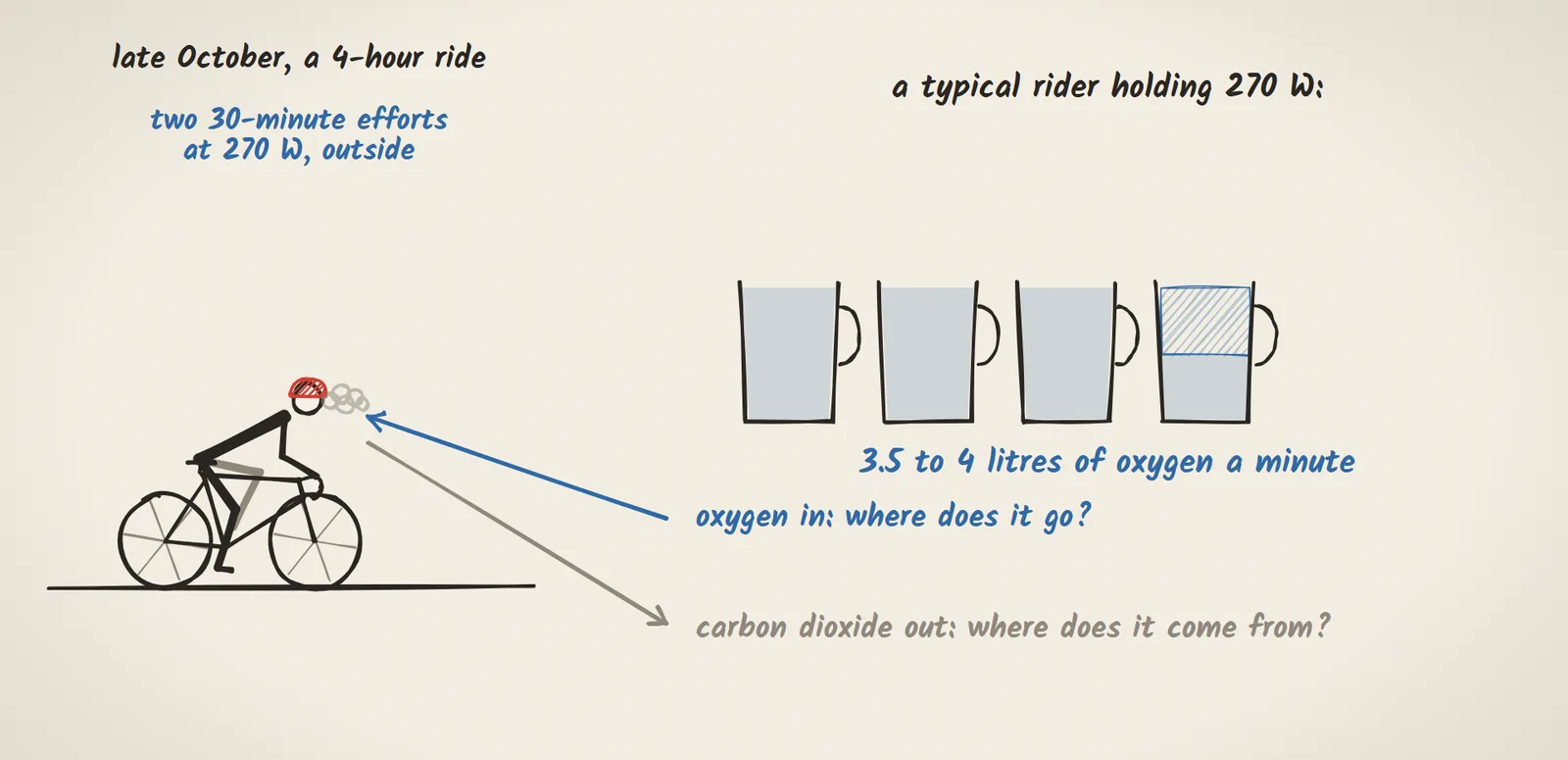
Where the carbon dioxide comes from
Start with your food. Sugar and fat are broken down into small pieces, loading some of their electrons onto carriers on the way, and inside the mitochondrion, a wheel of chemical steps takes the pieces apart. Textbooks call it the Krebs cycle, and it makes almost no ATP itself. Its job is to strip off the rest of the electrons, and along the way, the pieces’ carbon is cut loose as carbon dioxide. That’s most of the carbon dioxide you breathe out: carbon that was in your breakfast, your bottle or your own stores.
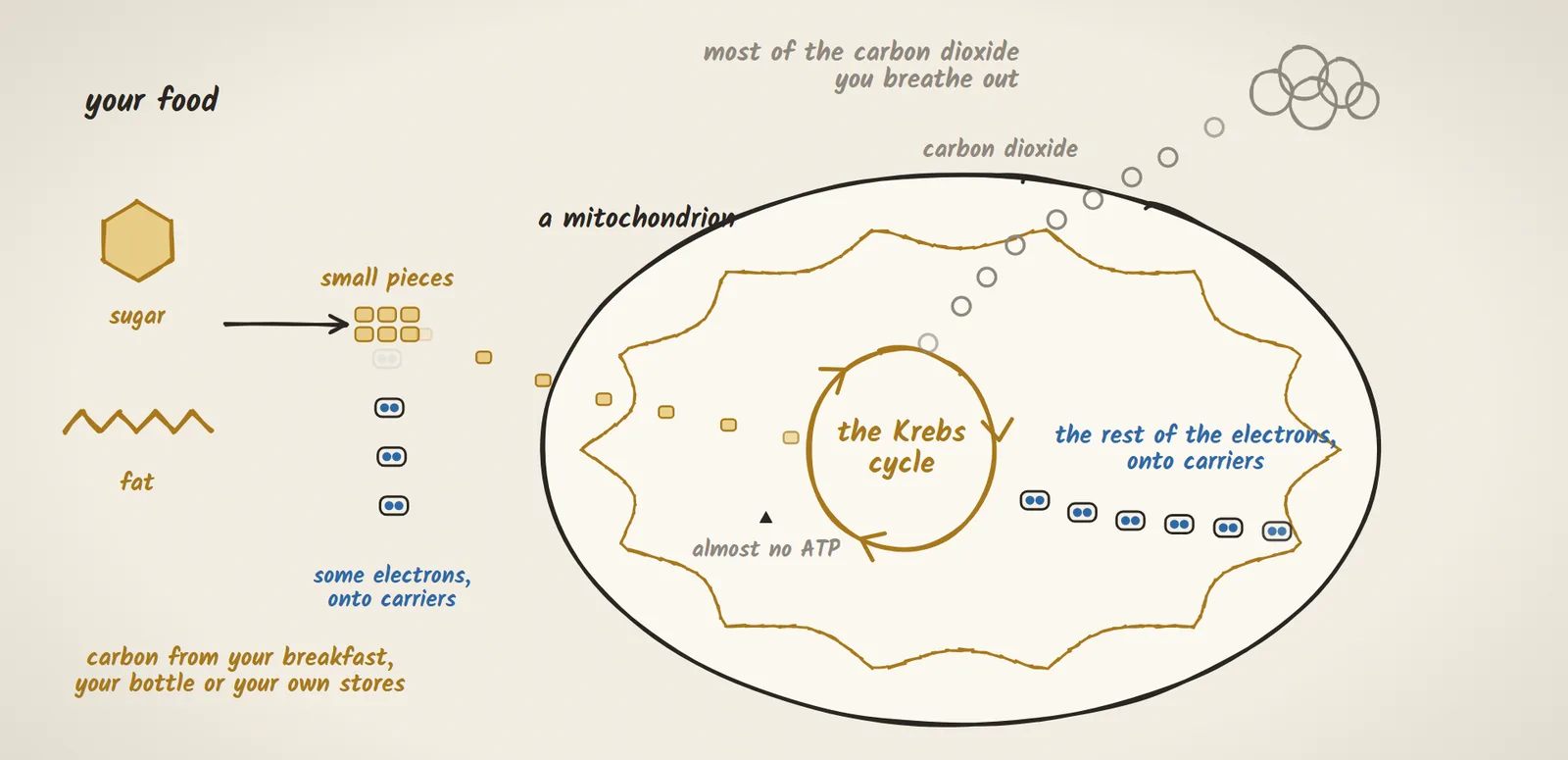
Where the oxygen goes
Then the electrons fall. The carriers hand them to a chain of proteins in the mitochondrion’s inner membrane, and they pass down it, step by step, to the strongest pull at the bottom, which is oxygen. Oxygen takes them on, along with hydrogen, and becomes water. That’s what the oxygen you take in is for. Hand them straight to oxygen and their energy comes out all at once, as a flame. In steps, it comes out in pieces small enough to catch.
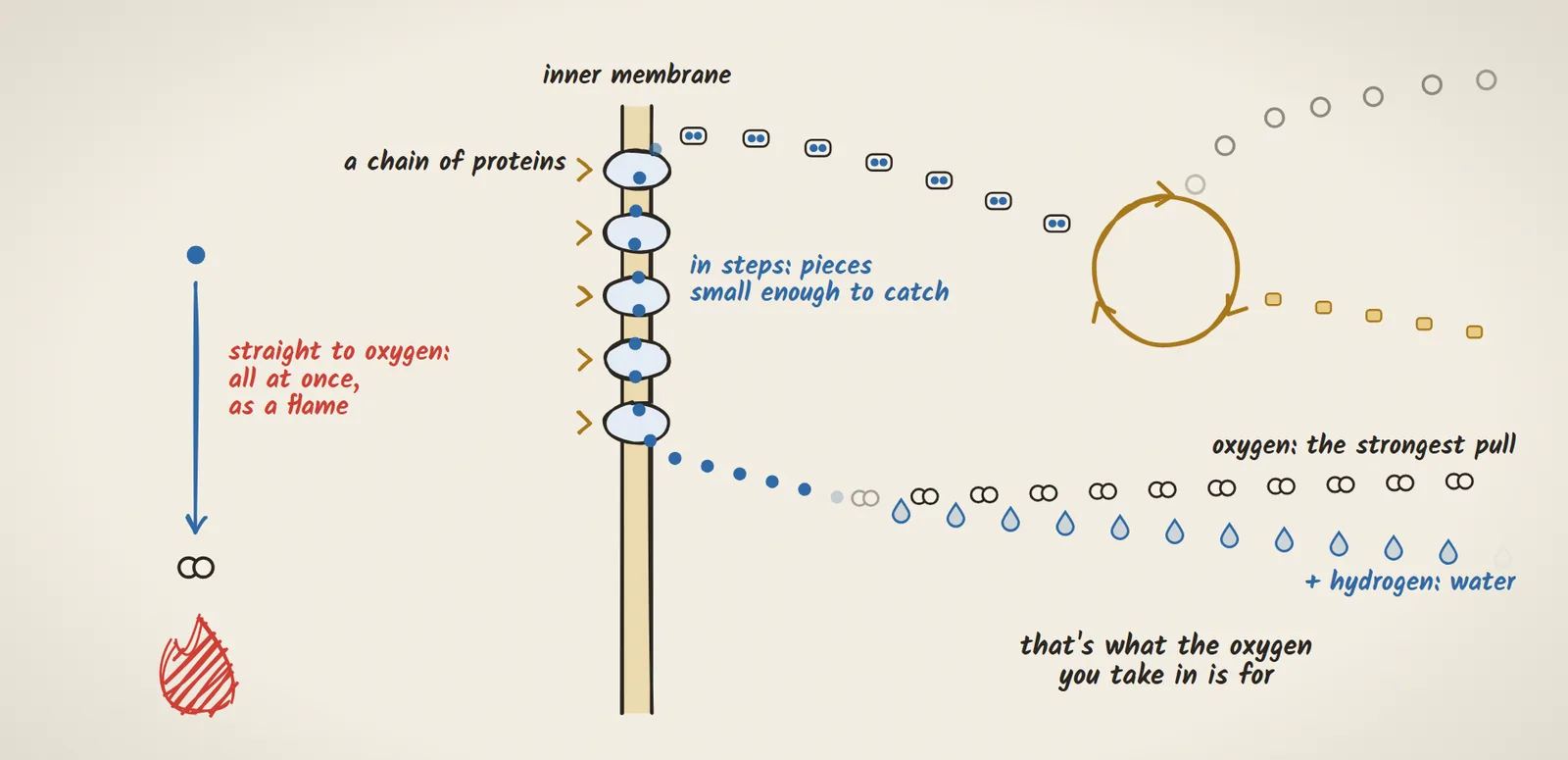
The dam and the motor
Picture a hydroelectric dam. At three of the steps, the falling electrons pump protons, which are hydrogen ions, out across the membrane, and they pile up on one side like water behind the dam, leaving the membrane charged. The protons flow back in through a turbine, a real rotary motor in the membrane, and every full turn of it makes 3 ATP. A bacterial version, run in reverse and breaking ATP down, has been filmed turning.
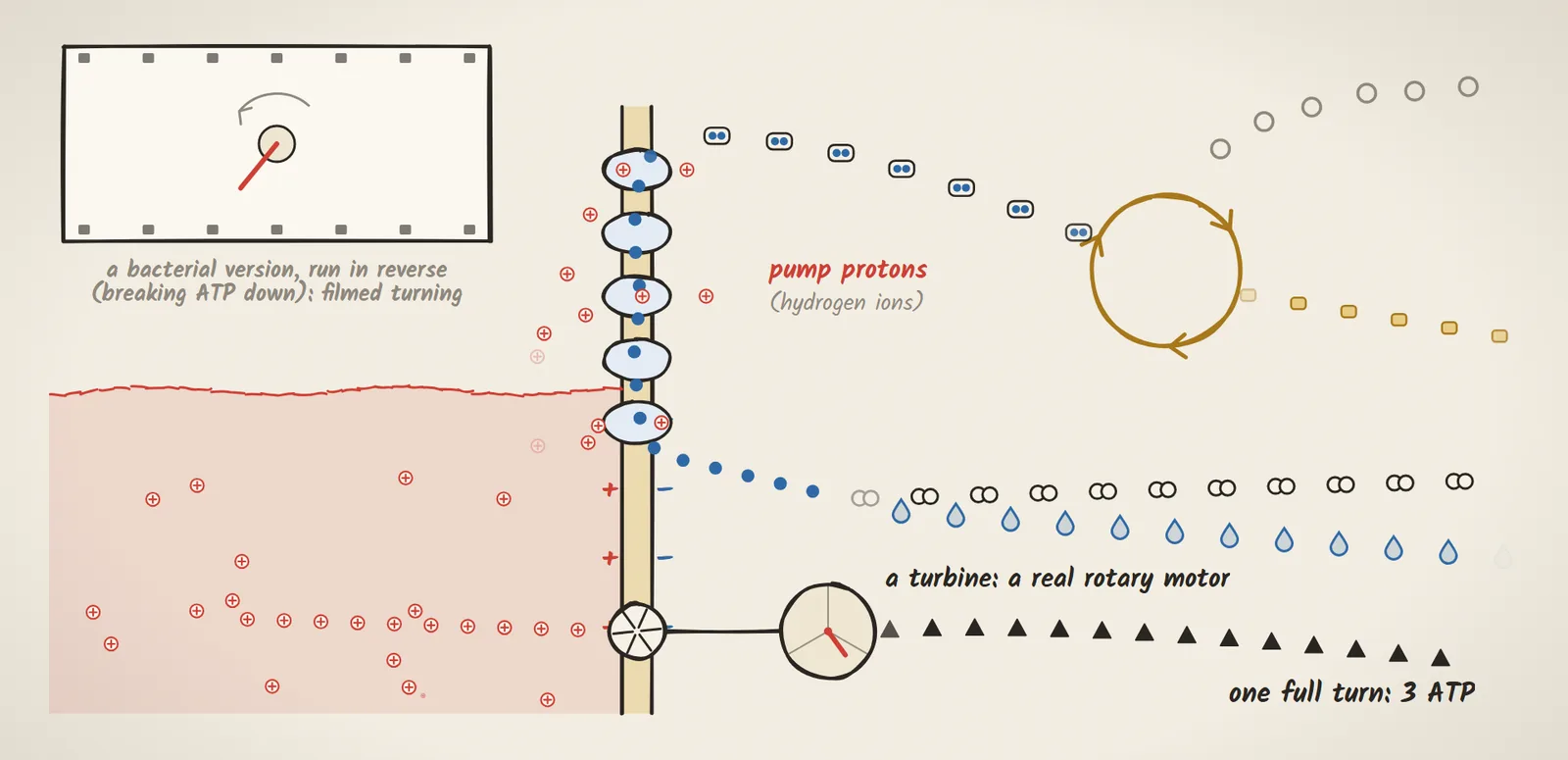
About a thousand amps
At 3.5 to 4 litres of oxygen a minute, the electrons falling through all your mitochondria add up to a current of about 1,000 amps. So that’s what a mitochondrion does on the bike: it runs a current from your food to the oxygen you breathe, and turns that current into ATP.
The experiment
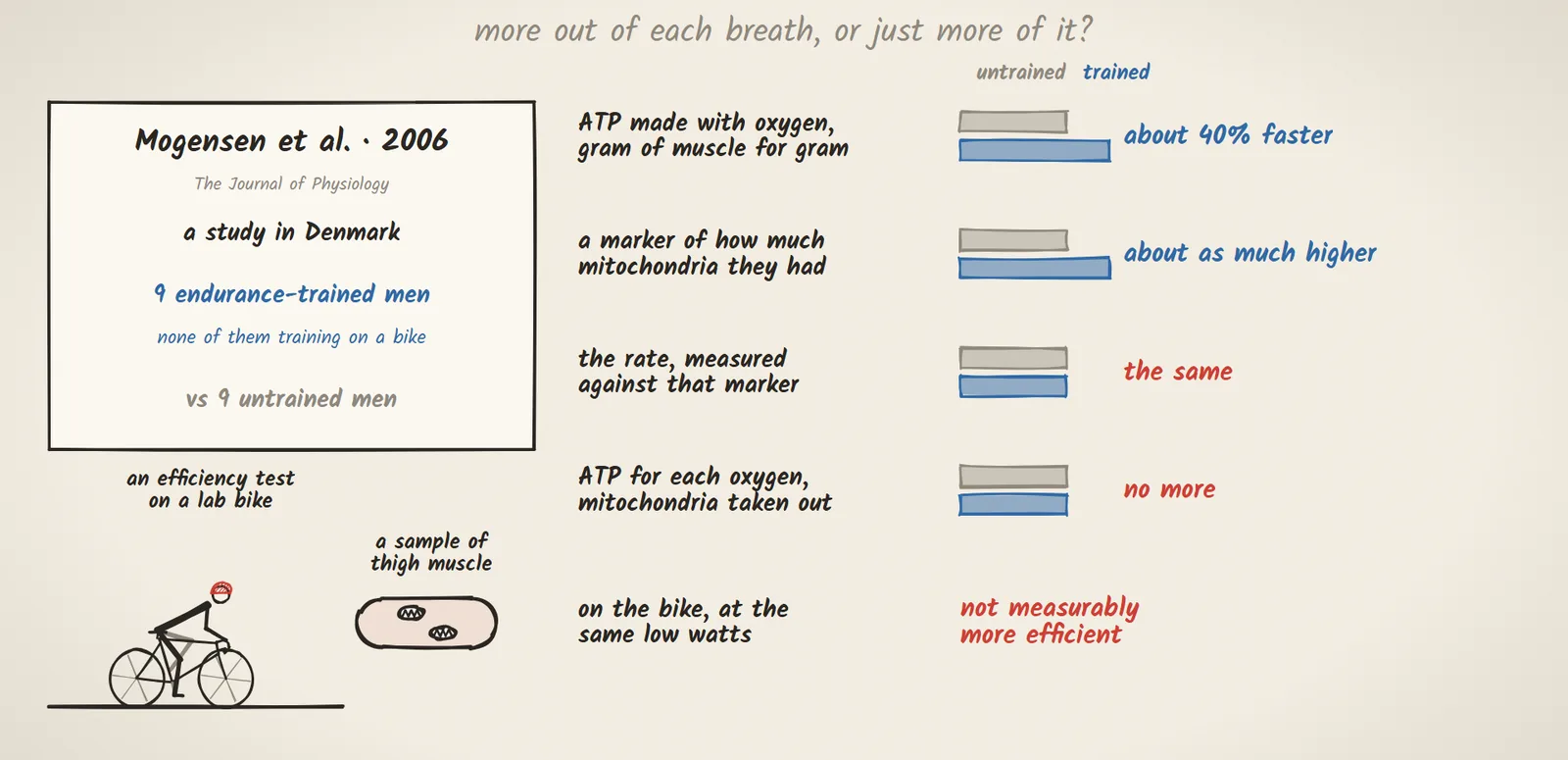
So does the machine inside trained muscle get more out of each breath, or is there just more of it? A study in Denmark compared 9 endurance-trained men, none of them training on a bike, with 9 untrained men. They did an efficiency test on a lab bike and gave a sample of thigh muscle. Gram for gram, the trained men’s muscle could make ATP with oxygen about 40% faster, but a standard marker of how much mitochondria they had was higher by about as much, and measured against it, the rate was the same. Taken out and tested, their mitochondria made no more ATP for each oxygen than the untrained men’s. And at the same low watts on the bike, the trained men weren’t measurably more efficient.
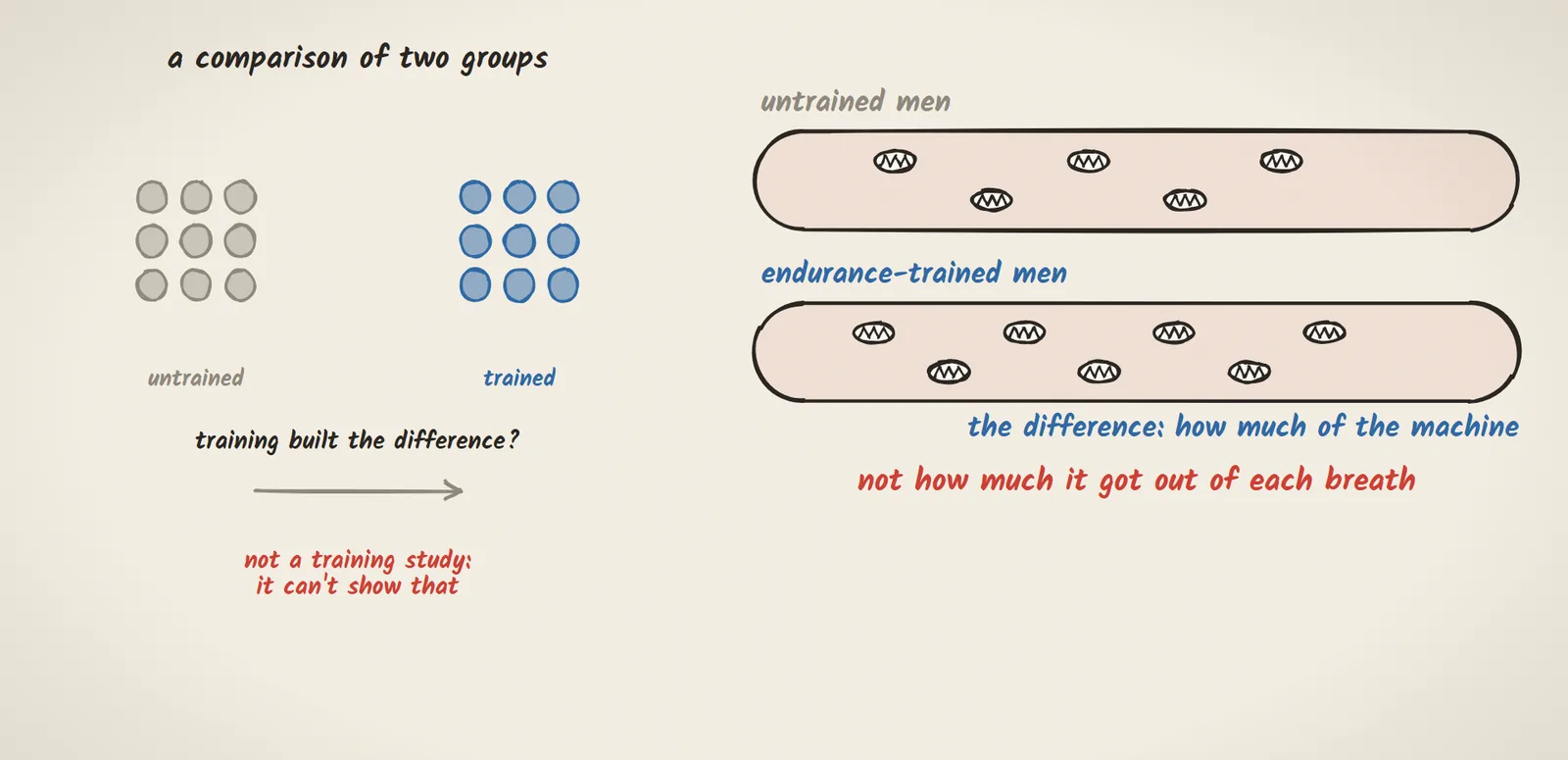
It’s a comparison of two groups, not a training study, so it can’t show that training built the difference. But in that comparison, the difference was how much of the machine the trained men had, not how much it got out of each breath.
What it means for you
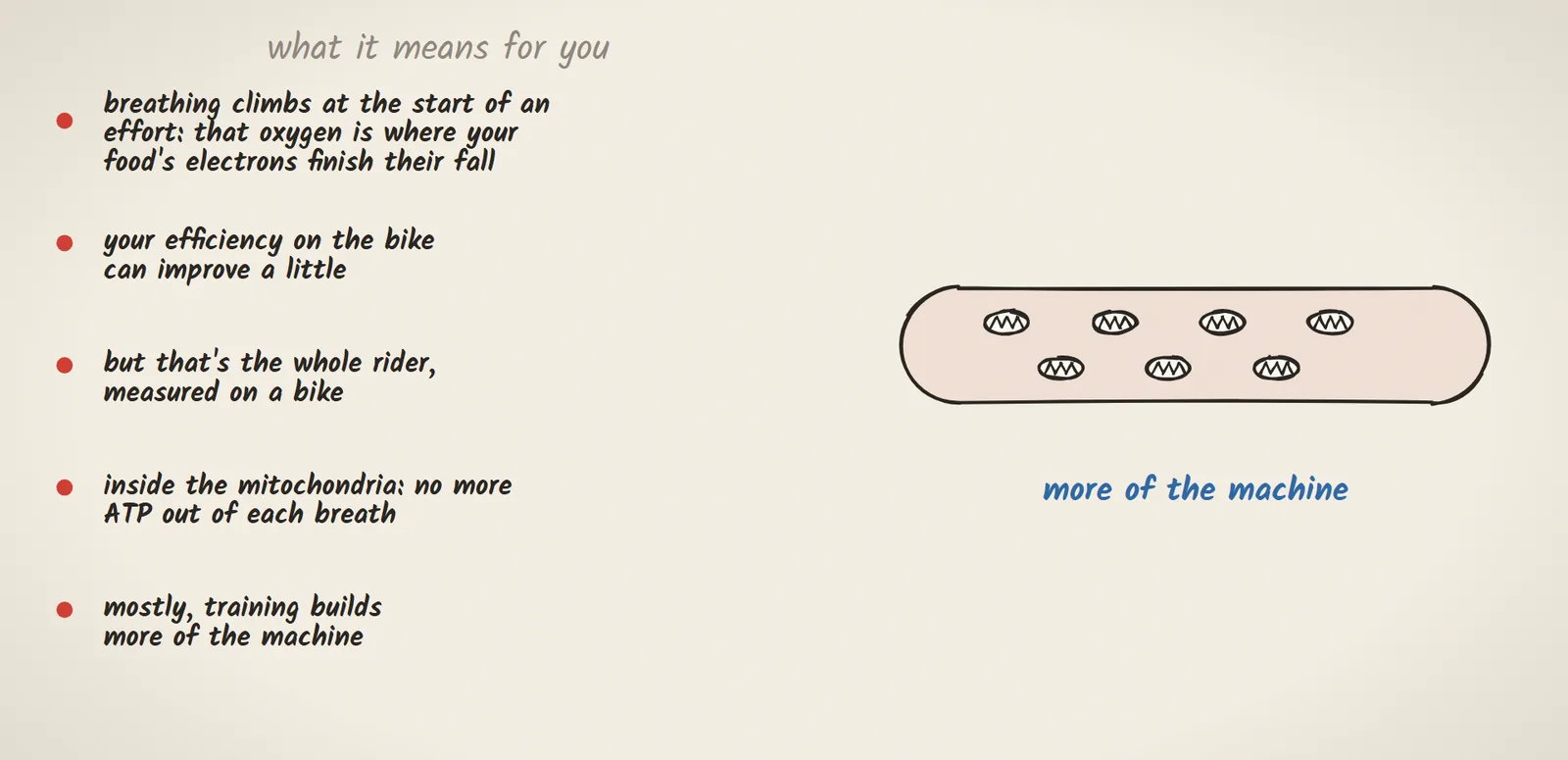
So what does this mean for you? The next time your breathing climbs at the start of an effort, that oxygen is where your food’s electrons finish their fall. Your efficiency on the bike can improve a little: in one study, 14 trained cyclists became about a percentage point more efficient over the build to their season, which means about 5% less energy for the same work. But that’s the whole rider, measured on a bike. Inside the mitochondria, the Danish study’s trained men got no more ATP out of each breath, which is worth knowing when something is sold as doing just that. Mostly, what training builds is more of the machine.
That’s what’s underneath the watts.
Sources
The study
- Mogensen M, Bagger M, Pedersen PK, Fernström M, Sahlin K. Cycling efficiency in humans is related to low UCP3 content and to type I fibres but not to mitochondrial efficiency. J Physiol. 2006;571(Pt 3):669-681. doi.org/10.1113/jphysiol.2005.101691
Also in this article
- Efficiency over the build to a season, 14 trained cyclists: Hopker J, Coleman D, Passfield L. Changes in cycling efficiency during a competitive season. Med Sci Sports Exerc. 2009;41(4):912-919. doi.org/10.1249/MSS.0b013e31818f2ab2
- The motor filmed turning (a bacterial version, run in reverse on ATP): Noji H, Yasuda R, Yoshida M, Kinosita K Jr. Direct observation of the rotation of F1-ATPase. Nature. 1997;386(6622):299-302. doi.org/10.1038/386299a0
- Three ATP a full turn (measured in cow heart mitochondria): Watt IN, Montgomery MG, Runswick MJ, Leslie AGW, Walker JE. Bioenergetic cost of making an adenosine triphosphate molecule in animal mitochondria. Proc Natl Acad Sci U S A. 2010;107(39):16823-16827. doi.org/10.1073/pnas.1011099107
- Citrate synthase as a marker of how much mitochondria a muscle has: Larsen S, Nielsen J, Hansen CN, et al. Biomarkers of mitochondrial content in skeletal muscle of healthy young human subjects. J Physiol. 2012;590(14):3349-3360. doi.org/10.1113/jphysiol.2012.230185
Written and researched by Yarin Podoler, a cyclist who wanted to know what’s underneath the watts.