What workouts improve lactate clearance?
There’s no special one. Steady riding and intervals both build your aerobic engine, and that one engine decides both how much lactate you make and how much you clear. In one detailed experiment, making less was the bigger part.
The video version, 3:32, narrated by a synthetic voice. Watch on YouTube · Watch the Short
The lactate test
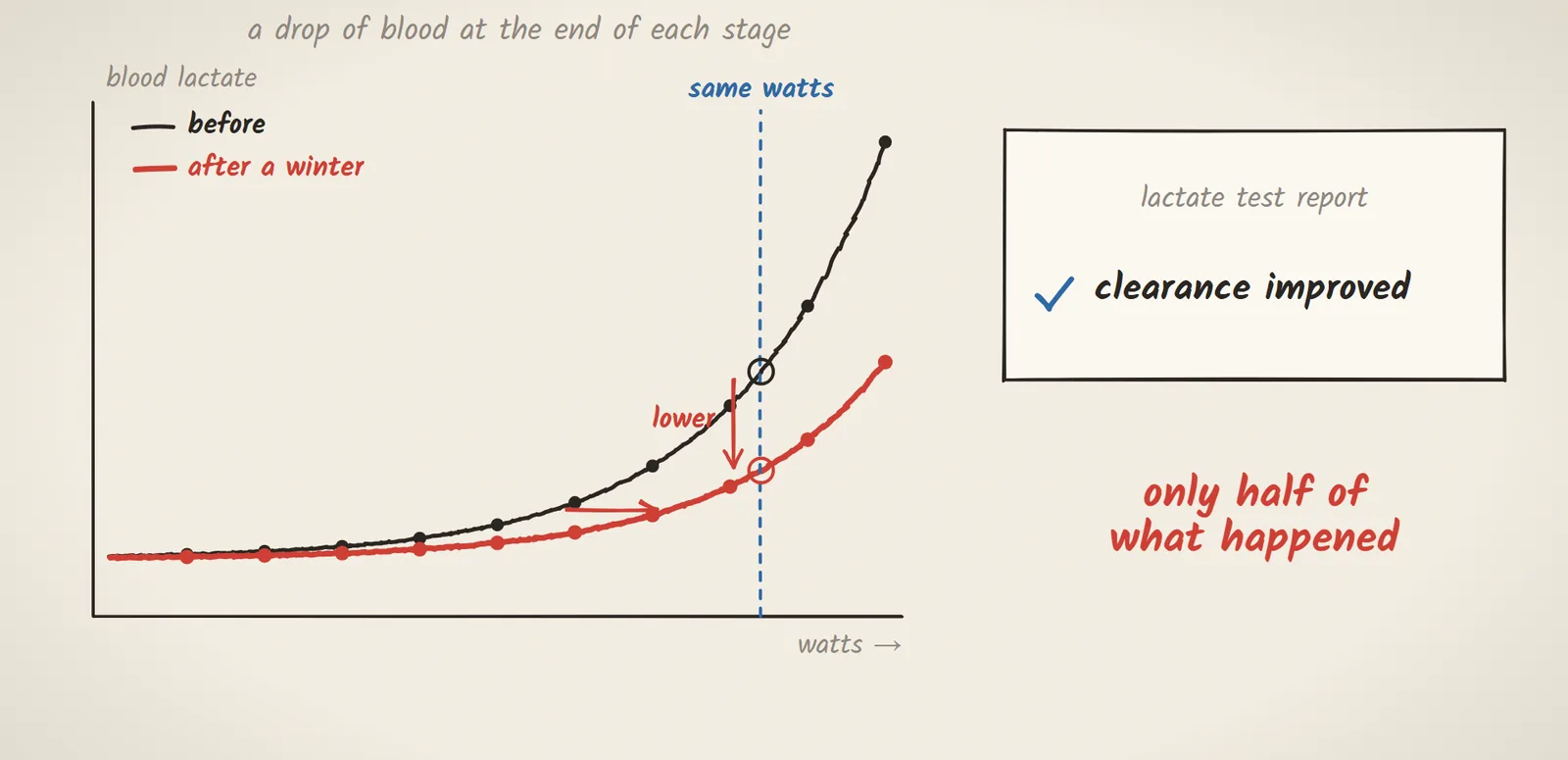
Maybe you’ve had a lactate test: a drop of blood from your earlobe at the end of each stage as the watts go up, and a curve that stays flat for a while and then bends upward. After a winter of steady riding you do it again, and the bend has moved to the right. The same watts now give you a lower number, and the report says your lactate clearance has improved. It sounds right. Lactate piles up, so getting fitter must mean getting rid of it faster, and it’s natural to wonder which workouts would push that further. But clearing it faster is only half of what happened.
Two roads for pyruvate
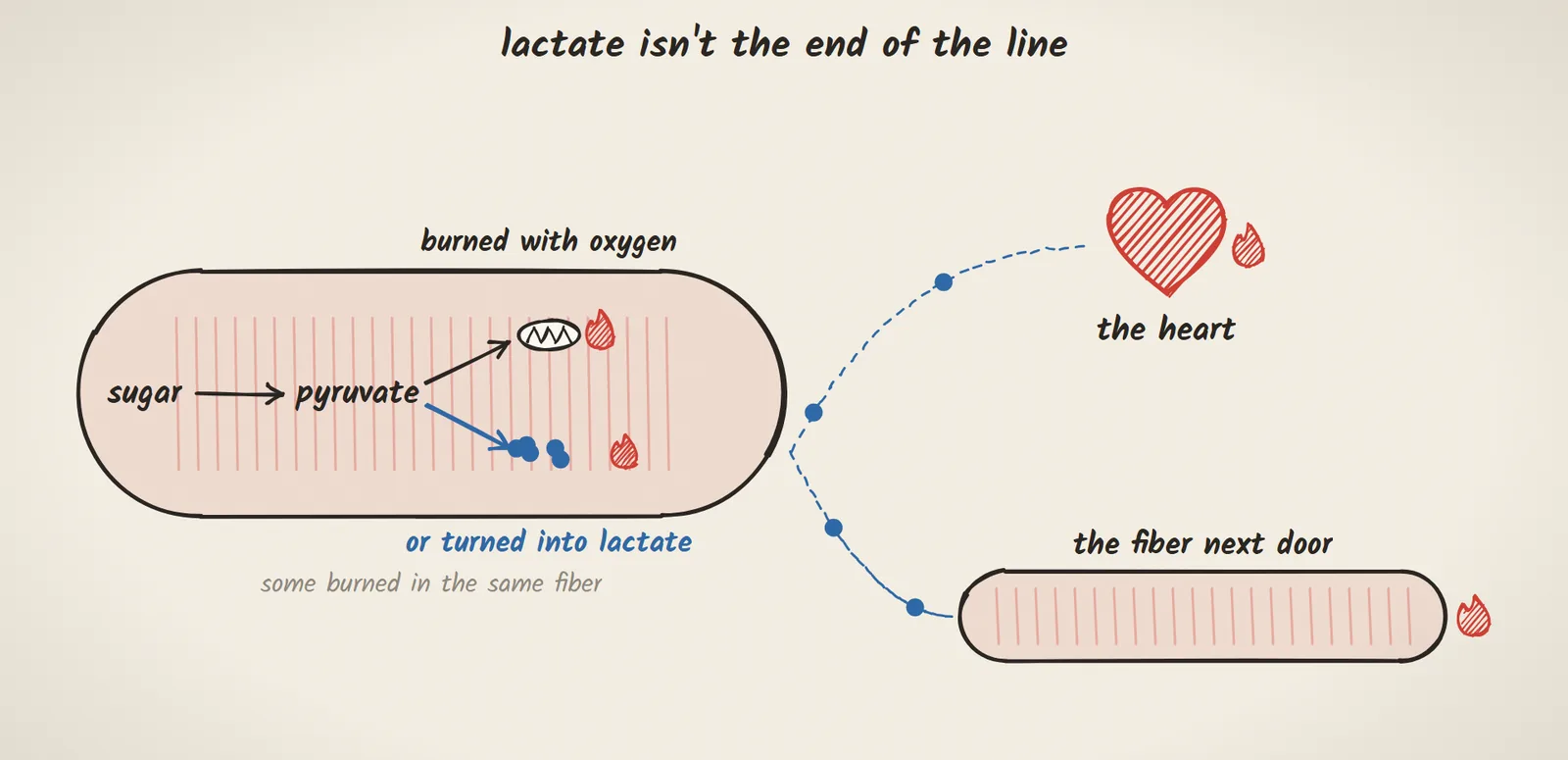
Start with what that number is. Your muscles make lactate all the time, even at rest, with plenty of oxygen around. When a fiber breaks down sugar for energy, what comes out, pyruvate, has two roads. It can go into the mitochondria and be burned with oxygen, or it can be turned into lactate. And lactate isn’t the end of the line. Some is burned in the same fiber, and much of it leaves and gets burned as fuel somewhere else: in the fiber next door, or in the heart.
The number is a balance
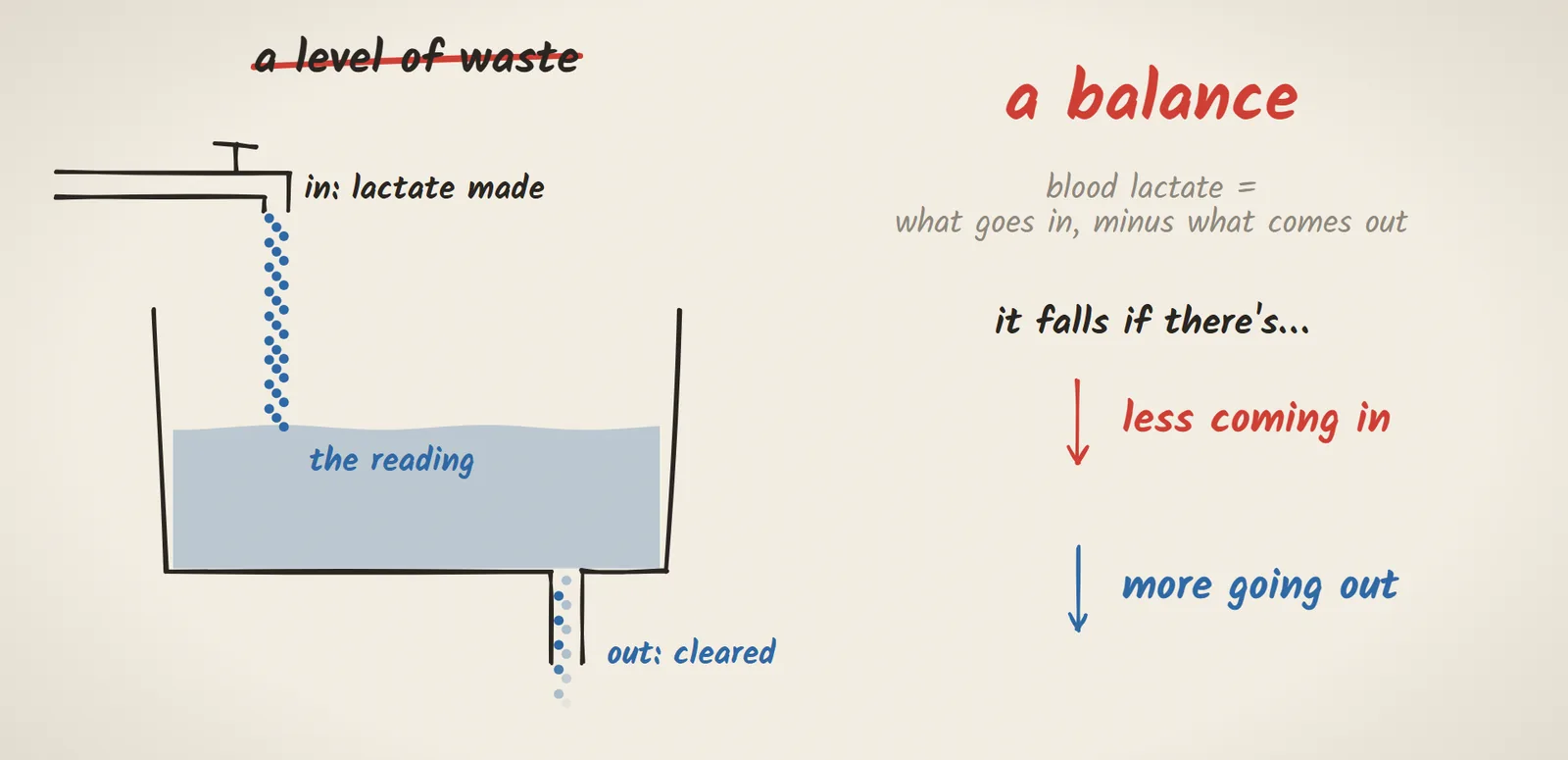
So the number from your earlobe isn’t a level of waste. It’s a balance, like the water in a bath with the tap running and the drain open. Lactate goes into the blood, lactate comes out, and the reading is whatever is left in between. It can fall for two reasons: less coming in, or more going out.
One engine, two sides
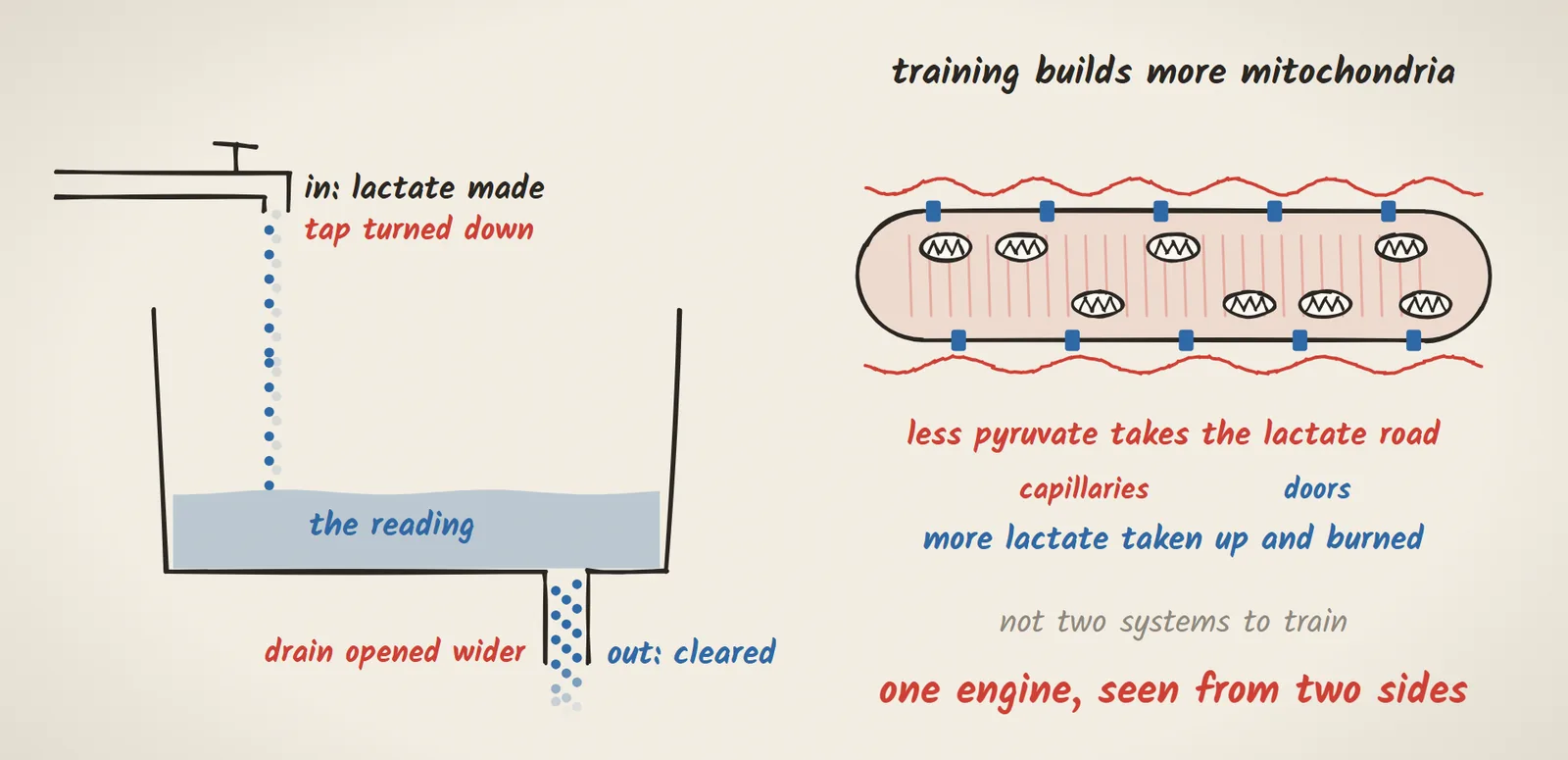
Now the engine. Training builds more mitochondria in the working fibers. More mitochondria can take in more pyruvate and burn it directly, so at the same watts, less of it takes the lactate road. That’s the tap turned down. Those same mitochondria, along with more capillaries around the fibers and more of the doors that let lactate in and out, also mean more lactate taken up and burned. That’s the drain opened wider. Making less and clearing more aren’t two systems to train. They’re one aerobic engine, seen from two sides.
The experiment
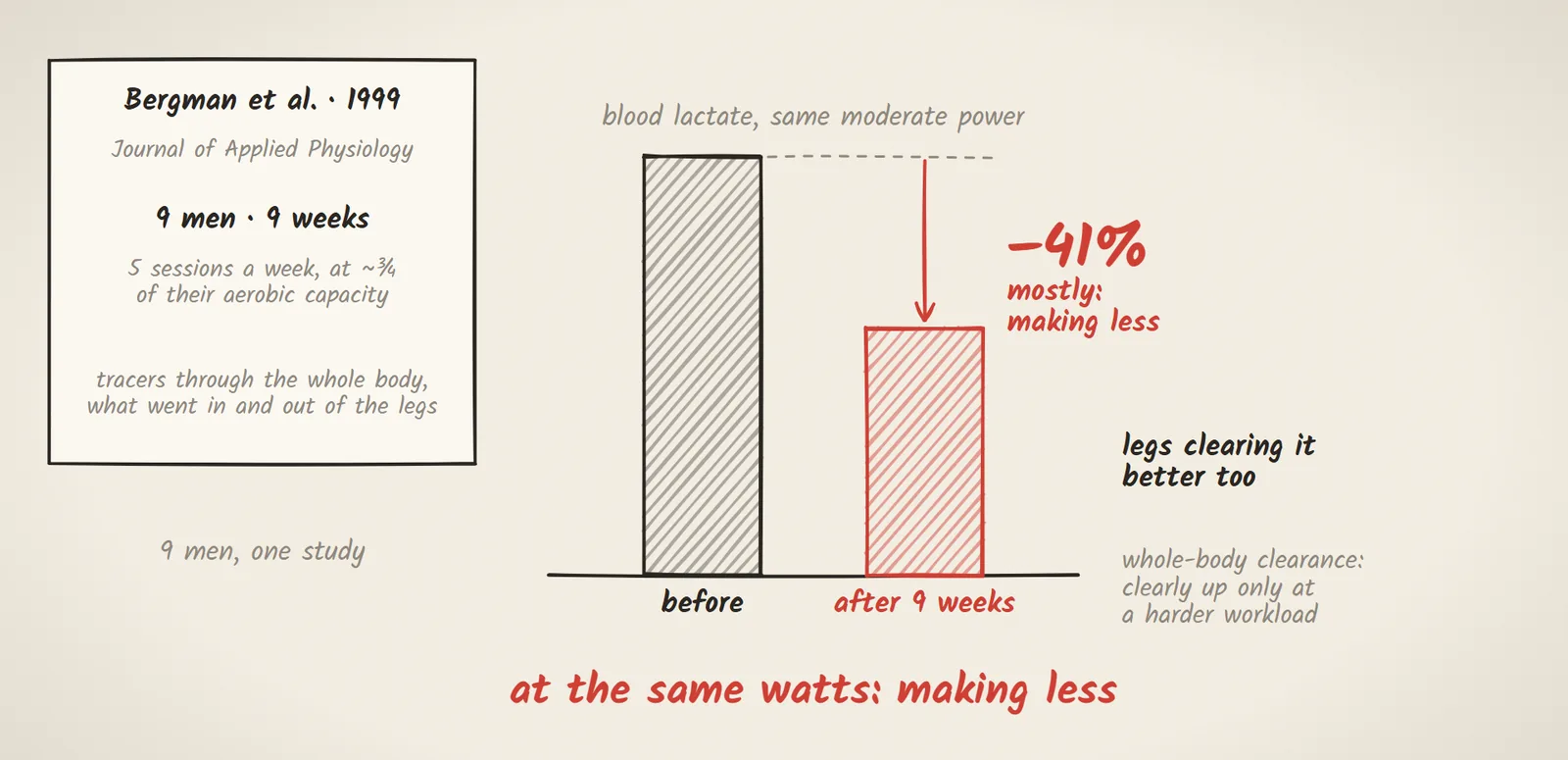
How do we know which side moves? In 1999, a lab in California had 9 men train on a bike for 9 weeks, 5 sessions a week, at about three-quarters of their aerobic capacity. Before and after, the researchers followed lactate through the whole body with tracers, and measured what went into and out of the legs. At the same moderate power they’d ridden before training, blood lactate was 41% lower, and most of that drop came from the legs making less. Their legs were clearing it better too, but the whole body’s clearance rose clearly only at a harder workload, matched to their new, higher capacity. Nine men and one study, but at the same watts, the big change was making less.
What it means for you
So what does this mean for you? Don’t go looking for a lactate workout. Both sides run on the same aerobic machinery, so judge a session by what it does for the engine, not by whether it promises clearance. If you test, a curve that moves to the right, on the same test with the same fuelling, is good news about that engine. It can’t tell you whether you’re making less or clearing more, and you don’t need it to.

That’s what’s underneath the watts.
Sources
The study
- Bergman BC, Wolfel EE, Butterfield GE, Lopaschuk GD, Casazza GA, Horning MA, Brooks GA. Active muscle and whole body lactate kinetics after endurance training in men. J Appl Physiol. 1999;87(5):1684-1696. doi.org/10.1152/jappl.1999.87.5.1684
Written and researched by Yarin Podoler, a cyclist who wanted to know what’s underneath the watts.