Why am I gasping before my legs give out?
Usually, it isn’t your lungs failing. An effort that hard demands enormous amounts of air, and moving it is work in its own right: near your maximum, your breathing muscles claim a share of the blood your heart pumps, partly at your legs’ expense. So breathing that hard is one of the things tiring your legs.
The video version, 4:20, narrated by a synthetic voice. Watch on YouTube · Watch the Short
The third interval
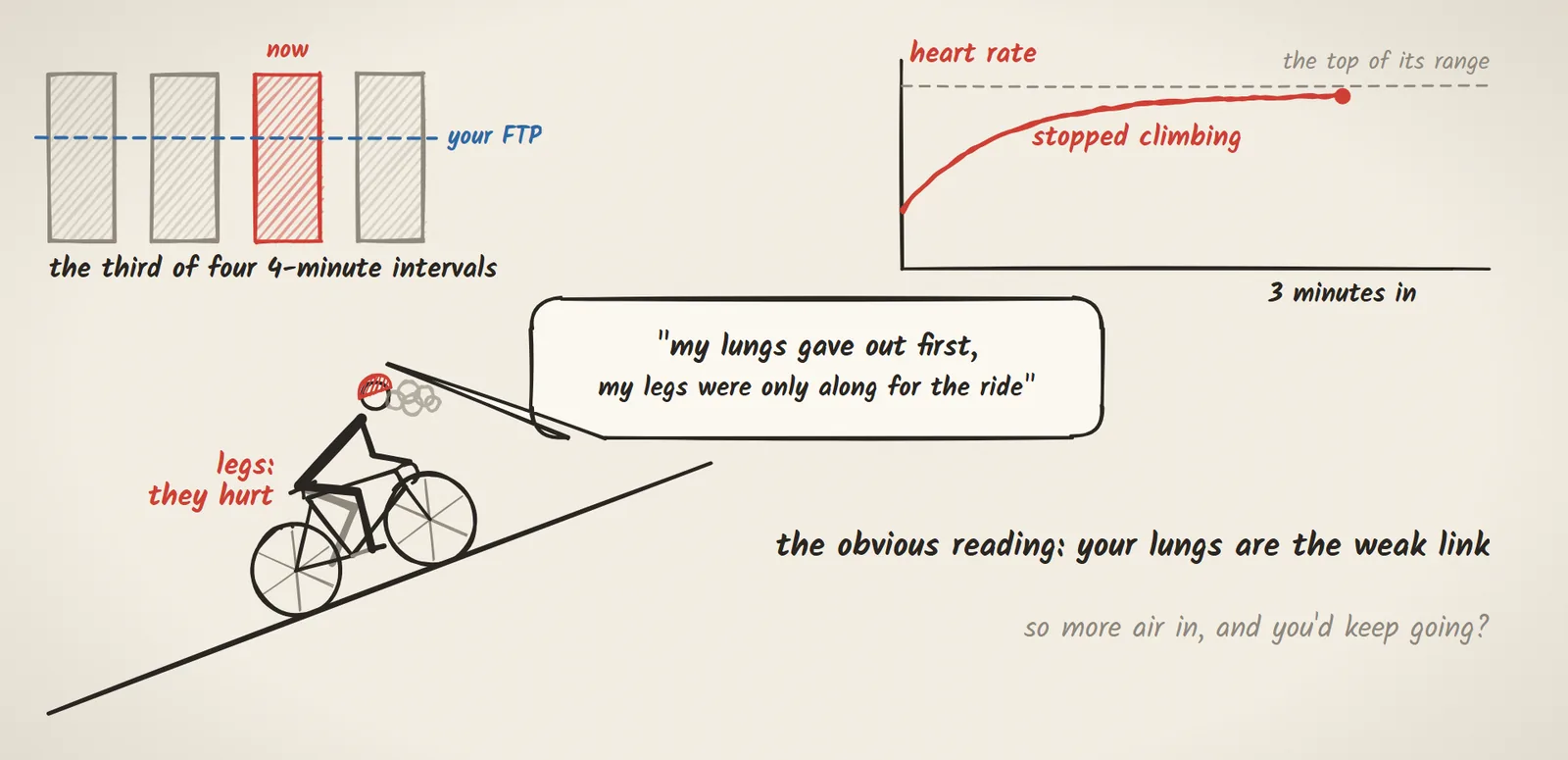
Picture the third of four 4-minute intervals on a long climb, at a power well above your FTP. Three minutes in, your heart rate is near the top of its range, and it has stopped climbing. Your legs hurt, but what fills your head is breathing, every breath as deep and as fast as you can make it, and it still doesn’t feel like enough. When the interval ends, it feels as if your lungs gave out first and your legs were only along for the ride. So the obvious reading is that your lungs are the weak link, and that if you could only get more air in, you’d keep going.
What drives the gasping
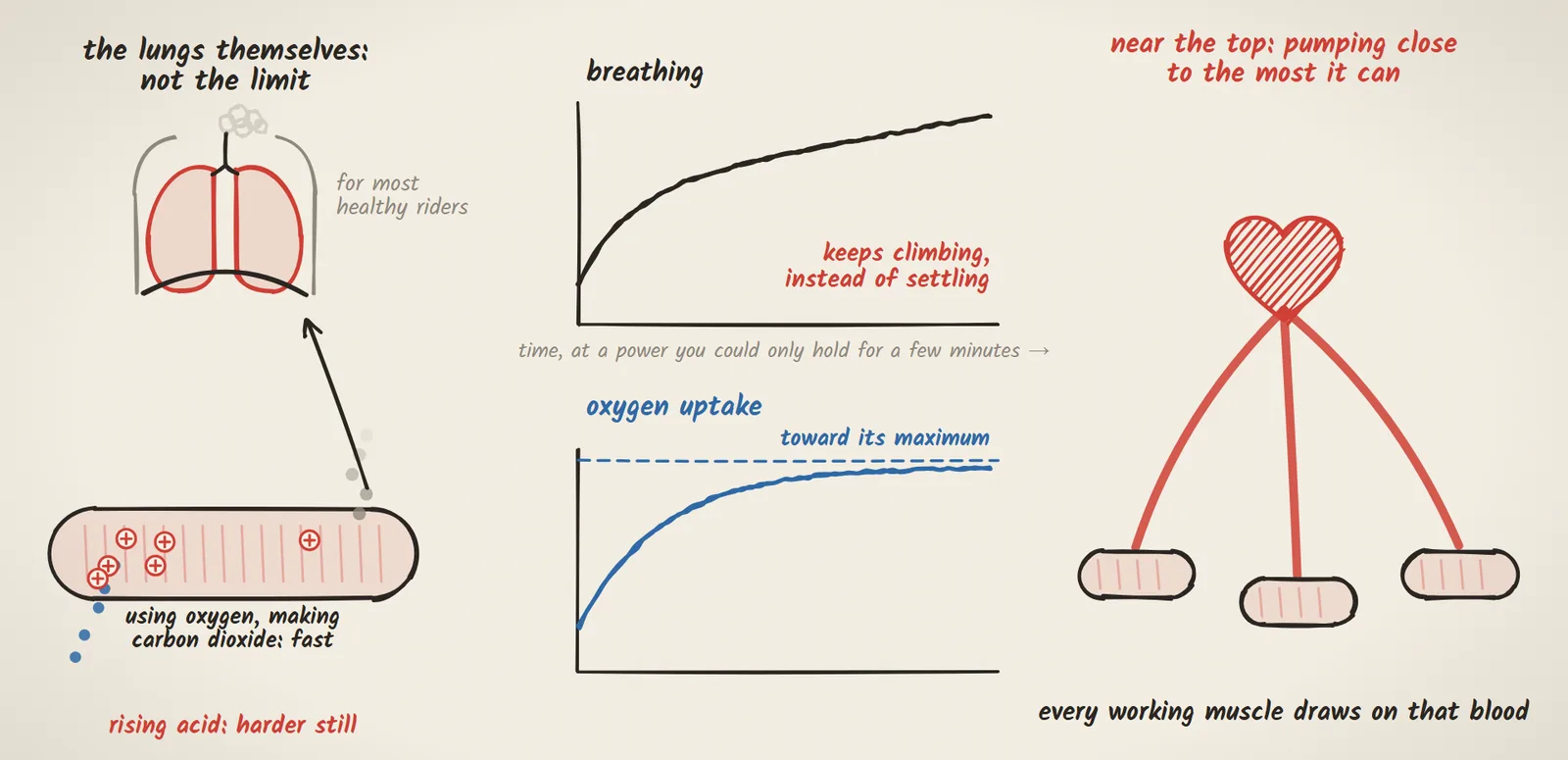
For most healthy riders, the lungs themselves aren’t the limit. The gasping is what an effort this hard asks of your breathing: your muscles are using oxygen and making carbon dioxide fast, rising acid pushes your breathing harder still, and at a power you could only hold for a few minutes, it keeps climbing instead of settling. Your oxygen uptake climbs too, toward its maximum, and near the top, your heart is pumping close to the most it can, with every muscle that’s working drawing on that blood.
Breathing is muscle work
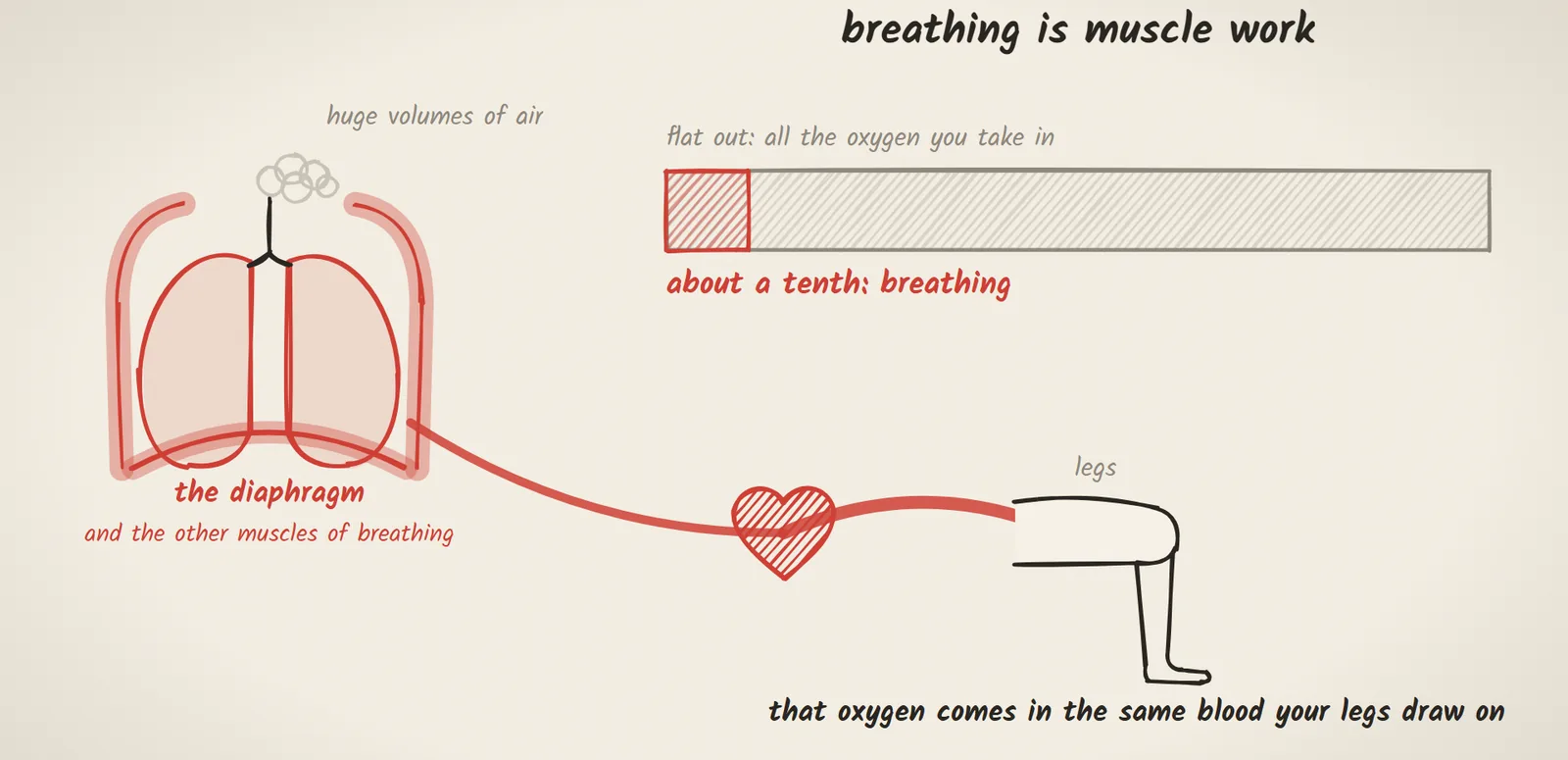
And breathing is muscle work. Your diaphragm and the other muscles of breathing are moving huge volumes of air, and flat out, breathing can use about a tenth of all the oxygen you take in. That oxygen comes in the blood, from the same supply your legs are drawing on.
Something has to give
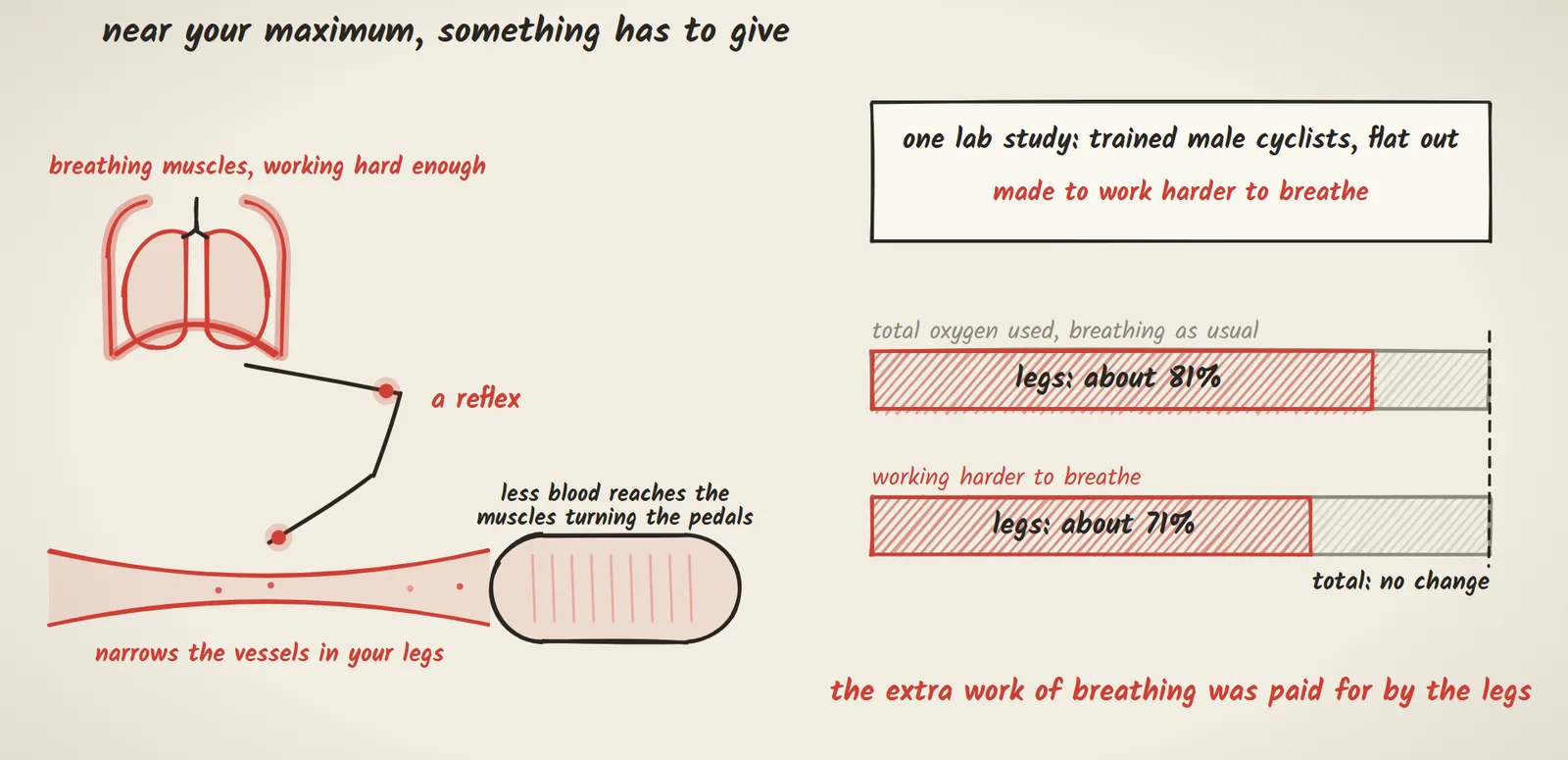
So near your maximum, something has to give. Once your breathing muscles are working hard enough, a reflex from them narrows the blood vessels in your legs, and less blood reaches the muscles turning the pedals. In one lab study, when trained male cyclists riding flat out had to work harder to breathe, their total oxygen use didn’t change, but the share of it used by their legs fell from about 81% to about 71%. In that test, the extra work of breathing was paid for by the legs.
A top-end effect
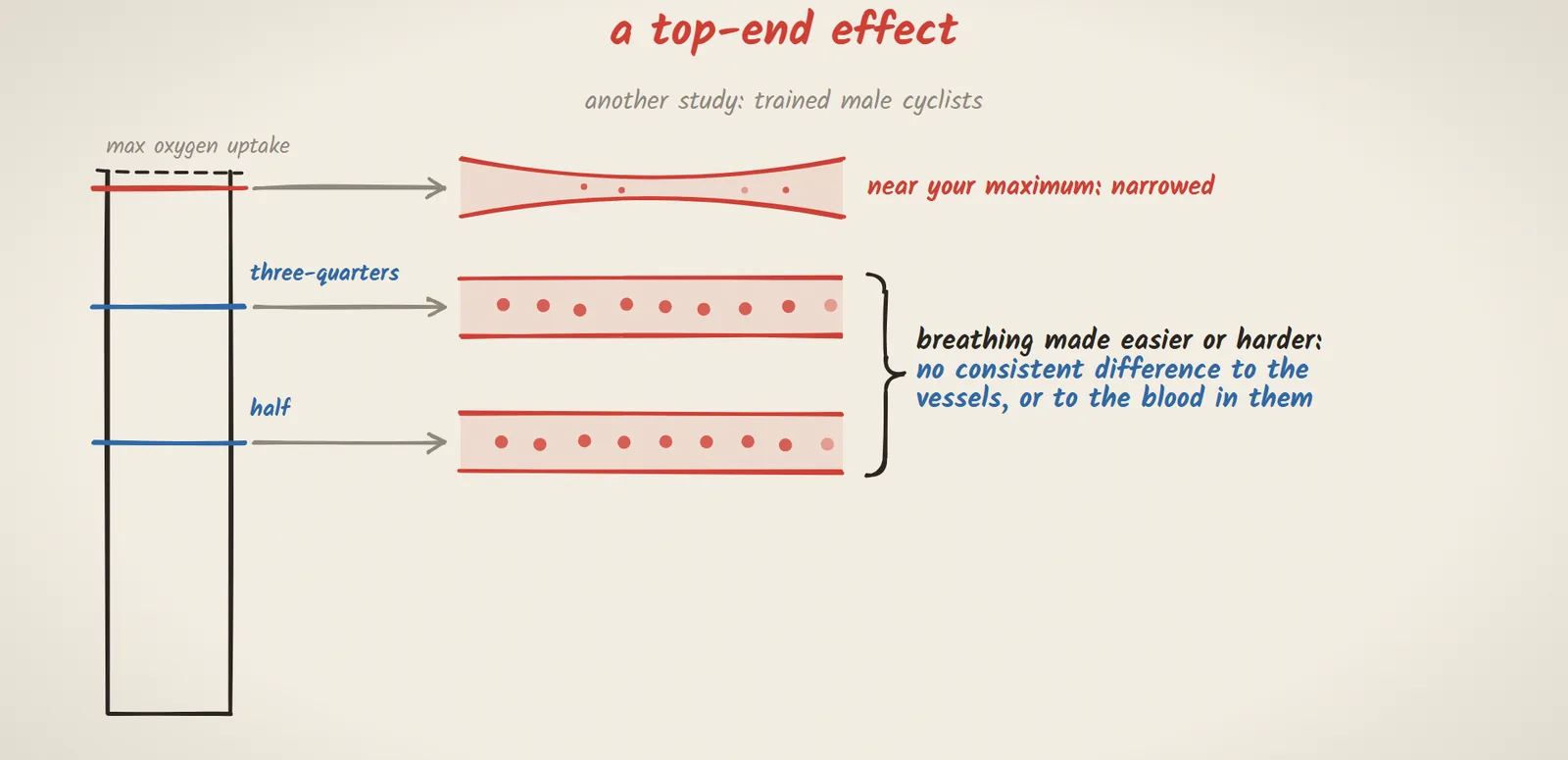
It’s a top-end effect. In another study, trained male cyclists rode at half and at three-quarters of their maximum oxygen uptake, and there, making breathing easier or harder made no consistent difference to the vessels in their legs or to the blood flowing through them.
The experiment
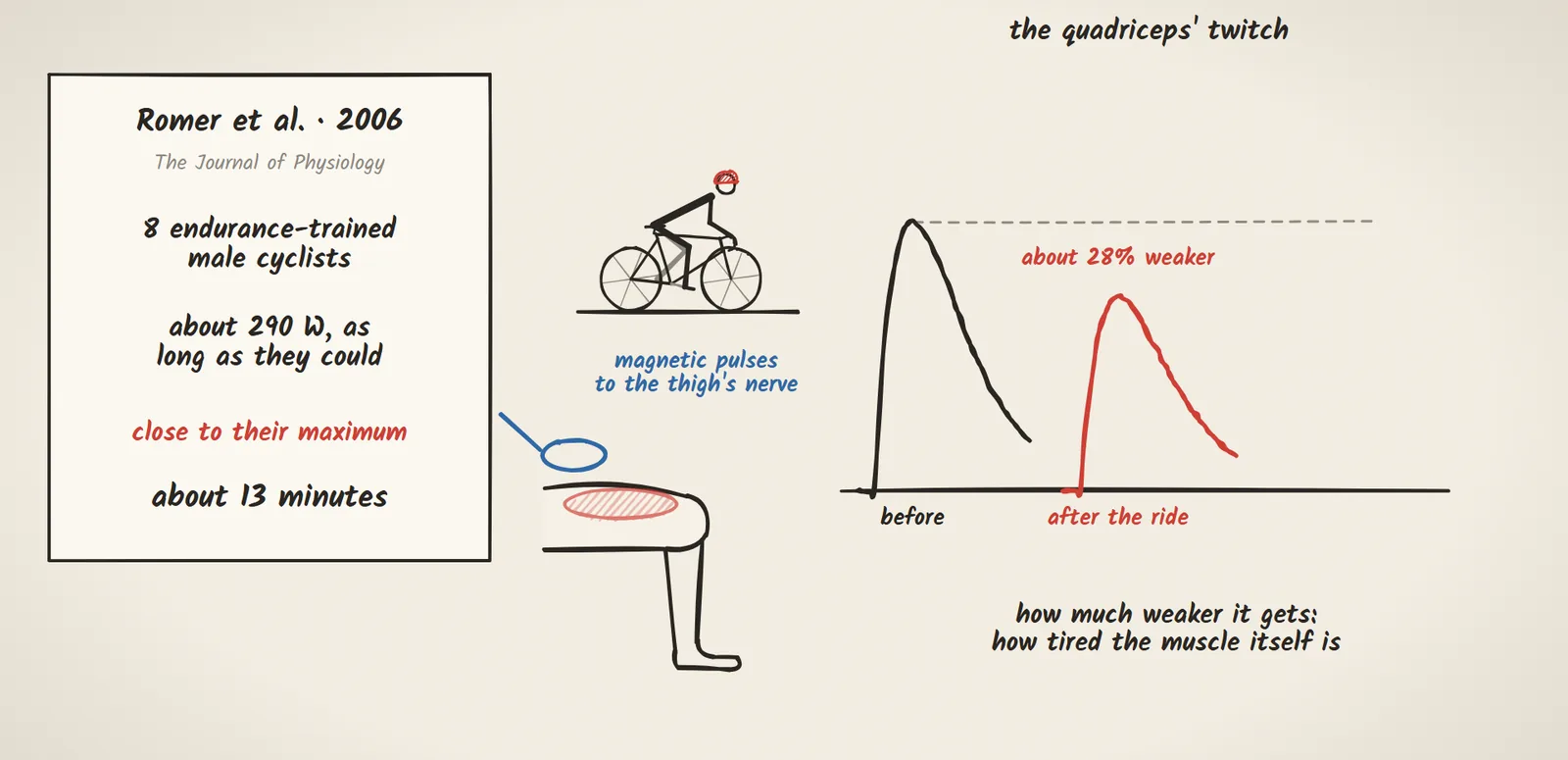
So does breathing actually tire your legs? Eight endurance-trained male cyclists rode as long as they could at about 290 W, close to their maximum, which came to about 13 minutes. Before and after, magnetic pulses to the nerve of the thigh made the quadriceps twitch, and how much weaker those twitches get shows how tired the muscle itself is. After the ride, they were about 28% weaker.
The same ride, with a ventilator
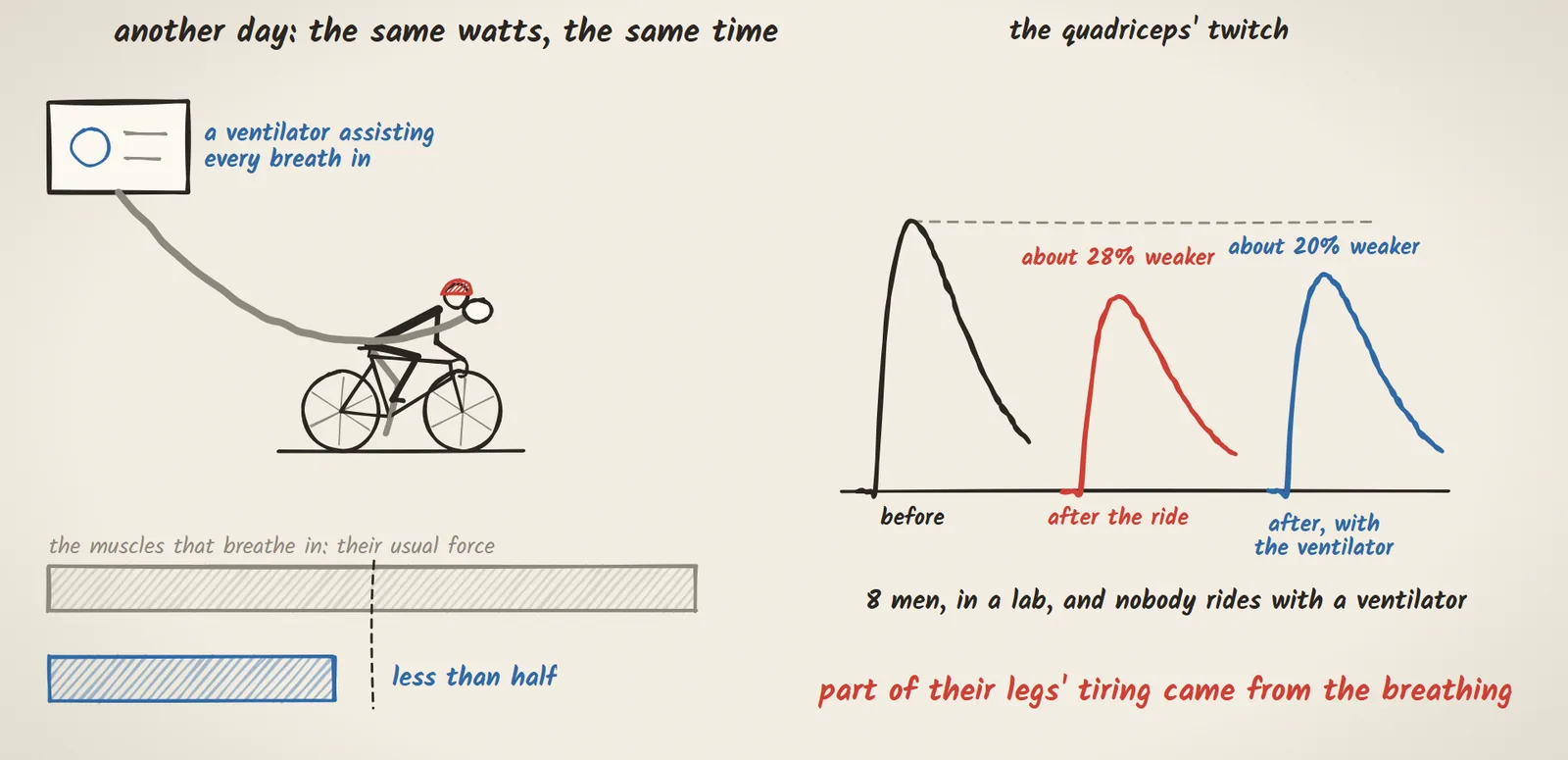
On another day, they rode the same watts for the same time, while a ventilator assisted every breath in, so the muscles that breathe in had to produce less than half their usual force. This time their quadriceps came out only about 20% weaker, and both their breathing and their legs felt easier. Making breathing harder did the opposite: the legs tired more. Eight men, in a lab, and nobody rides with a ventilator. But their legs were tiring, and part of that came from the breathing.
What it means for you
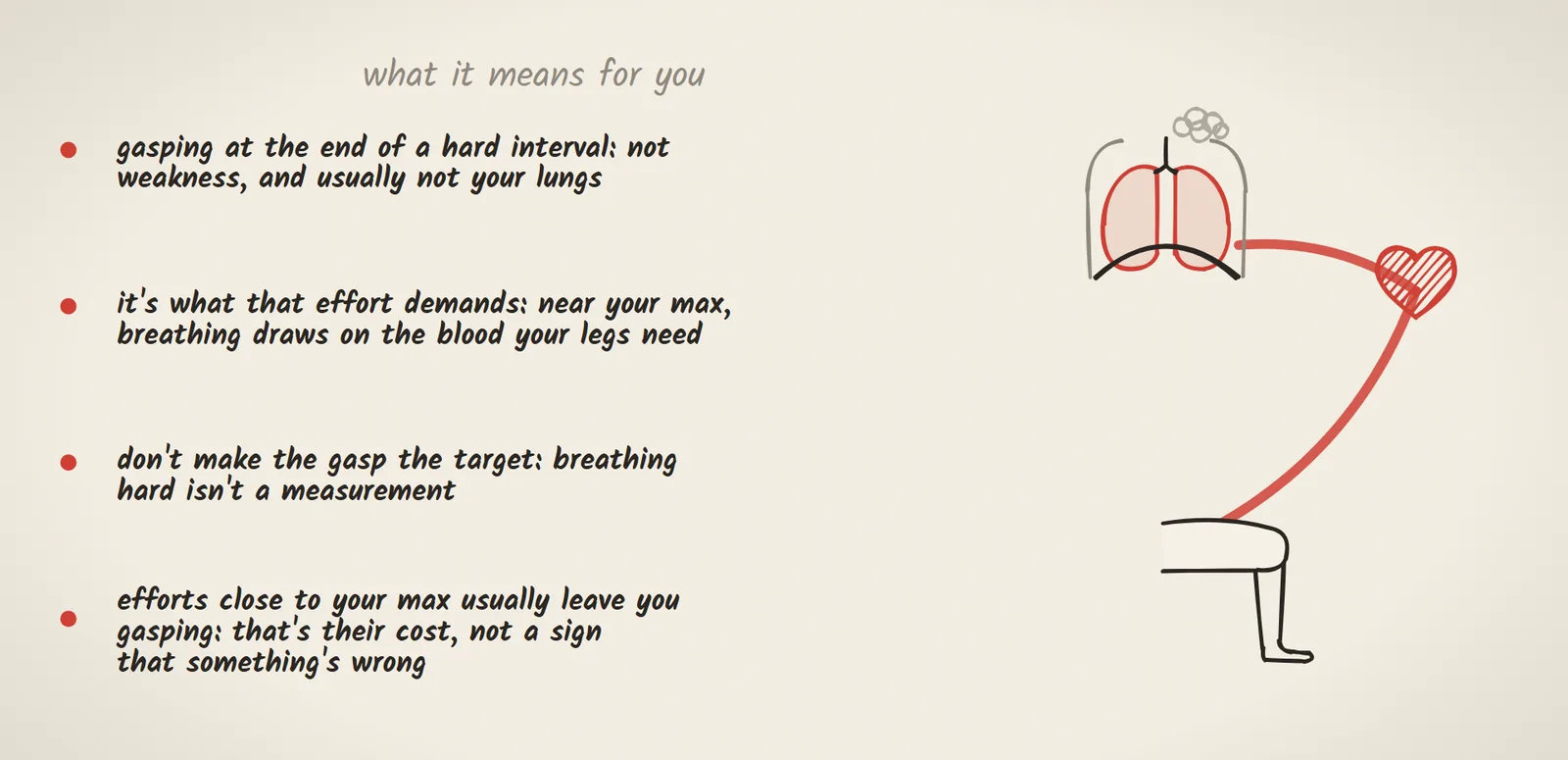
So what does this mean for you? When a hard interval ends in gasping, that isn’t weakness, and it usually isn’t your lungs letting you down. It’s what an effort that hard demands, and near your maximum, the breathing it takes draws on the same blood your legs need. But don’t make the gasp the target. Breathing hard isn’t a measurement: you can gasp at an effort that isn’t doing the job, and do the job without gasping. The efforts that take you close to your maximum will usually leave you gasping, and that’s what they cost, not a sign that something’s wrong.
That’s what’s underneath the watts.
Sources
The study
- Romer LM, Lovering AT, Haverkamp HC, Pegelow DF, Dempsey JA. Effect of inspiratory muscle work on peripheral fatigue of locomotor muscles in healthy humans. J Physiol. 2006;571(Pt 2):425-439. doi.org/10.1113/jphysiol.2005.099697
Also in this article
- Breathing made harder at maximal exercise: the legs’ share of the oxygen fell from 81% to 71% (7 male cyclists): Harms CA, Babcock MA, McClaran SR, Pegelow DF, Nickele GA, Nelson WB, Dempsey JA. Respiratory muscle work compromises leg blood flow during maximal exercise. J Appl Physiol. 1997;82(5):1573-1583. doi.org/10.1152/jappl.1997.82.5.1573
- No consistent effect on the legs’ blood flow at 50% and 75% of VO2max (10 trained male cyclists): Wetter TJ, Harms CA, Nelson WB, Pegelow DF, Dempsey JA. Influence of respiratory muscle work on VO2 and leg blood flow during submaximal exercise. J Appl Physiol. 1999;87(2):643-651. doi.org/10.1152/jappl.1999.87.2.643
- The oxygen cost of breathing, about a tenth of the total at maximal exercise: Aaron EA, Seow KC, Johnson BD, Dempsey JA. Oxygen cost of exercise hyperpnea: implications for performance. J Appl Physiol. 1992;72(5):1818-1825. doi.org/10.1152/jappl.1992.72.5.1818
- The breathing muscles’ share of the heart’s output at maximal exercise (8 male cyclists): Harms CA, Wetter TJ, McClaran SR, Pegelow DF, Nickele GA, Nelson WB, Hanson P, Dempsey JA. Effects of respiratory muscle work on cardiac output and its distribution during maximal exercise. J Appl Physiol. 1998;85(2):609-618. doi.org/10.1152/jappl.1998.85.2.609
- Easing breathing let cyclists last longer at 90% of VO2max, and making it harder cut their time (7 male cyclists): Harms CA, Wetter TJ, St Croix CM, Pegelow DF, Dempsey JA. Effects of respiratory muscle work on exercise performance. J Appl Physiol. 2000;89(1):131-138. doi.org/10.1152/jappl.2000.89.1.131
Written and researched by Yarin Podoler, a cyclist who wanted to know what’s underneath the watts.