Why do I bonk?
It feels like a switch, but it’s been building for hours. The carbohydrate in your legs runs down from the first hour, the sugar in your blood quietly covers for it, and when that runs short too, the watts you’ve been holding cost more than you can pay.
The video version, 4:31, narrated by a synthetic voice. Watch on YouTube · Watch the Short
Three hours in
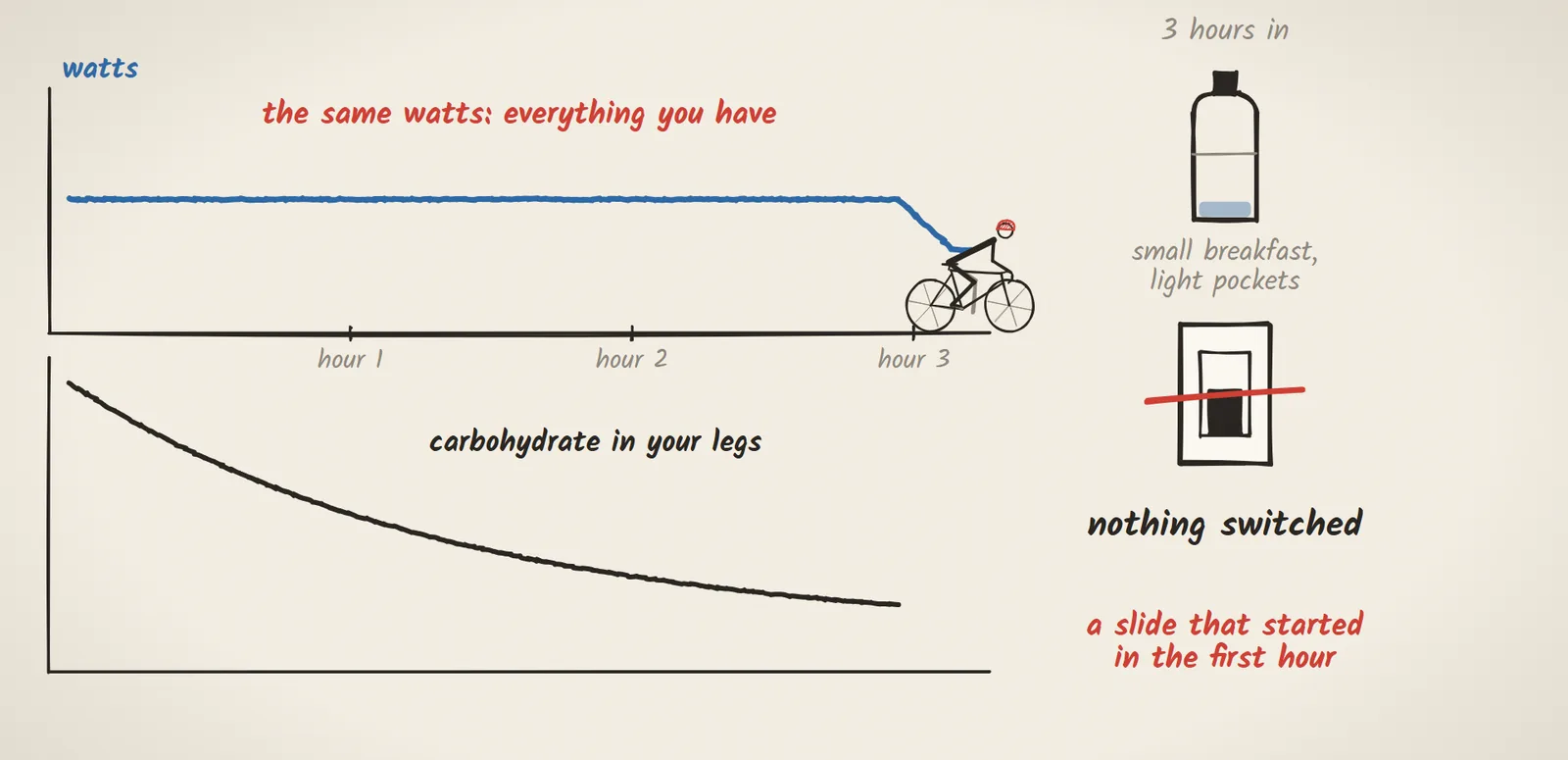
Picture a long ride, 3 hours in, on a morning when breakfast was small and the pockets were lighter than they should have been. All day, the power has sat where you wanted it. Then, over what seems like a few minutes, the same watts need everything you have, and soon you can’t hold them at all. You feel empty, as if something just switched off. But nothing switched: what you’re feeling is the end of a slide that started in the first hour.
Two sources
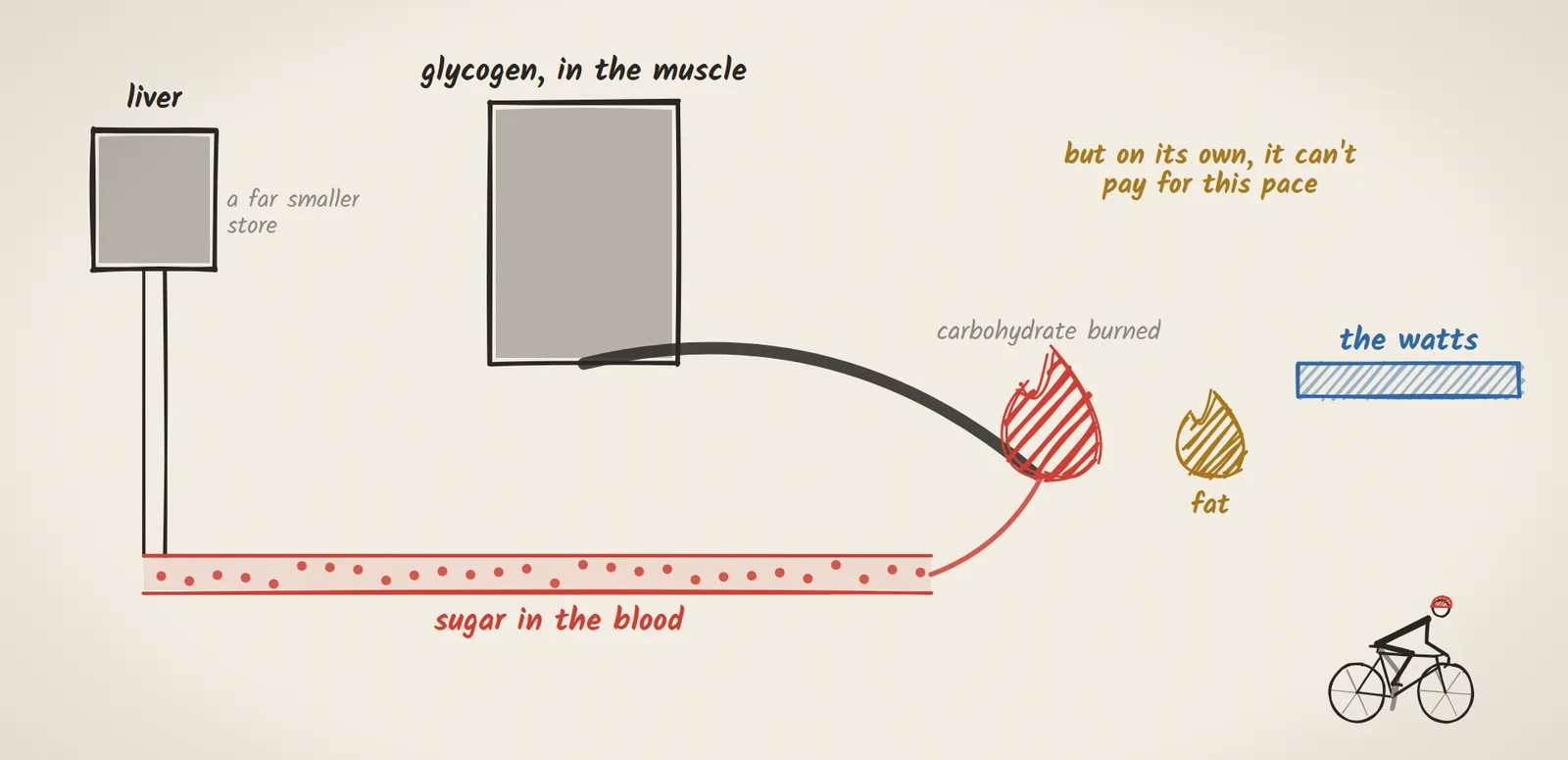
At a solid, steady pace, your muscles burn a lot of carbohydrate, and they draw it from two places: glycogen, the carbohydrate stored inside the muscle itself, and the sugar in your blood, which your liver keeps topped up, much of it from a far smaller store of its own. Fat burns the whole time too, and on a ride short of food, it’s paying more of the bill late on than it was at the start, not less. But on its own, fat can’t pay for a pace like that.
The handover
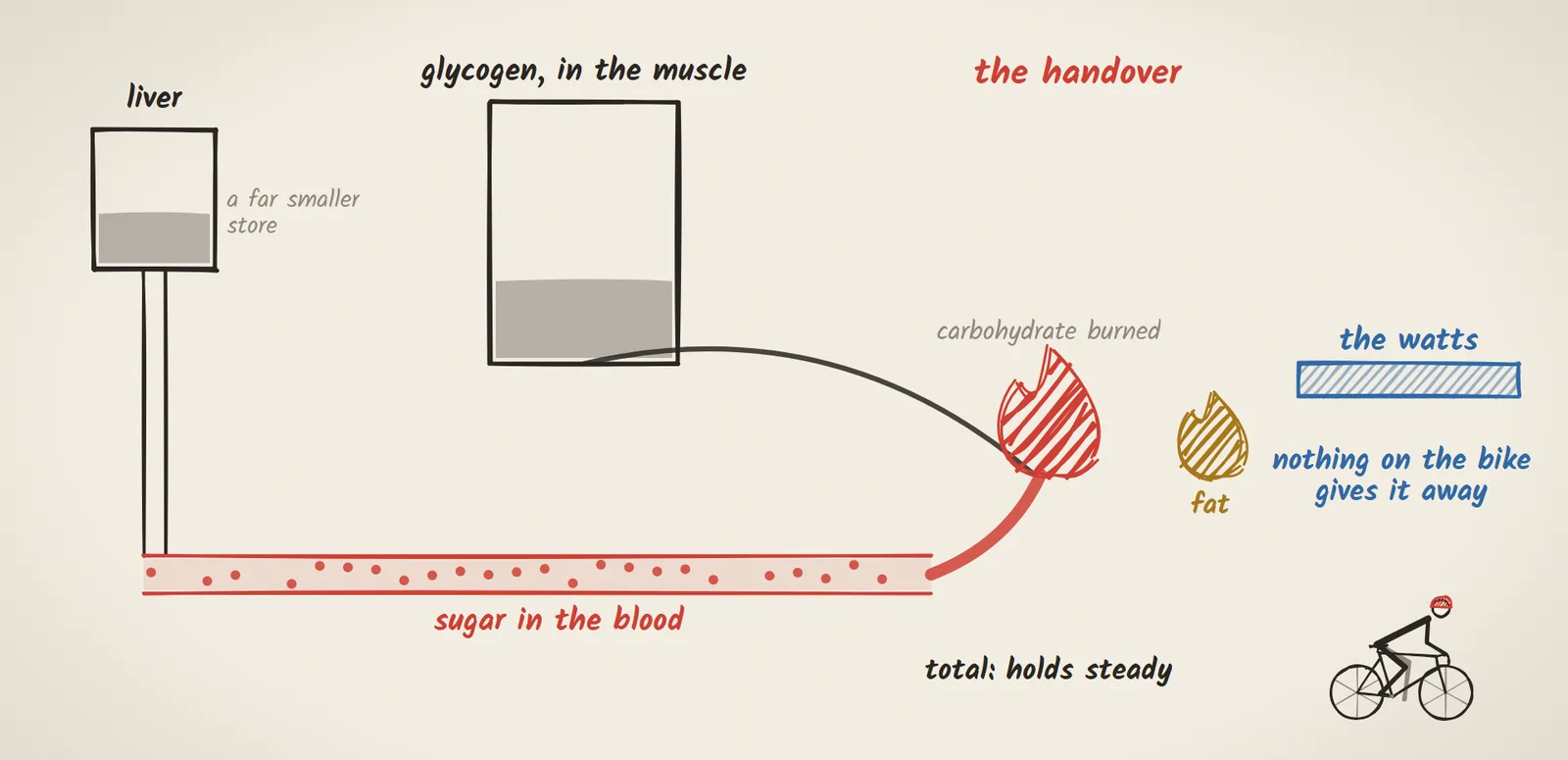
The glycogen in the muscle runs down fastest, early in the ride. As it does, the muscle leans more and more on sugar from the blood to make up the difference, so for a while the total carbohydrate you’re burning holds steady, and nothing on the bike gives it away. That handover is why nothing seems wrong for hours.
Both short at once
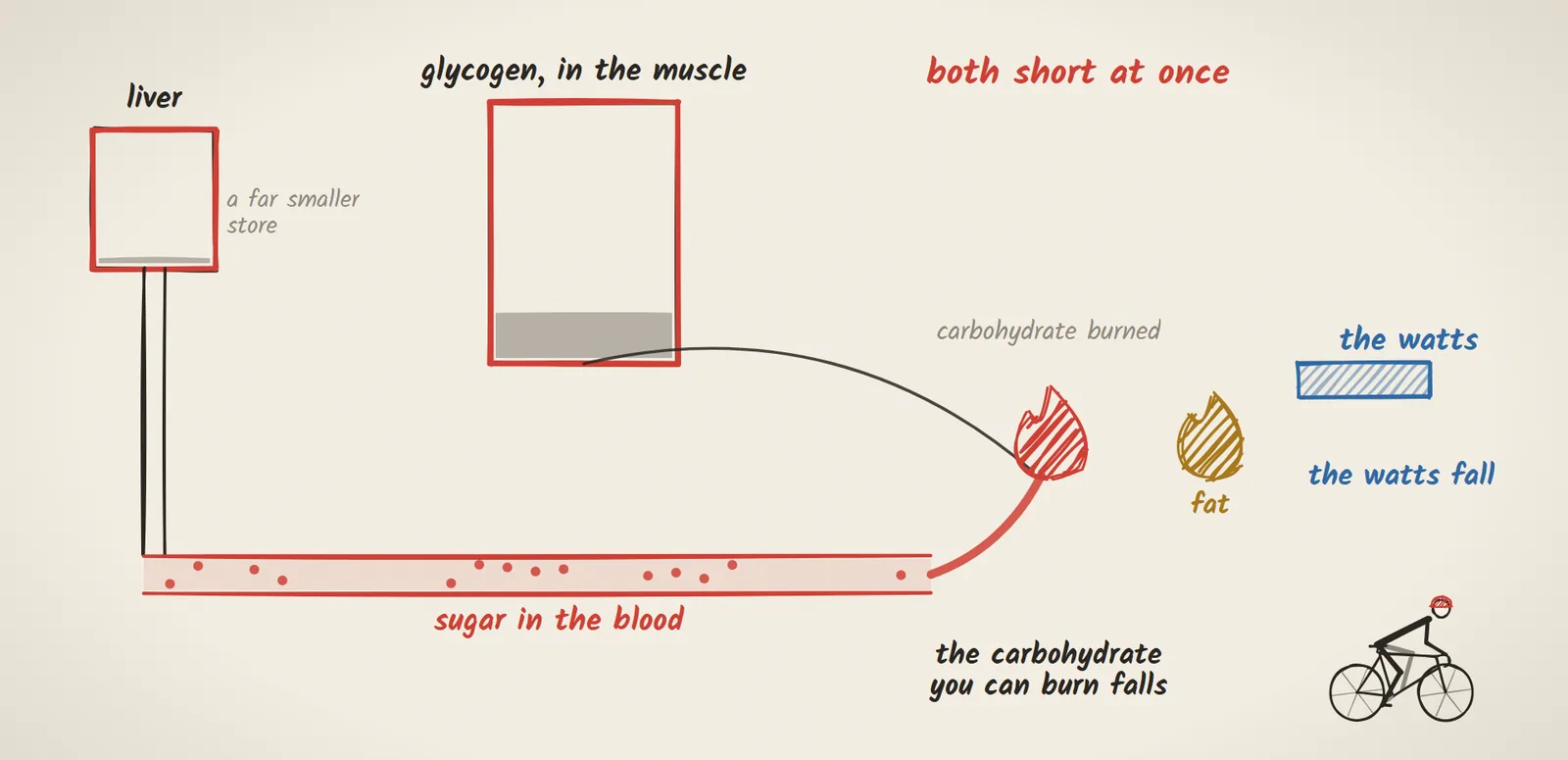
But the liver’s store is small, and on a long ride without enough food, your blood sugar starts to slip. Once it’s low, the blood can no longer make up what the muscle’s own glycogen doesn’t cover. Now both sources are short at the same time, the carbohydrate you can burn falls, and the watts fall with it.
The tipping point, measured
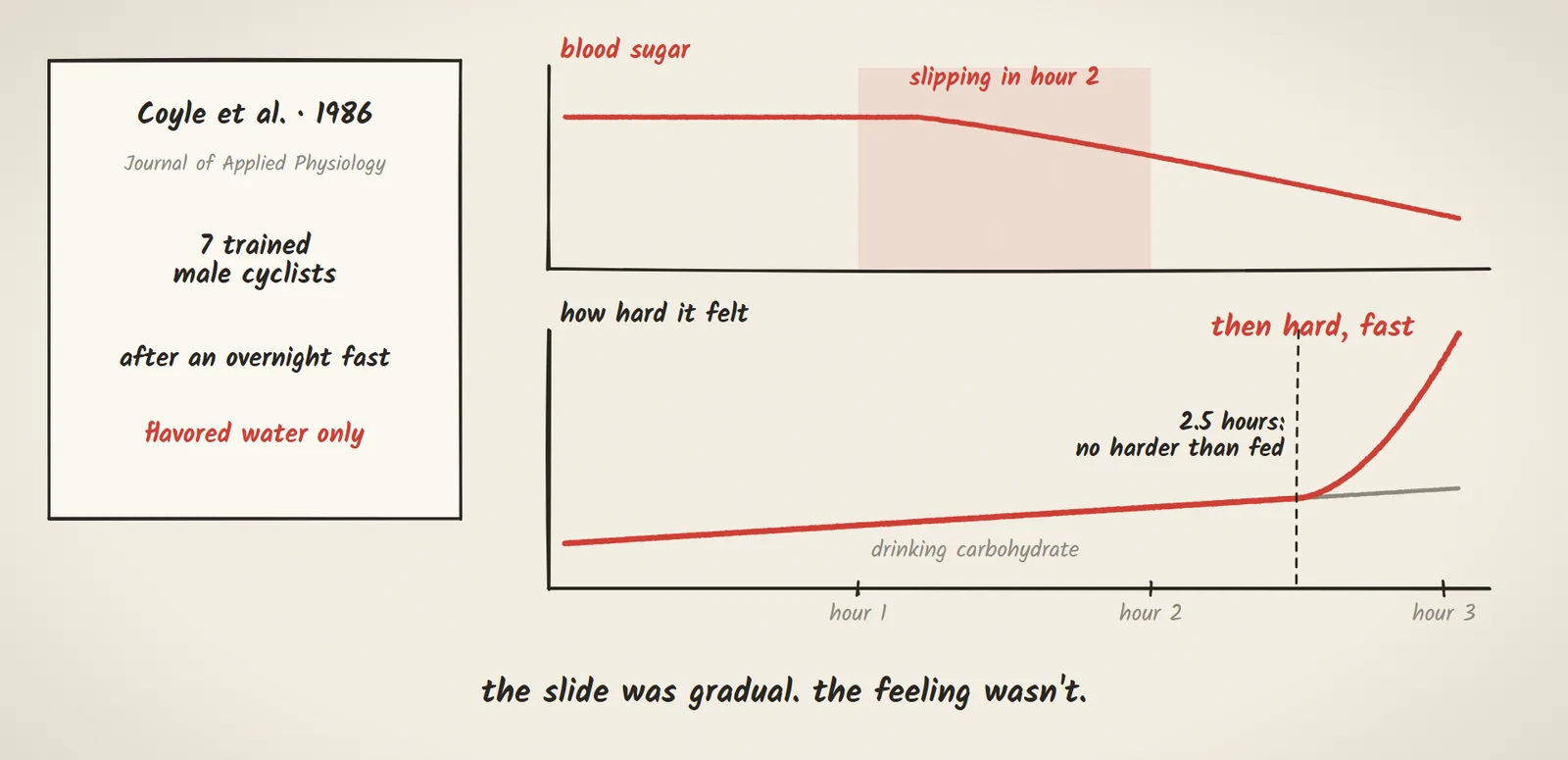
You can see that tipping point in the lab. In one study, 7 trained male cyclists rode at a solid, steady pace after an overnight fast, drinking only flavored water. Their blood sugar began slipping in the second hour. Yet for two and a half hours, the ride felt no harder than when the same riders drank carbohydrate; only then did it get hard, fast. None of them felt light-headed or sick; they simply couldn’t hold the work rate anymore. The slide was gradual, but the feeling wasn’t.
The rescue experiment
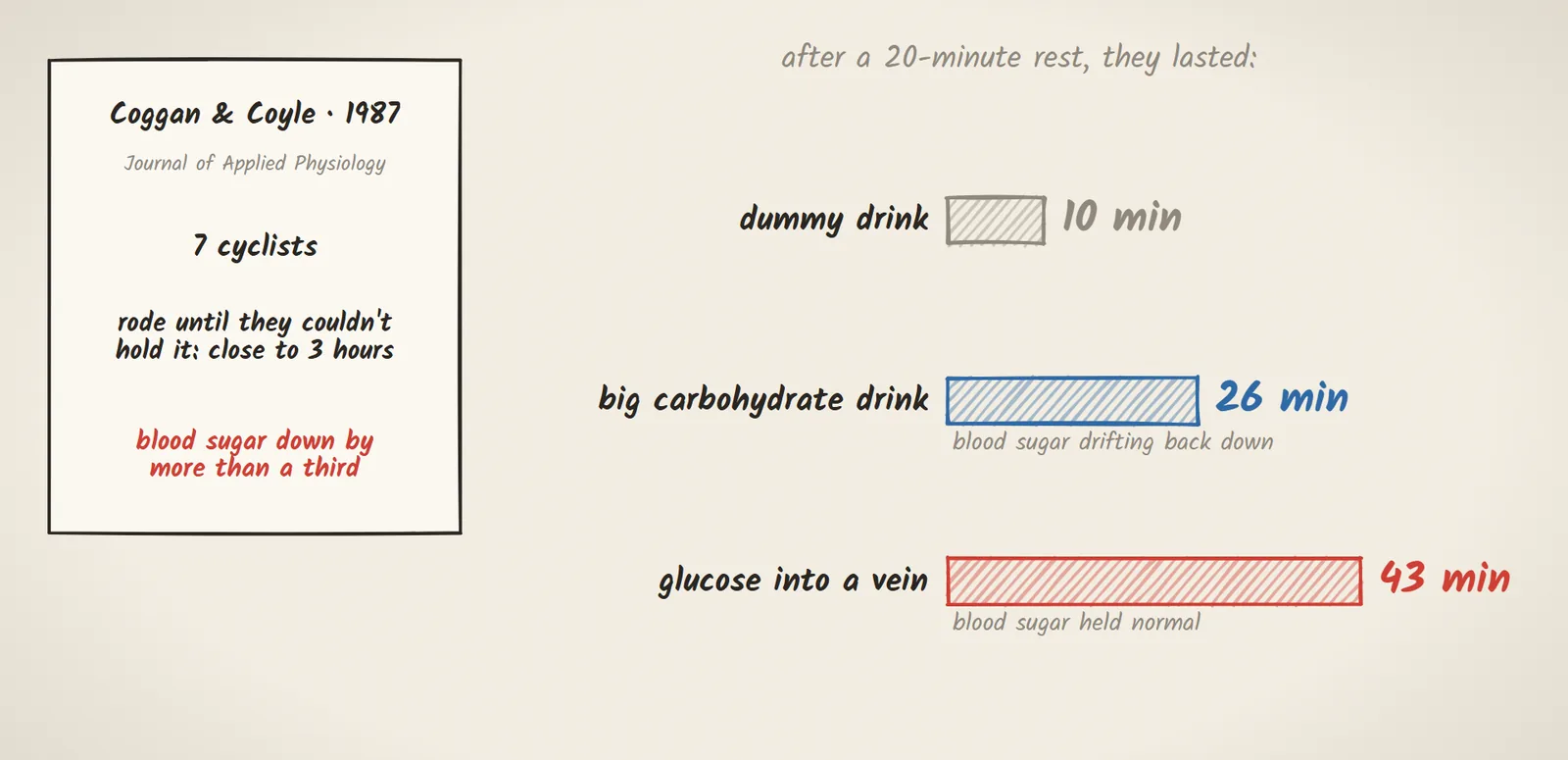
How do we know it’s the blood sugar that gives out? A year later, the same researchers had 7 cyclists ride at that kind of pace until they couldn’t hold it, which took close to 3 hours. By then their blood sugar was down by more than a third. They rested for 20 minutes and then tried to carry on. On a dummy drink, they lasted about 10 minutes. On a big carbohydrate drink, about 26, with their blood sugar drifting back down. With glucose dripped straight into a vein, holding their blood sugar normal, they lasted 43.
What the drip shows
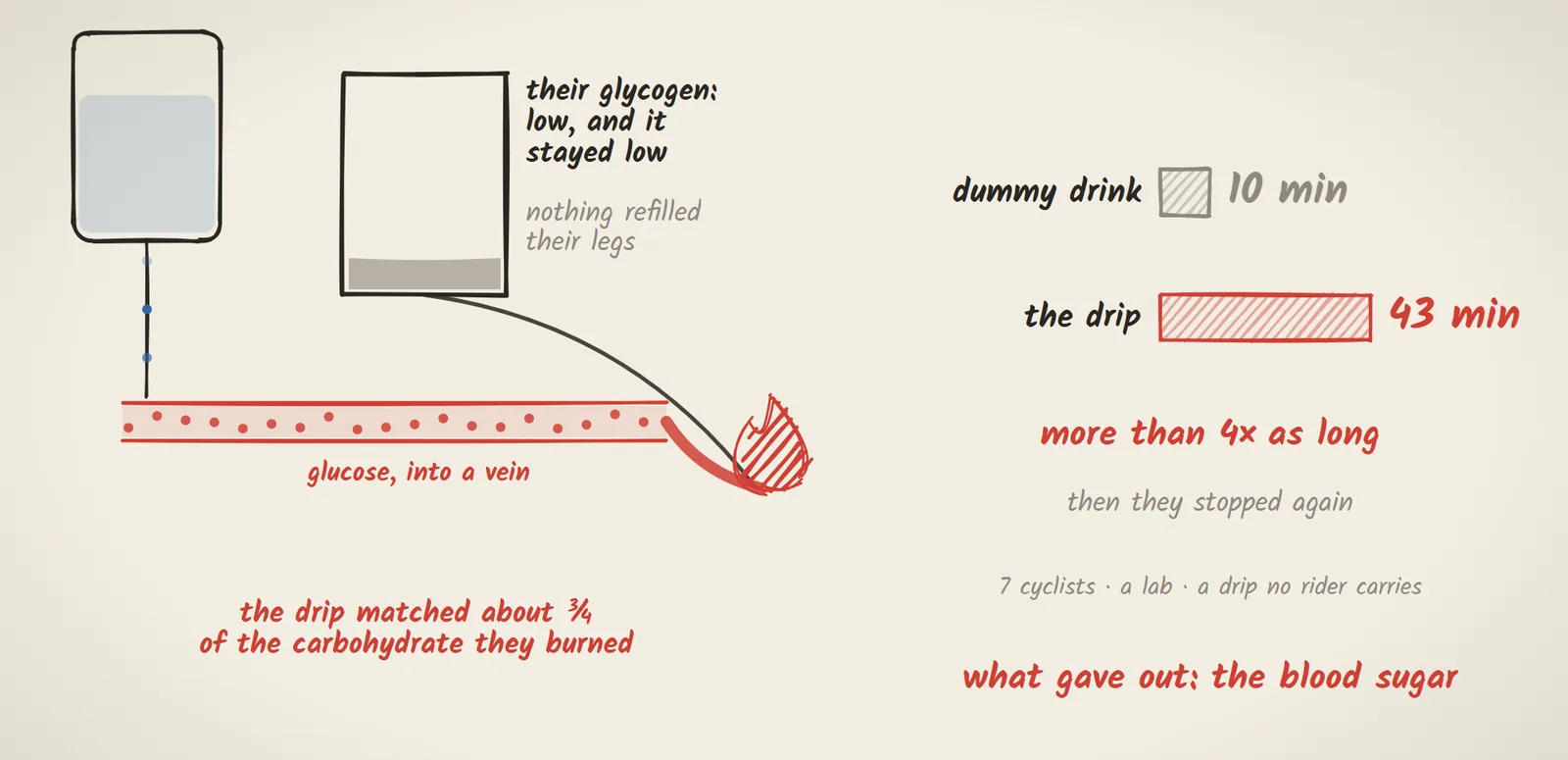
The telling part is what happened in their legs. During the drip, their glycogen was low, and it stayed low, while the glucose going in through the drip matched about three-quarters of the carbohydrate they burned. Nothing refilled their legs, yet restoring the blood sugar on its own kept them going more than 4 times as long as the dummy drink, and then they stopped again. Seven cyclists, in a lab, with a drip no rider carries on the road, but it shows which side of the handover had given out.
What it means for you
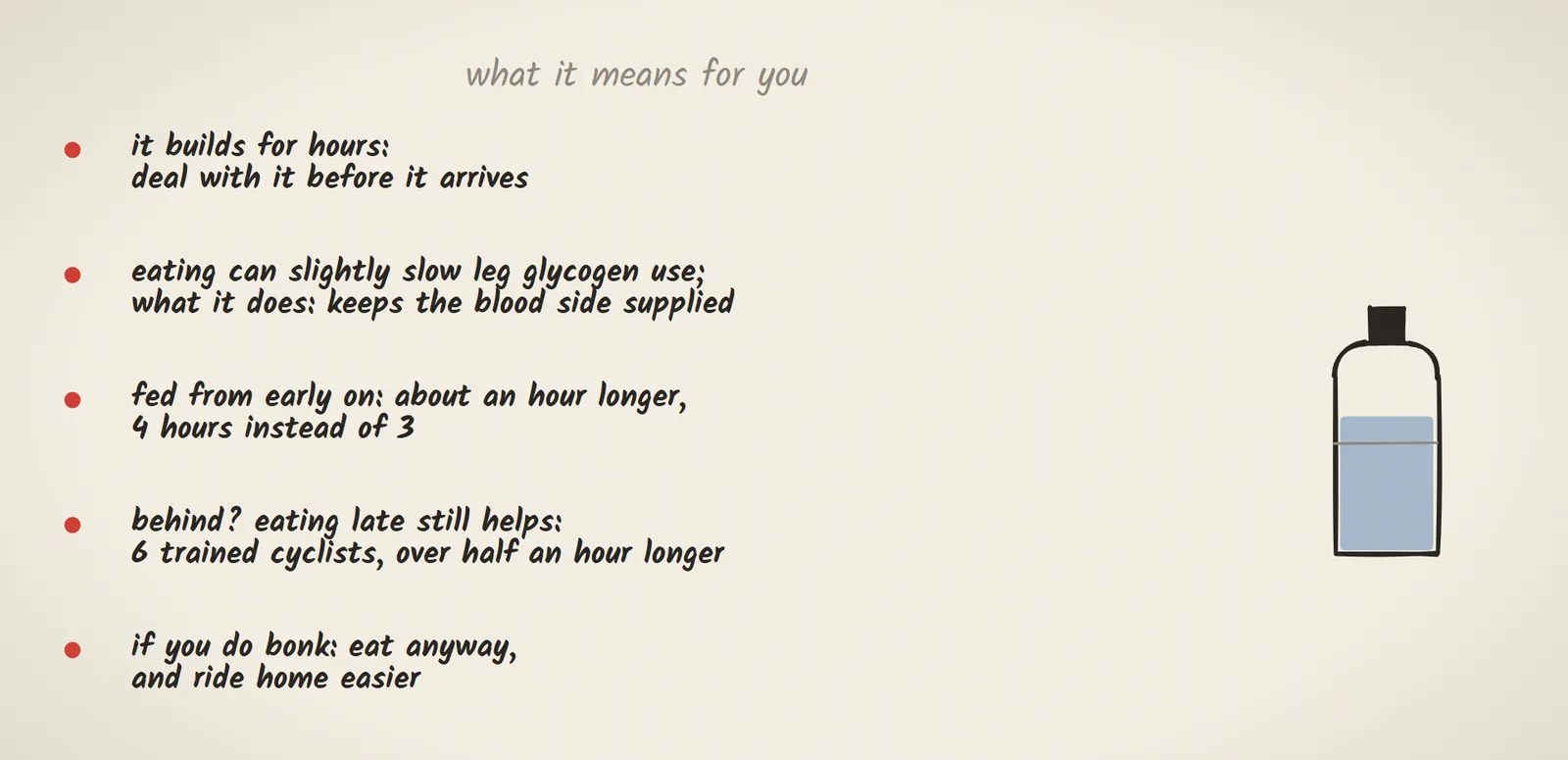
So what does this mean for you? The bonk builds for hours before you feel it, so the time to deal with it is before it arrives. Eating on the bike can slightly slow your legs’ use of their own glycogen, but in that first study, the researchers found no difference. What it does is keep the blood side of the handover supplied: when those riders drank carbohydrate from early in the ride, they lasted about an hour longer, 4 hours instead of 3, before fatigue came anyway. And if you’ve fallen behind, eating late still helps: in another study from the same researchers, 6 trained cyclists given one big carbohydrate drink two and a quarter hours in, with their blood sugar already slipping, lasted more than half an hour longer. If you do bonk, eat anyway, and ride home easier than you planned.
That’s what’s underneath the watts.
Sources
The study
- Coggan AR, Coyle EF. Reversal of fatigue during prolonged exercise by carbohydrate infusion or ingestion. J Appl Physiol. 1987;63(6):2388-2395. doi.org/10.1152/jappl.1987.63.6.2388
Also in this article
- The time course, and an hour more when fed from the start: Coyle EF, Coggan AR, Hemmert MK, Ivy JL. Muscle glycogen utilization during prolonged strenuous exercise when fed carbohydrate. J Appl Physiol. 1986;61(1):165-172. doi.org/10.1152/jappl.1986.61.1.165
- Eating late still helps: Coggan AR, Coyle EF. Metabolism and performance following carbohydrate ingestion late in exercise. Med Sci Sports Exerc. 1989;21(1):59-65. doi.org/10.1249/00005768-198902000-00011
- Does eating spare your legs’ glycogen? Slightly, on average: Rothschild JA, Dudley-Rode H, Carpenter H, Smith ASM, Plews DJ, Maunder E. Carbohydrate ingestion during prolonged exercise and net skeletal muscle glycogen utilization: a meta-analysis. J Appl Physiol. 2026;140(1):76-87. doi.org/10.1152/japplphysiol.00861.2025
Written and researched by Yarin Podoler, a cyclist who wanted to know what’s underneath the watts.