Why do I fall apart in the last hour of a long ride?
Because the power you can sustain isn’t fixed. After a couple of hours of hard riding it can drop, and the same watts start costing more. How well you resist that has a name: durability.
The video version, 4:22, narrated by a synthetic voice. Watch on YouTube · Watch the Short
The long ride with a climb at the end
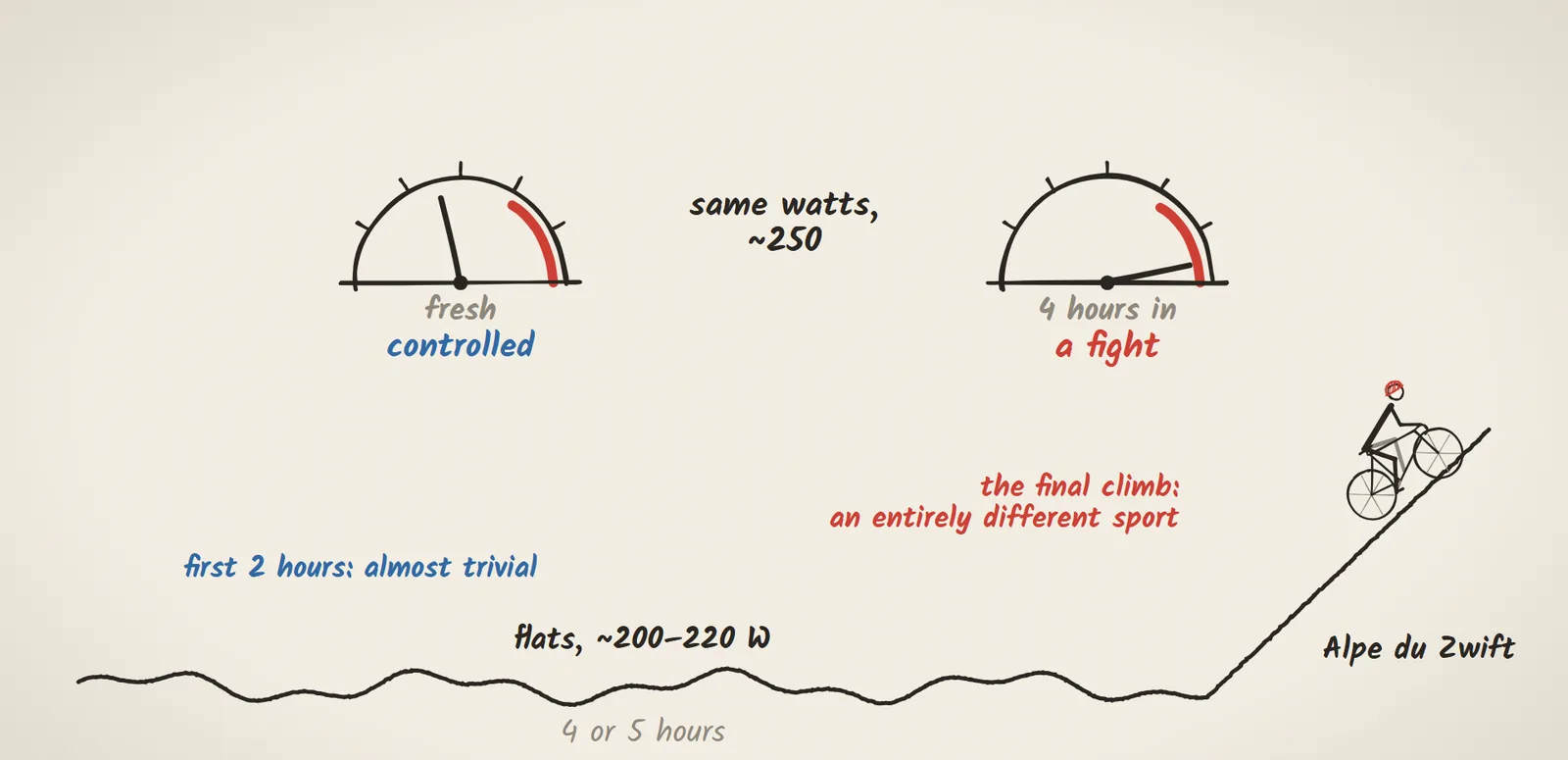
I’ve done plenty of long rides that end with a climb: 4 or 5 hours, flats somewhere around 200 to 220 W, and then something like Alpe du Zwift saved for the end. The first 2 hours can feel almost trivial, and the final climb feels like an entirely different sport. The watts on that climb aren’t extreme, often somewhere around 250. Fresh, that’s a controlled effort for me. Four hours in, the same watts are a fight. If you ride long, you’ve almost certainly felt something like it.
Who’s doing the work
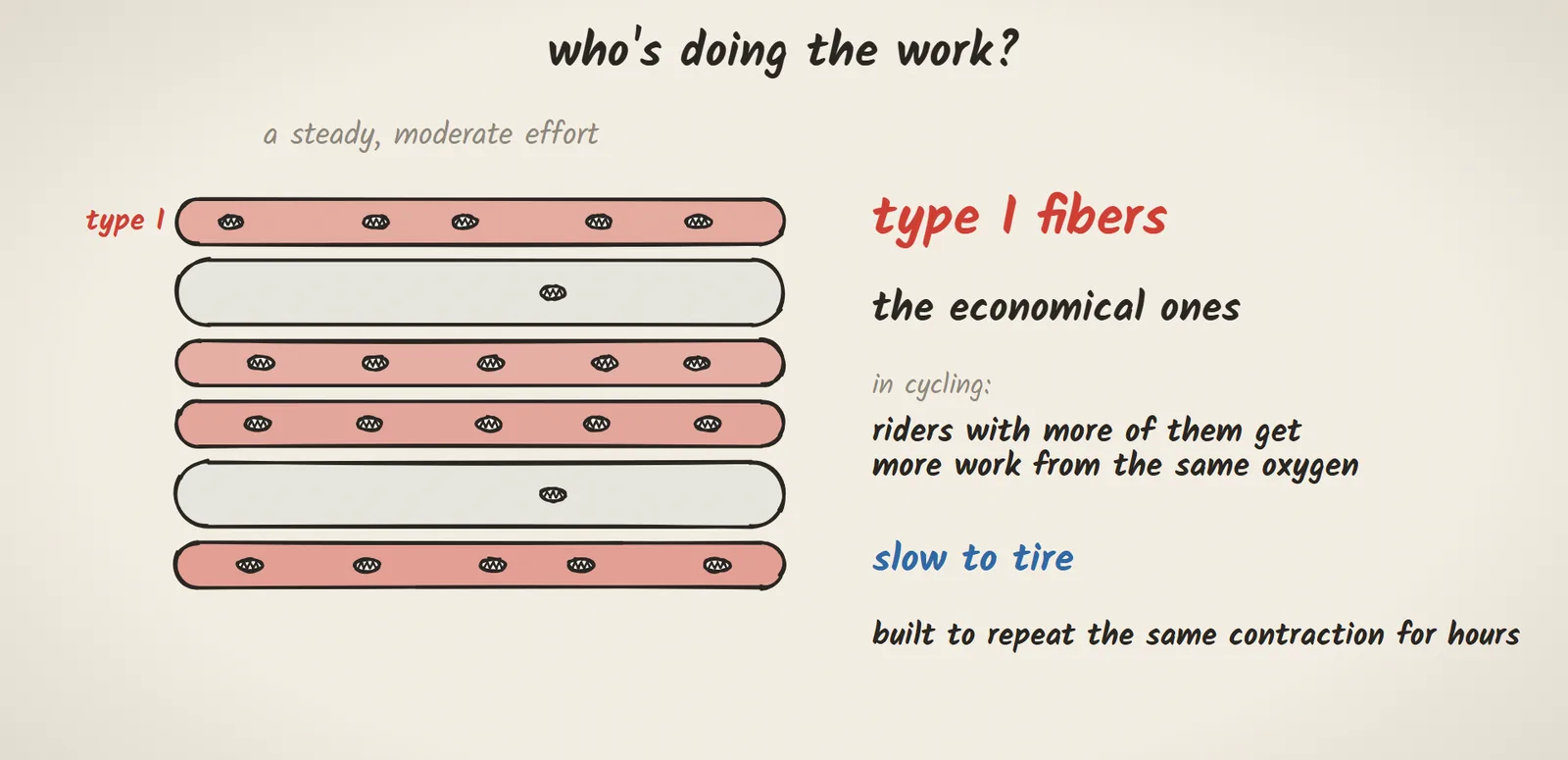
Start with who’s doing the work. Early in a ride, at a steady, moderate effort, your power comes mostly from type I muscle fibers. They’re the economical ones: in cycling, riders with more of them get more work from the same oxygen. They’re also slow to tire, built to repeat the same contraction for hours.
Fatigue builds anyway
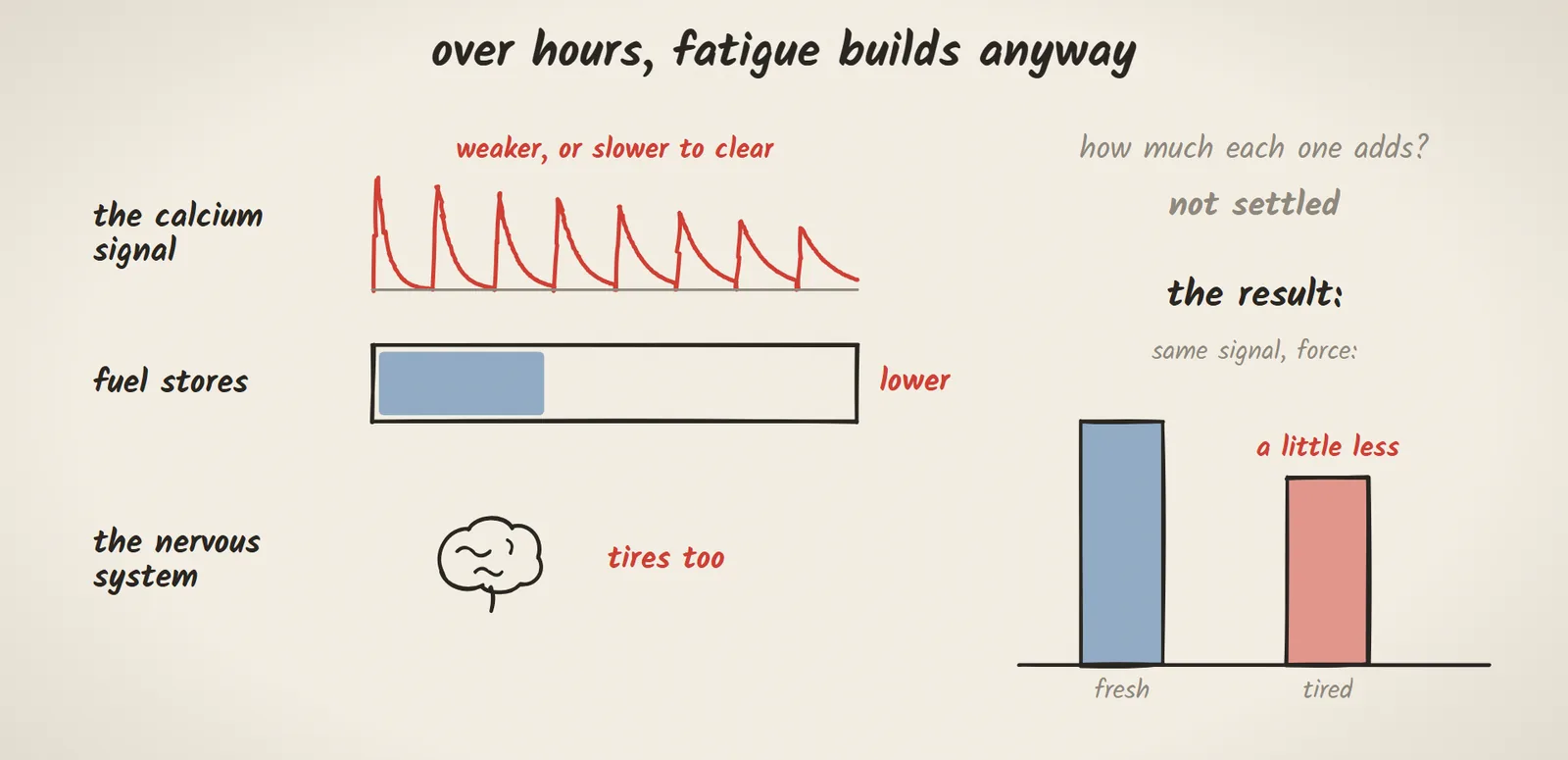
Over hours, fatigue builds anyway. Inside the fibers, the calcium signal that switches each contraction on gets weaker or slower to clear, and fuel stores run lower. Some of the fatigue builds in the nervous system itself. Exactly how much each of those contributes over one afternoon isn’t settled. What’s clearer is the result: tired fibers give a little less force for the same signal.
A more expensive engine
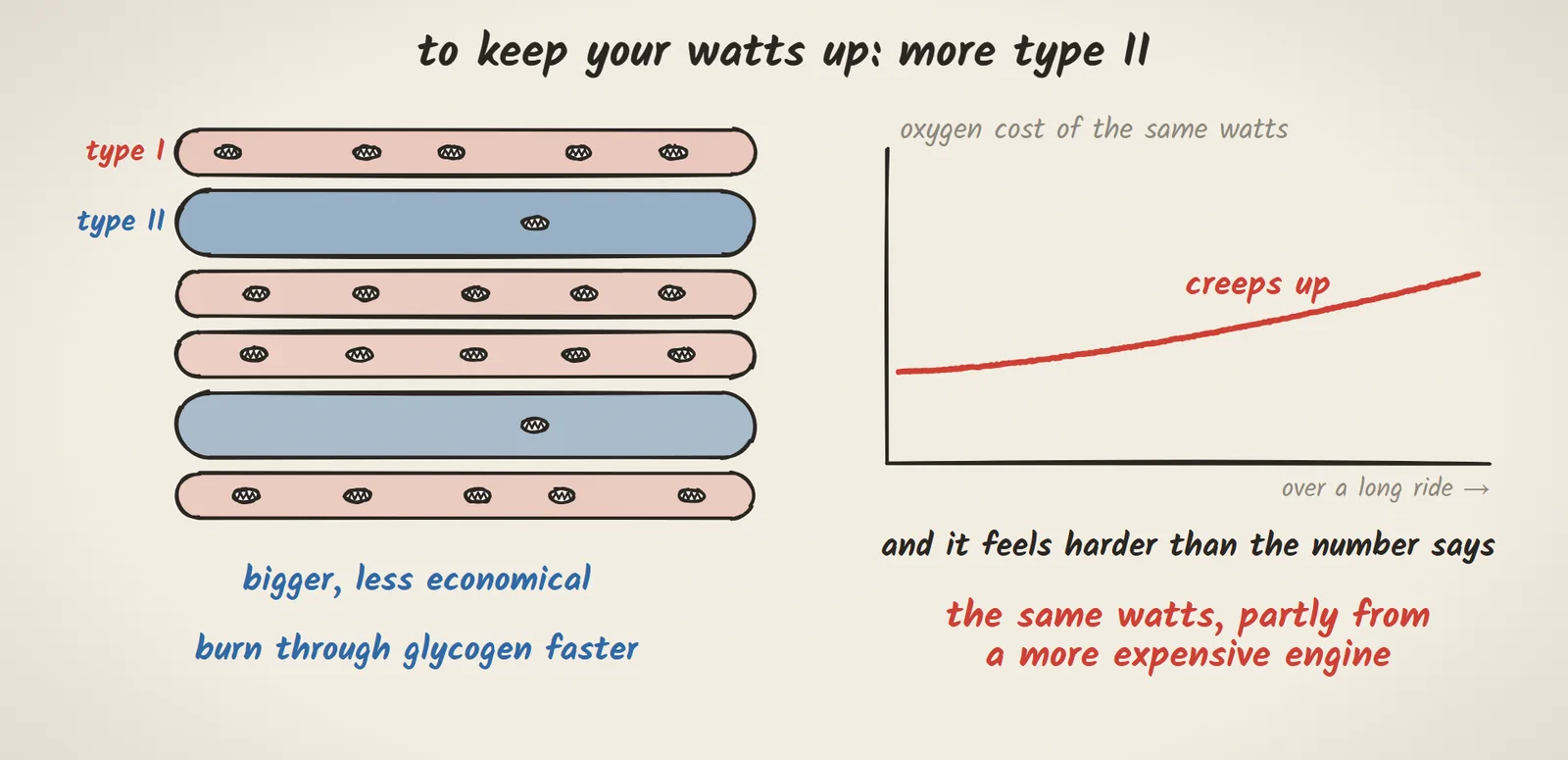
To keep your watts up, your nervous system increasingly draws on the bigger type II fibers. They can make the power, but they’re less economical and burn through glycogen faster. Over a long ride, the oxygen cost of the same watts tends to creep up, and the effort feels harder than the number says. The same watts are now coming partly from a more expensive engine.
The line itself can move
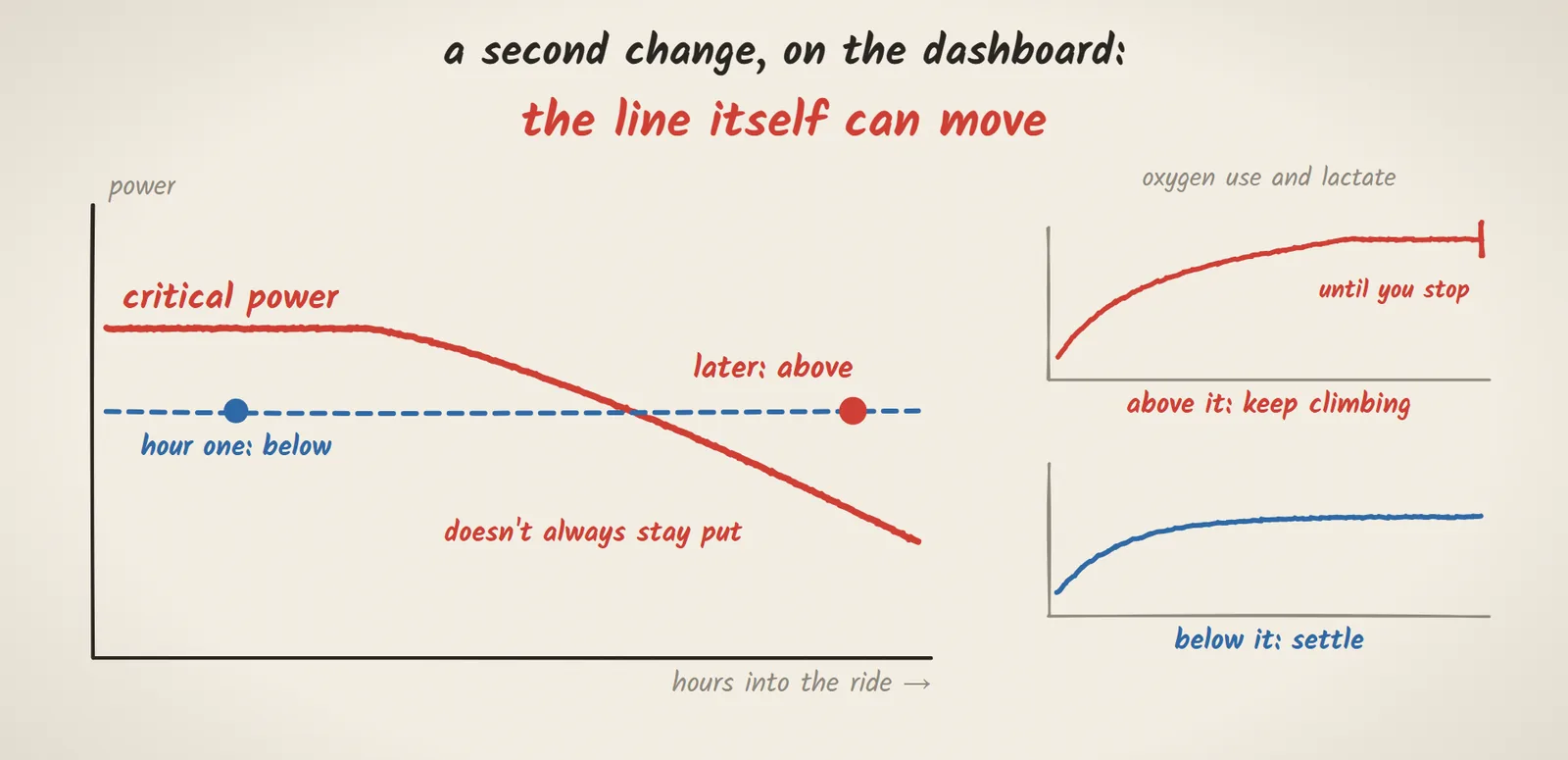
There’s a second change, and it shows up on the dashboard: the line itself can move. One well-tested way to locate that line is critical power: the boundary between efforts where your oxygen use and lactate settle and efforts where they keep climbing until you stop. It doesn’t always stay put for a whole ride. Something that sat below it at hour one can sit above it later.
The experiment
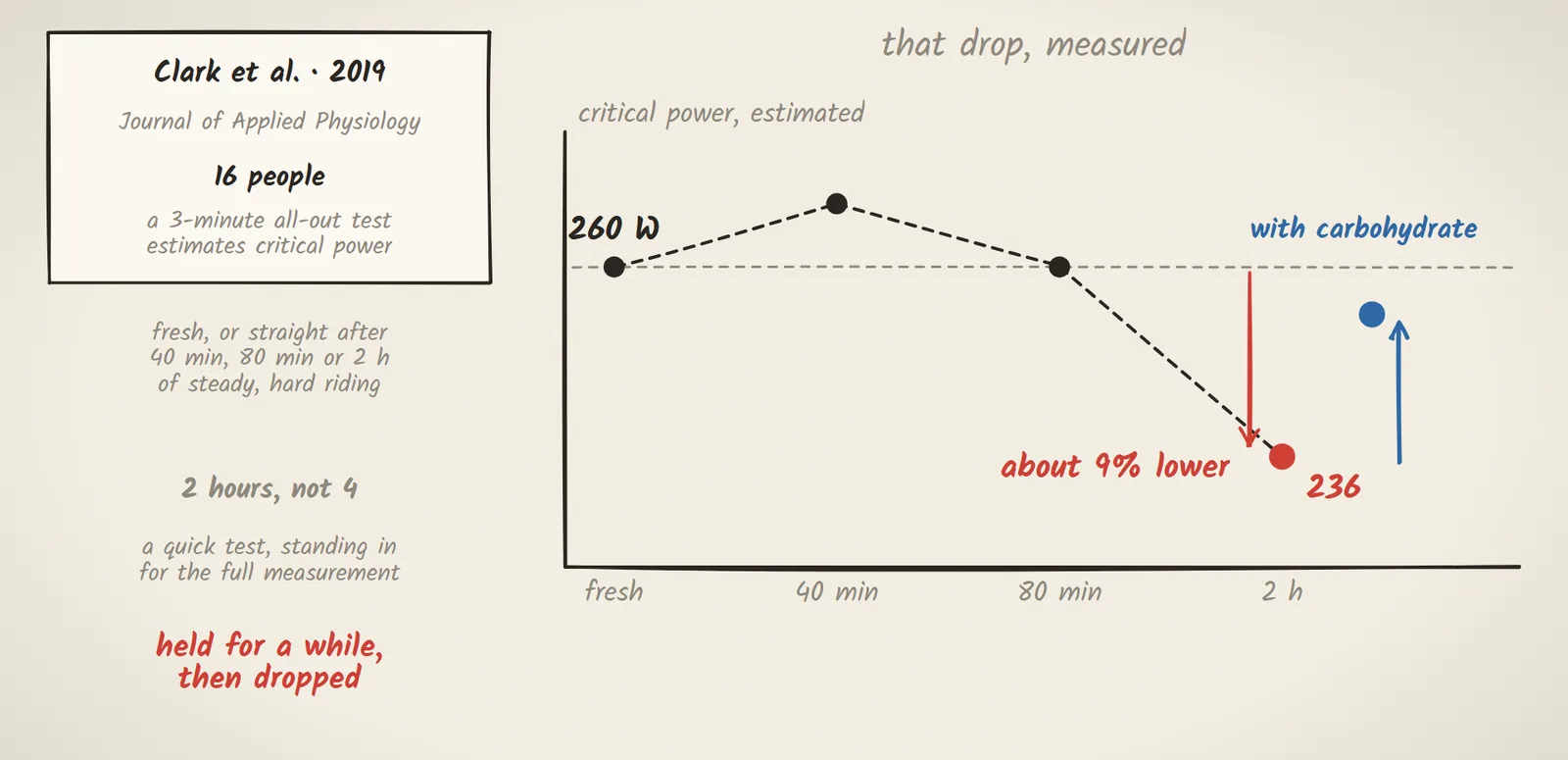
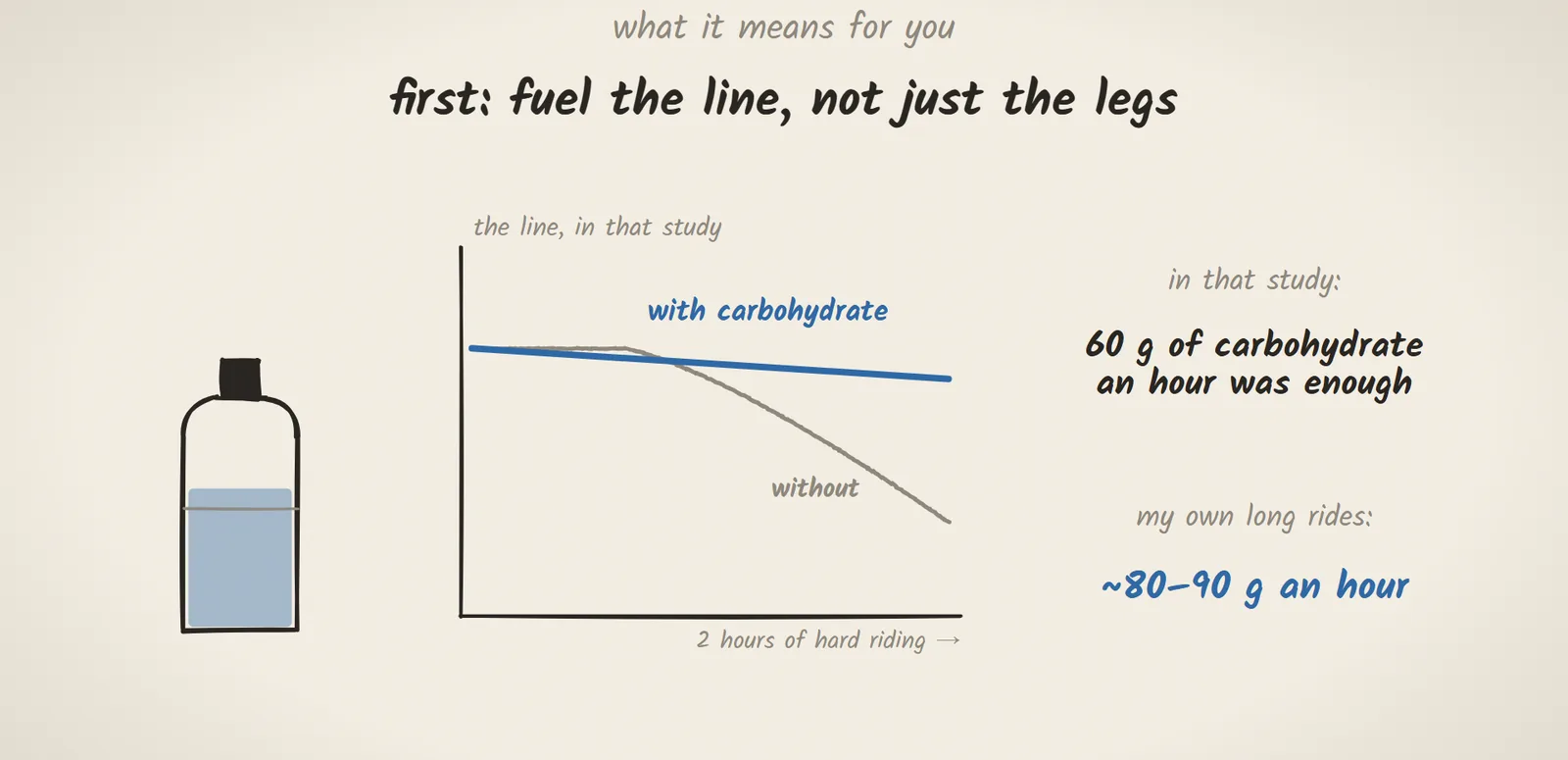
That drop has been measured. In 2019, researchers had 16 people do a 3-minute all-out test that estimates critical power: once fresh, and on other occasions straight after 40 minutes, 80 minutes or 2 hours of steady, hard riding. Fresh, the estimate was about 260 W. After 40 and 80 minutes it hadn’t dropped. After 2 hours, it was down to 236, about 9% lower. On another occasion they drank 60 g of carbohydrate an hour through the same 2 hours, and the drop almost disappeared. That’s 2 hours rather than 4, and a quick test standing in for the full measurement, but in that study, the estimate held for a while, and then it dropped.
What it means for you: fuel the line
So what does this mean for you? First, fuel the line, not just the legs. In that study, 60 g of carbohydrate an hour was enough to keep it in place. On my own long rides I aim for something like 80 to 90.
Test the rider who shows up
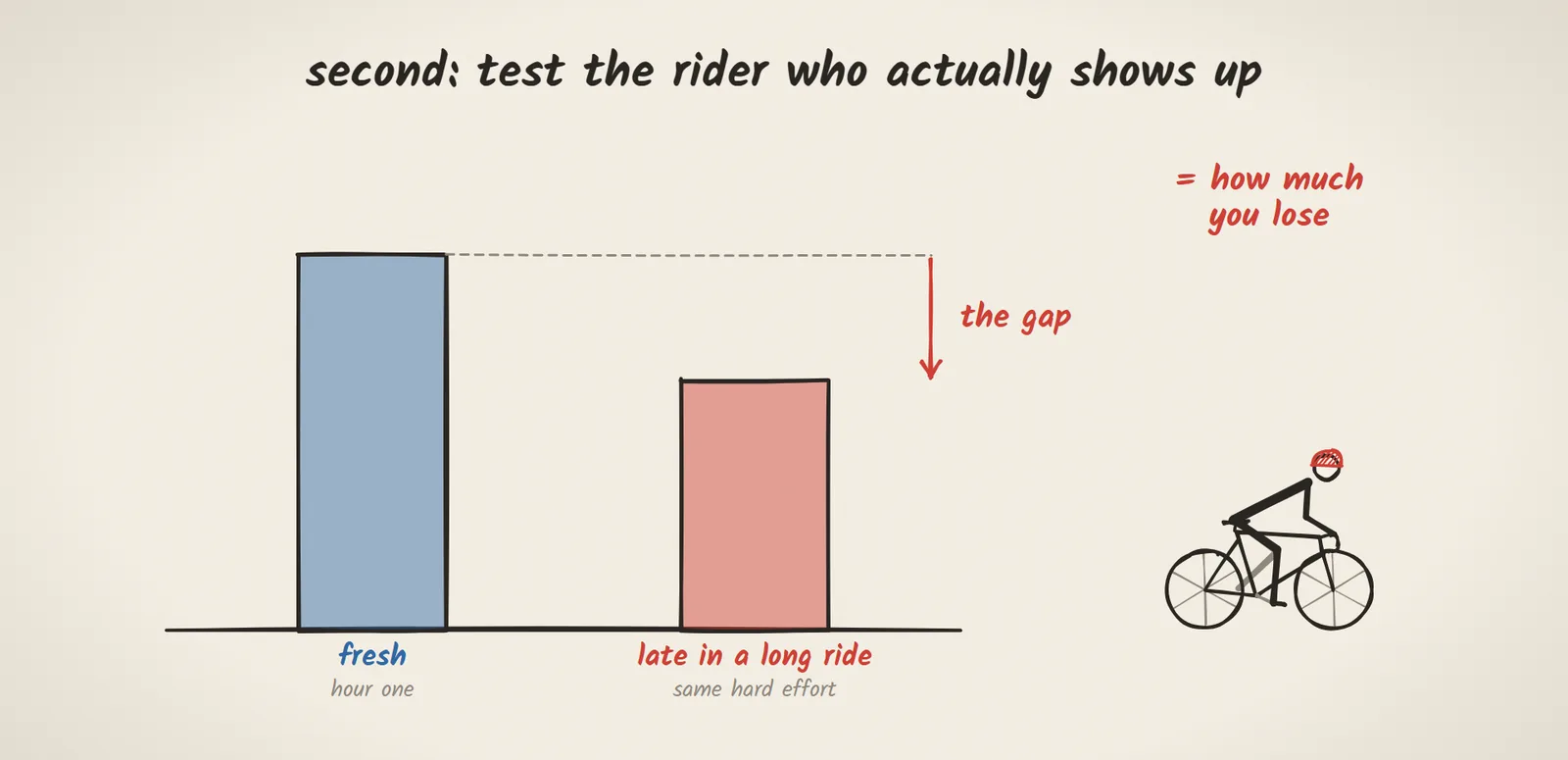
Second, test the rider who actually shows up. A fresh test tells you about hour one. Repeat the same hard effort late in a long ride, and the gap between the two is a direct measure of how much you lose.
Durability isn’t fixed
And third, durability isn’t fixed. One study followed 30 under-23 professional riders through a season. Their power after 2,000 kJ of work changed more across the season than their fresh power did, and the riders who spent more time riding easy, below their first threshold, tended to improve their 2-minute power after that work. A pattern in 30 riders isn’t a training plan, but it fits with doing plenty of long, easy riding. The goal was never just a big fresh number. It’s how much of it is still yours at hour 4.
That’s what’s underneath the watts.
Sources
The study
- Clark IE, Vanhatalo A, Thompson C, Joseph C, Black MI, Blackwell JR, Wylie LJ, Tan R, Bailey SJ, Wilkins BW, Kirby BS, Jones AM. Dynamics of the power-duration relationship during prolonged endurance exercise and influence of carbohydrate ingestion. J Appl Physiol. 2019;127(3):726-736. doi.org/10.1152/japplphysiol.00207.2019
Also in this article
- Spragg J, Leo P, Swart J. The relationship between training characteristics and durability in professional cyclists across a competitive season. Eur J Sport Sci. 2023;23(4):489-498. doi.org/10.1080/17461391.2022.2049886
- Coyle EF, Sidossis LS, Horowitz JF, Beltz JD. Cycling efficiency is related to the percentage of type I muscle fibers. Med Sci Sports Exerc. 1992;24(7):782-788. doi.org/10.1249/00005768-199207000-00008
- Maunder E, Seiler S, Mildenhall MJ, Kilding AE, Plews DJ. The importance of 'durability’ in the physiological profiling of endurance athletes. Sports Med. 2021;51(8):1619-1628. doi.org/10.1007/s40279-021-01459-0
Written and researched by Yarin Podoler, a cyclist who wanted to know what’s underneath the watts.