Why do I lose fitness so fast when I take time off?
Part of what goes first isn’t muscle. It’s blood plasma, the liquid part of your blood. Training expands it within days, and when you stop, it’s quick to drain away.
The video version, 4:02, narrated by a synthetic voice. Watch on YouTube · Watch the Short
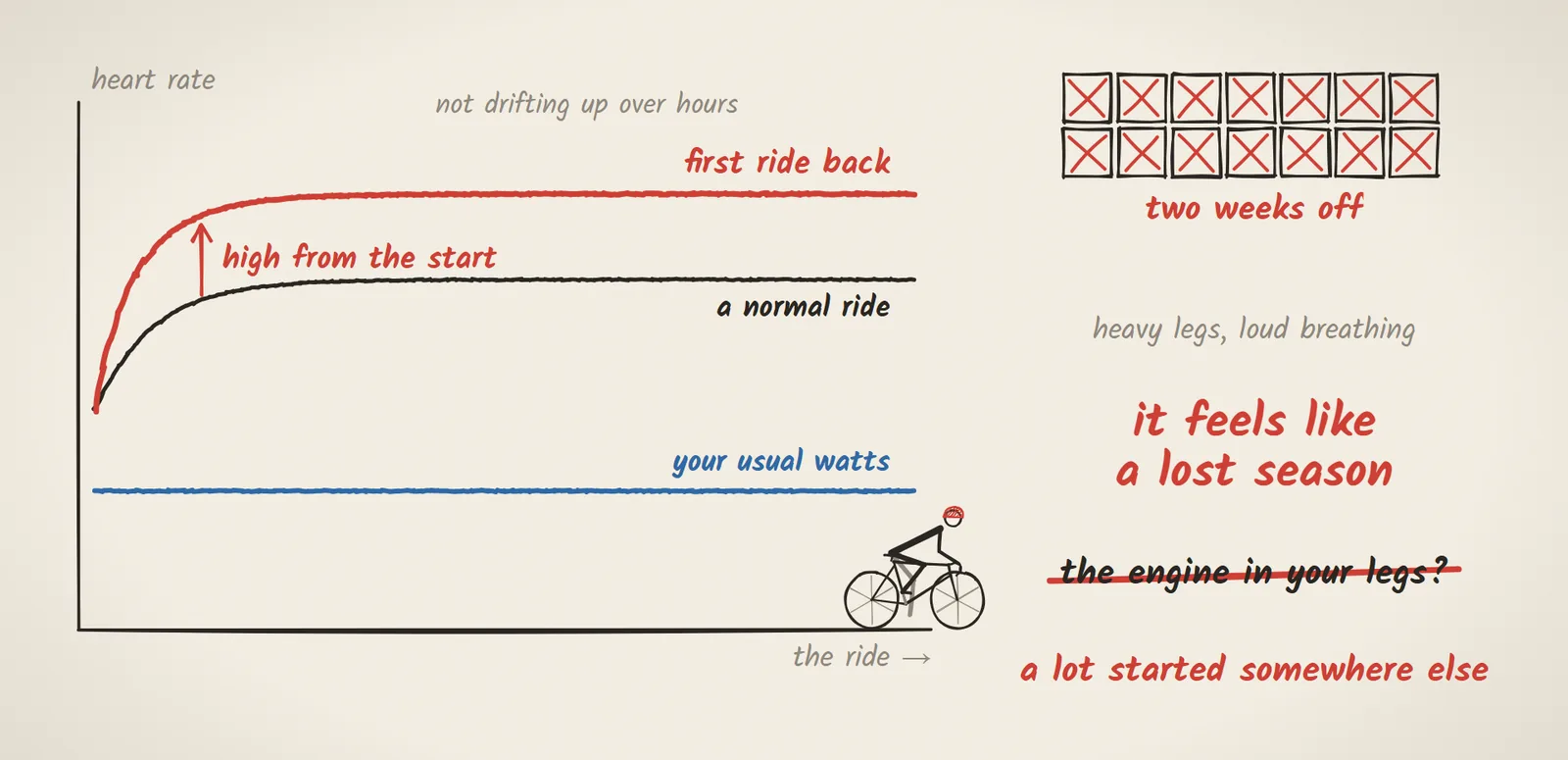
The first ride back
Maybe it was a holiday, or two weeks of work that left no room for the bike. You get back on for an easy ride, the kind you’ve done a hundred times, at the watts you always ride. And the heart rate is wrong from the first few minutes, well above where it usually sits. Not drifting up over hours. High from the start. The legs feel heavy, the breathing sounds loud, and a climb you’d normally ride steady has you staring at the screen. Two weeks, and it feels like you’ve lost a season. It’s natural to assume the engine in your legs has gone. But a lot of what you’re feeling started somewhere else.
Three clocks
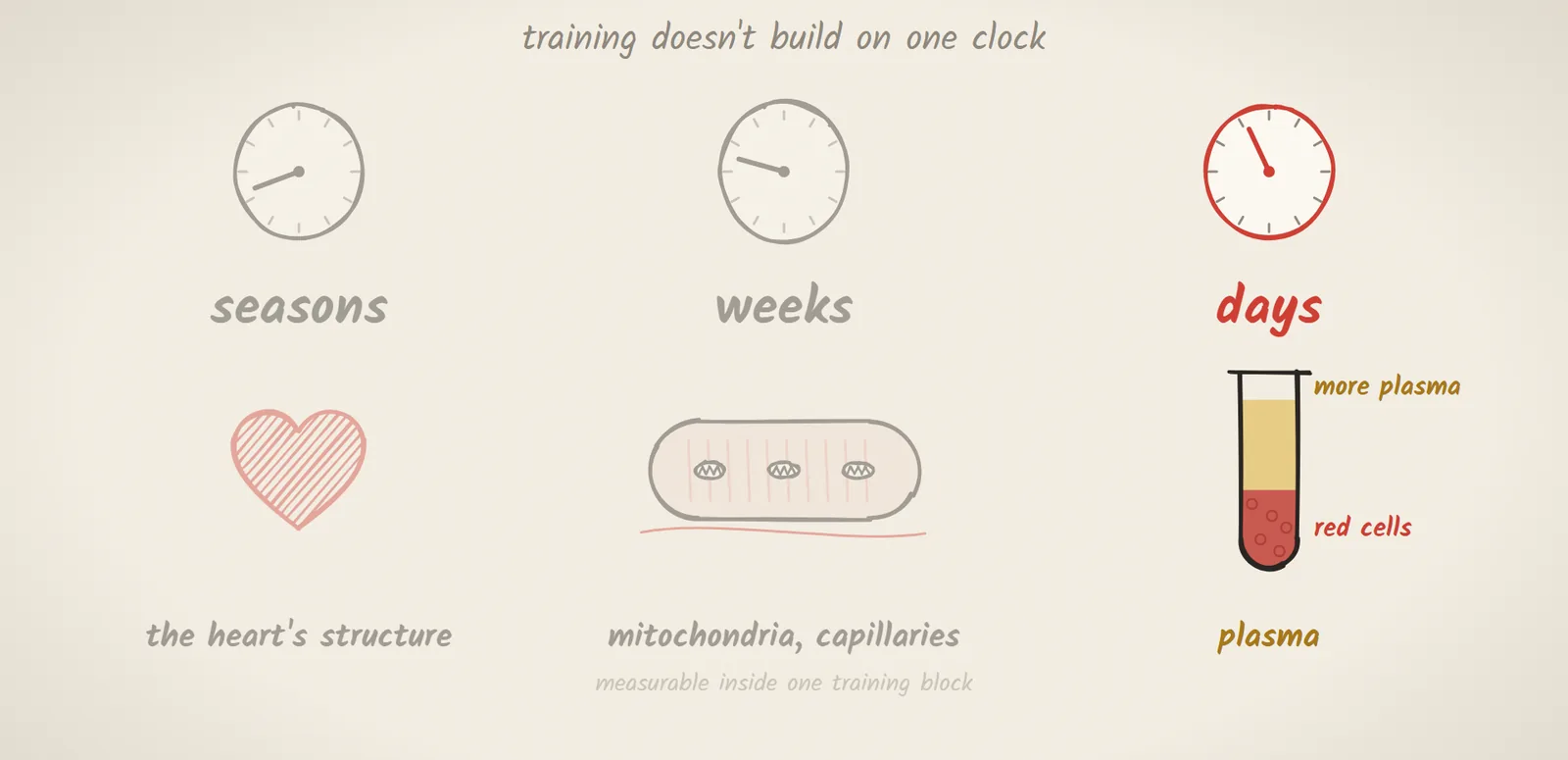
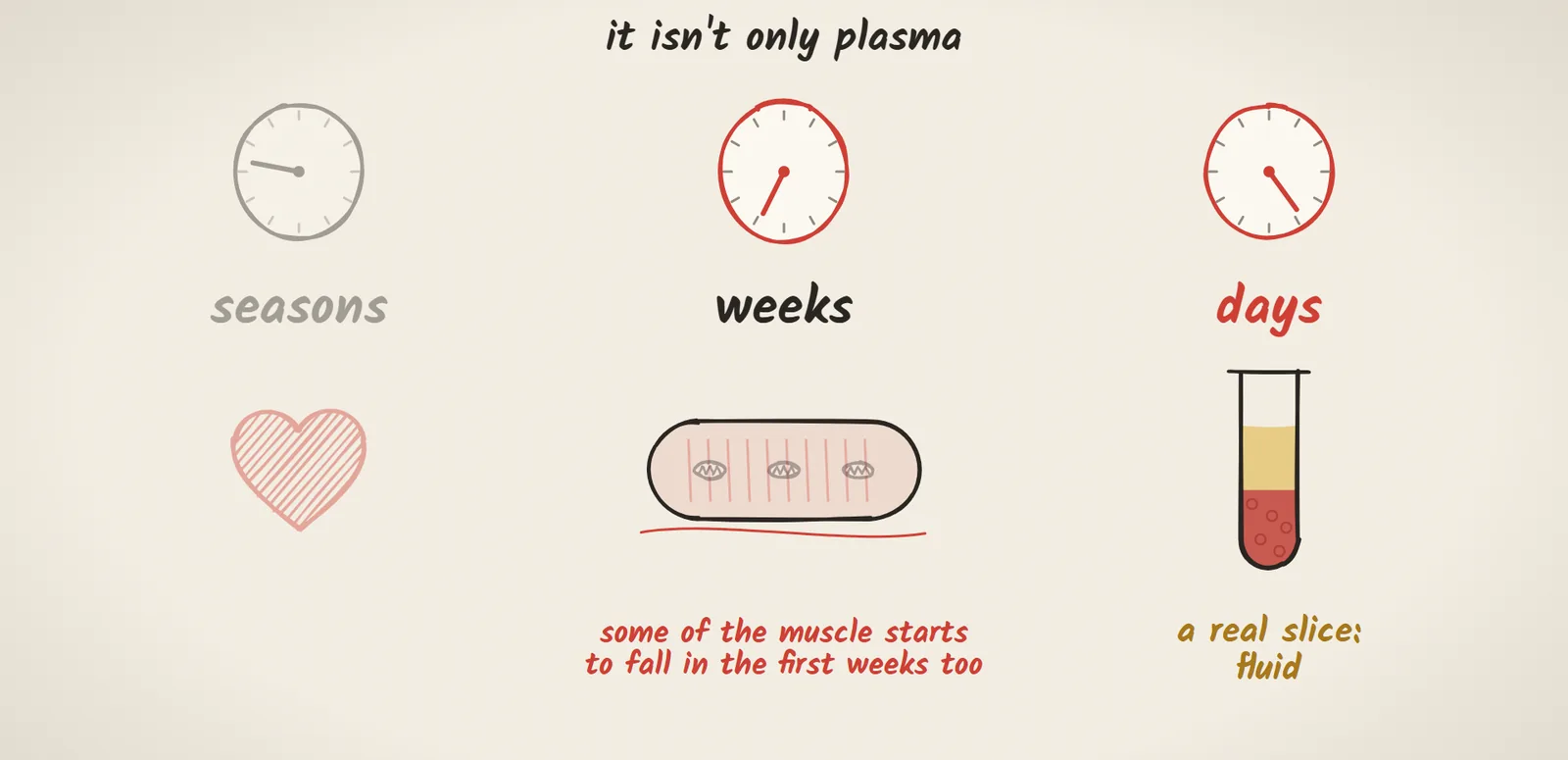
Start with how training builds your oxygen system, because it doesn’t do it on one clock. The structure of the heart itself keeps remodelling across seasons. The mitochondria and capillaries in your legs change on a clock of weeks: you can measure the difference inside one training block. And the fastest of the three runs in days. Start riding consistently, and within days your body holds on to more plasma, the liquid your red cells float in.
A fuller heart
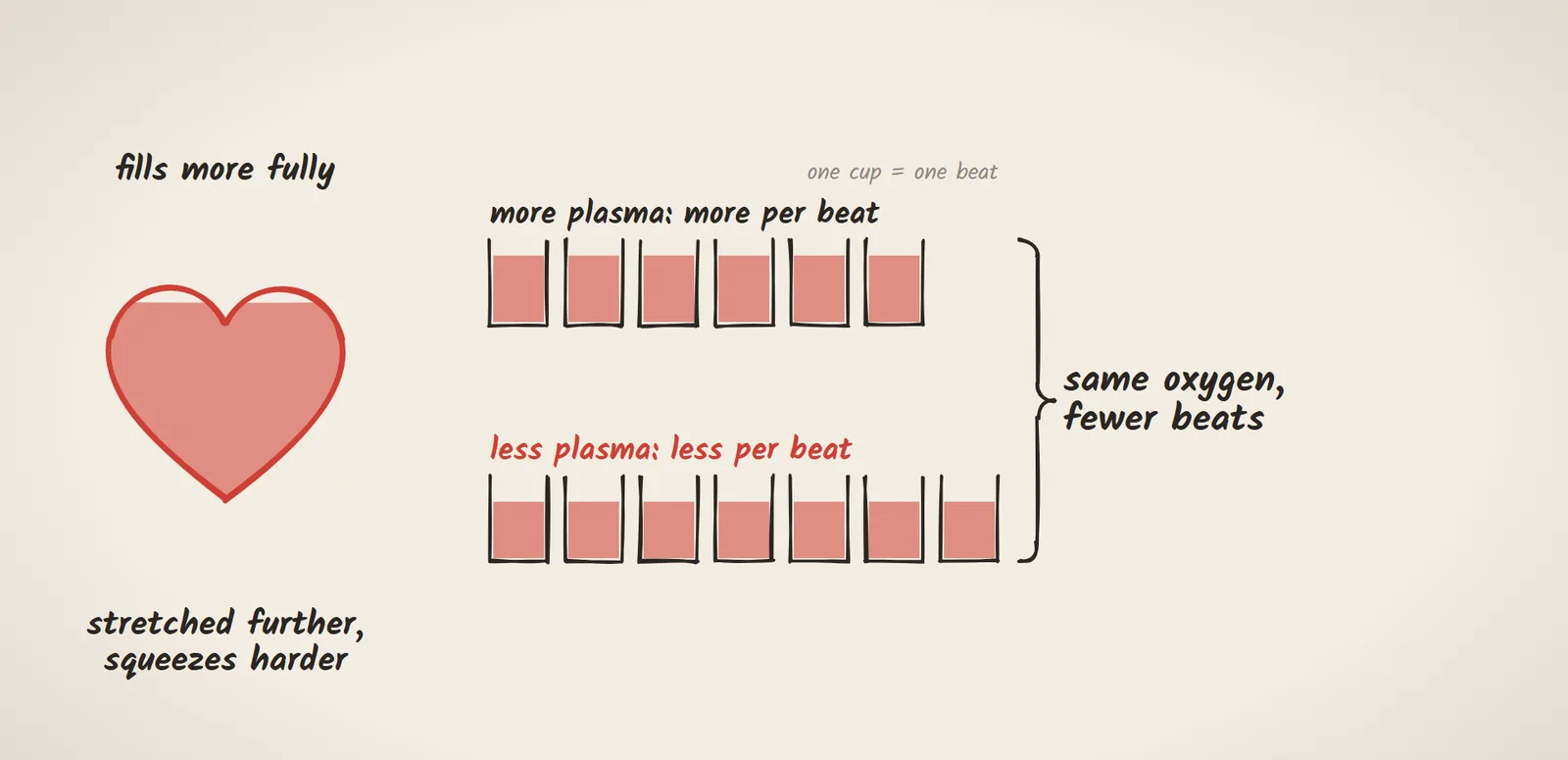
More blood in the system means the heart fills more fully between beats. A fuller heart is stretched further, and heart muscle that’s stretched further squeezes harder, so each beat pushes out more blood. More blood per beat means the same oxygen reaches your legs with fewer beats.
Two weeks off
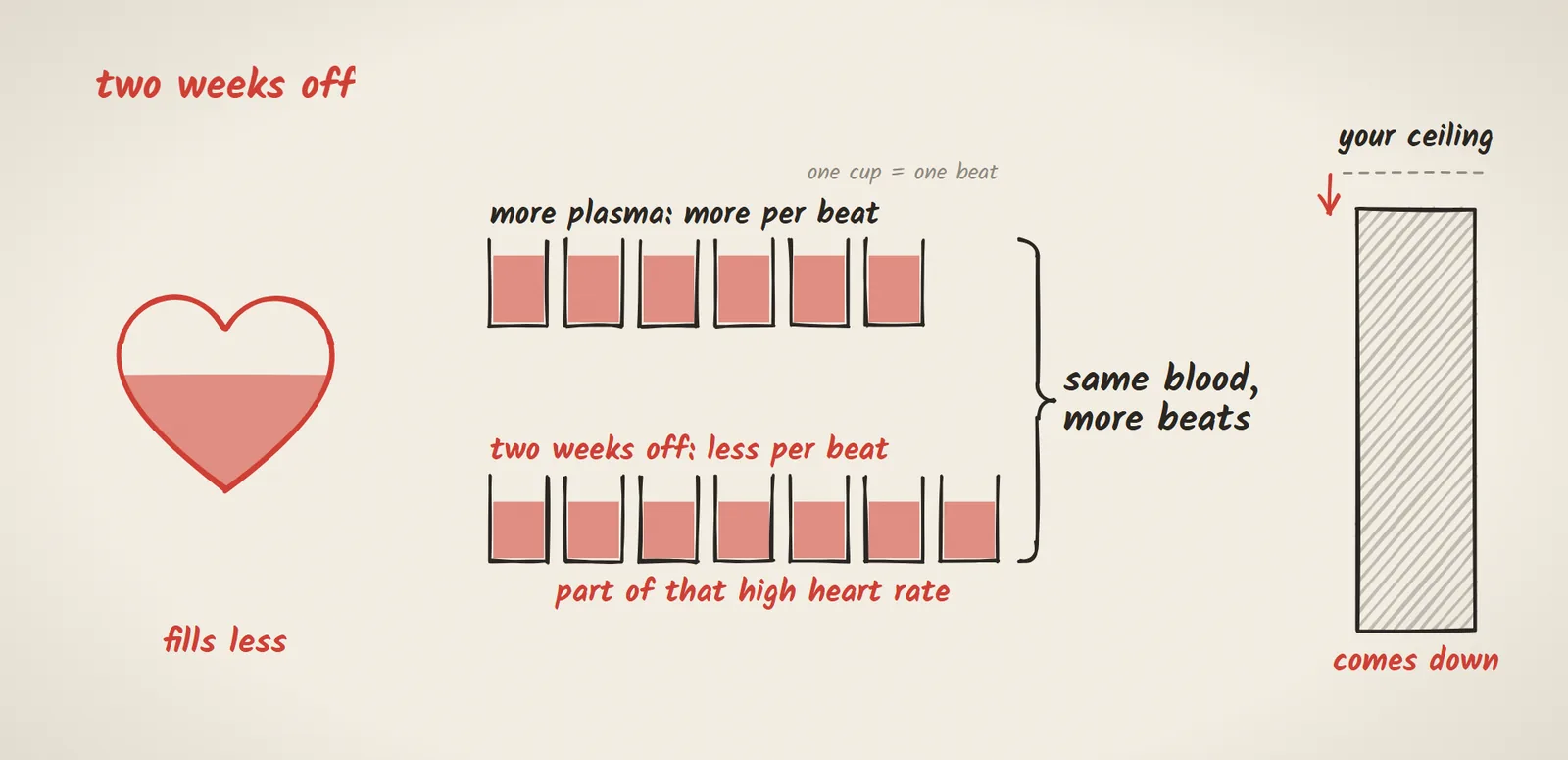
Now take two weeks off. The extra plasma doesn’t wait around. With less blood coming back to it, the heart fills less and each beat pushes out less, so to keep pumping the same amount of blood at the same watts, it has to beat faster. That’s part of the heart rate you saw on the first ride back. And at your limit, the heart can’t beat fast enough to make all of it up, so your ceiling comes down too.
Not only plasma
It isn’t only plasma. The slower clocks don’t wait their turn: some of what training built in the muscle starts to fall within the first couple of weeks too. But a real slice of what feels like lost fitness is, unglamorously, fluid.
The experiment
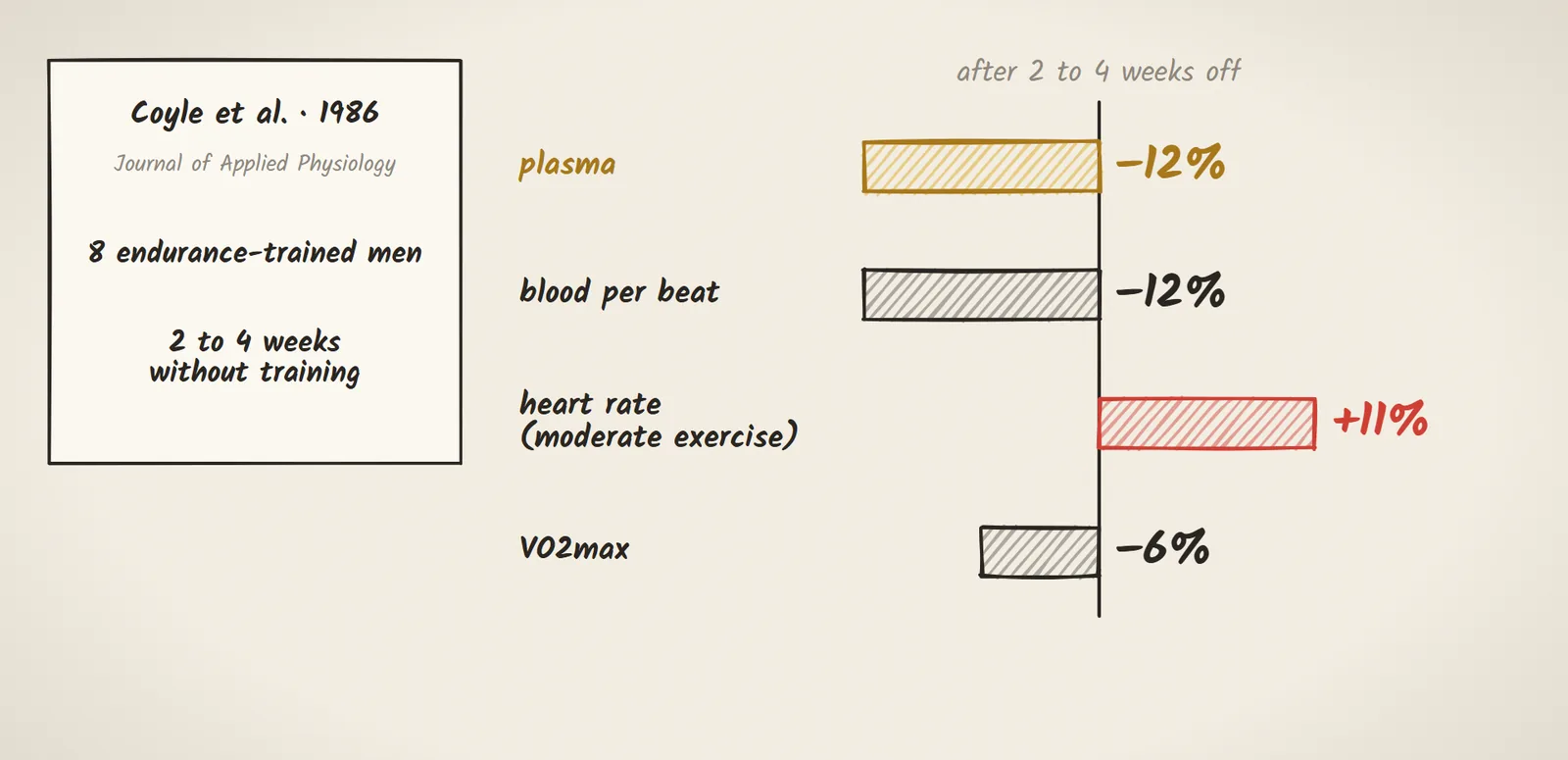
How do we know it’s the blood? In 1986, researchers took 8 endurance-trained men and had them stop training for 2 to 4 weeks. Their plasma fell by 12%. During moderate exercise, each heartbeat pushed out 12% less blood, and the heart beat 11% faster to make up for it. Their aerobic ceiling, their VO2max, was down 6%.
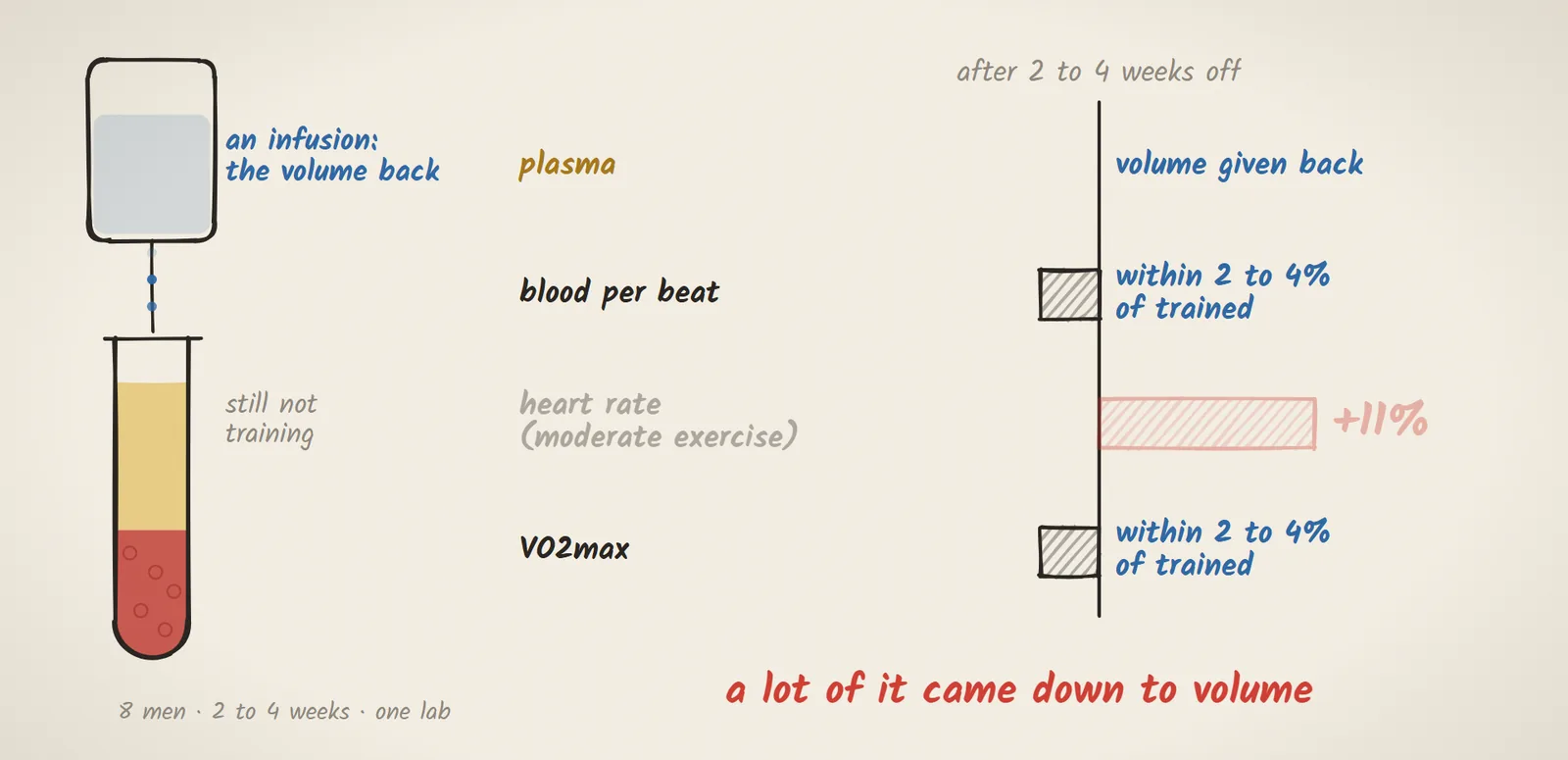
Then came the clever part. While the men were still not training, the researchers gave the missing volume back, with an infusion of a solution that stays in the bloodstream and expands it. Stroke volume and VO2max both climbed back, to within 2 to 4% of where they’d been when the men were trained. Give back the volume, and a good part of the loss came back with it. Eight men, 2 to 4 weeks, one lab, but a lot of what they’d lost came down to volume.
What it means for you
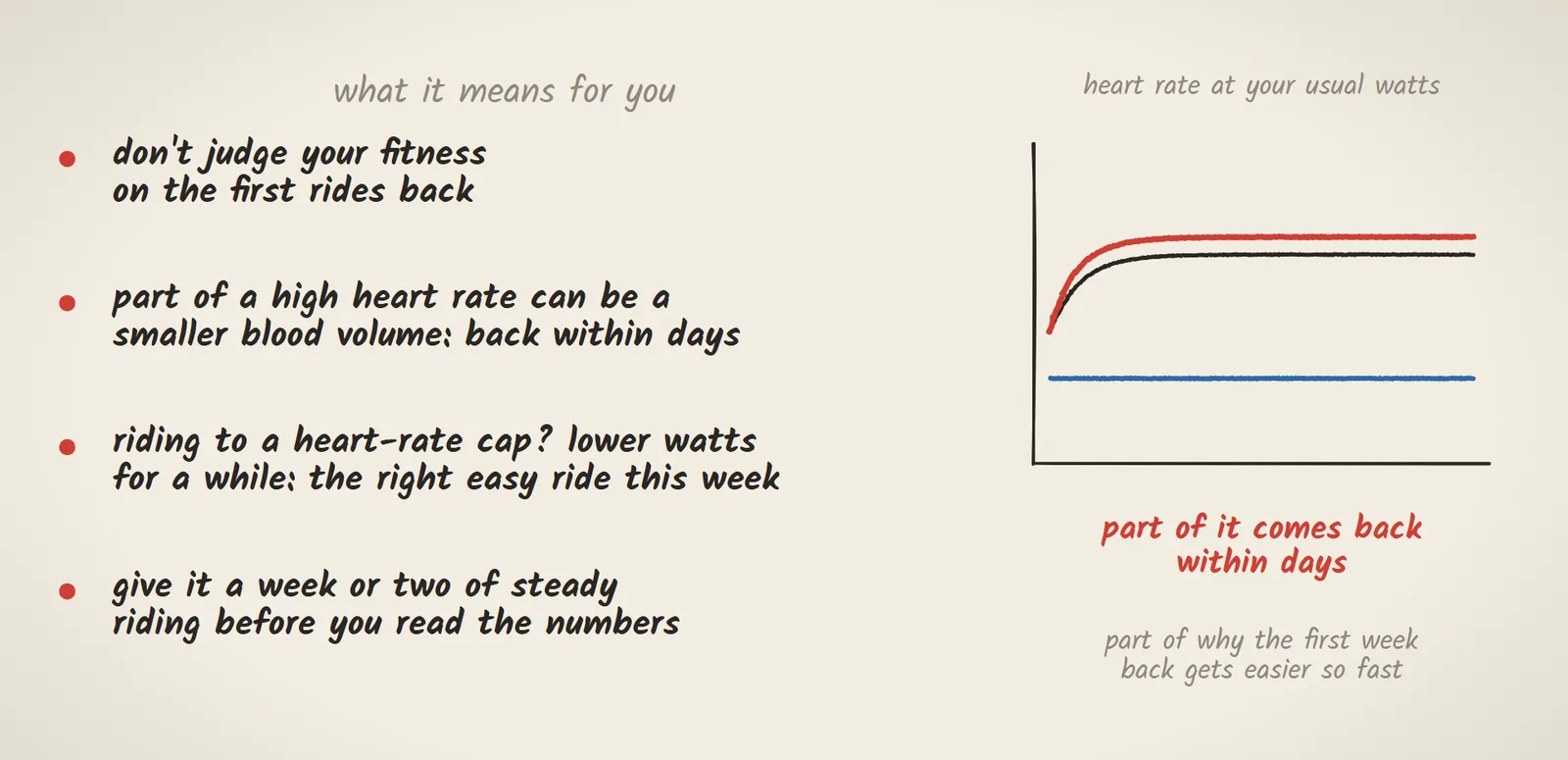
So what does this mean for you? Don’t judge your fitness on the first rides back. After a break, part of what pushes your heart rate up at your usual watts can be a smaller blood volume, and that part starts coming back within days of riding consistently again. If you ride your easy days to a heart-rate cap, that cap will hold you to lower watts for a while, and that’s the right easy ride for the body you have this week. And when the first week back gets easier faster than seems fair, that’s part of the reason. Give it a week or two of steady riding before you read anything into the numbers.
That’s what’s underneath the watts.
Sources
The study
- Coyle EF, Hemmert MK, Coggan AR. Effects of detraining on cardiovascular responses to exercise: role of blood volume. J Appl Physiol. 1986;60(1):95-99. doi.org/10.1152/jappl.1986.60.1.95
Also in this article
- Coyle EF, Martin WH 3rd, Sinacore DR, Joyner MJ, Hagberg JM, Holloszy JO. Time course of loss of adaptations after stopping prolonged intense endurance training. J Appl Physiol. 1984;57(6):1857-1864. doi.org/10.1152/jappl.1984.57.6.1857
Written and researched by Yarin Podoler, a cyclist who wanted to know what’s underneath the watts.