Why does my second interval feel better than my first?
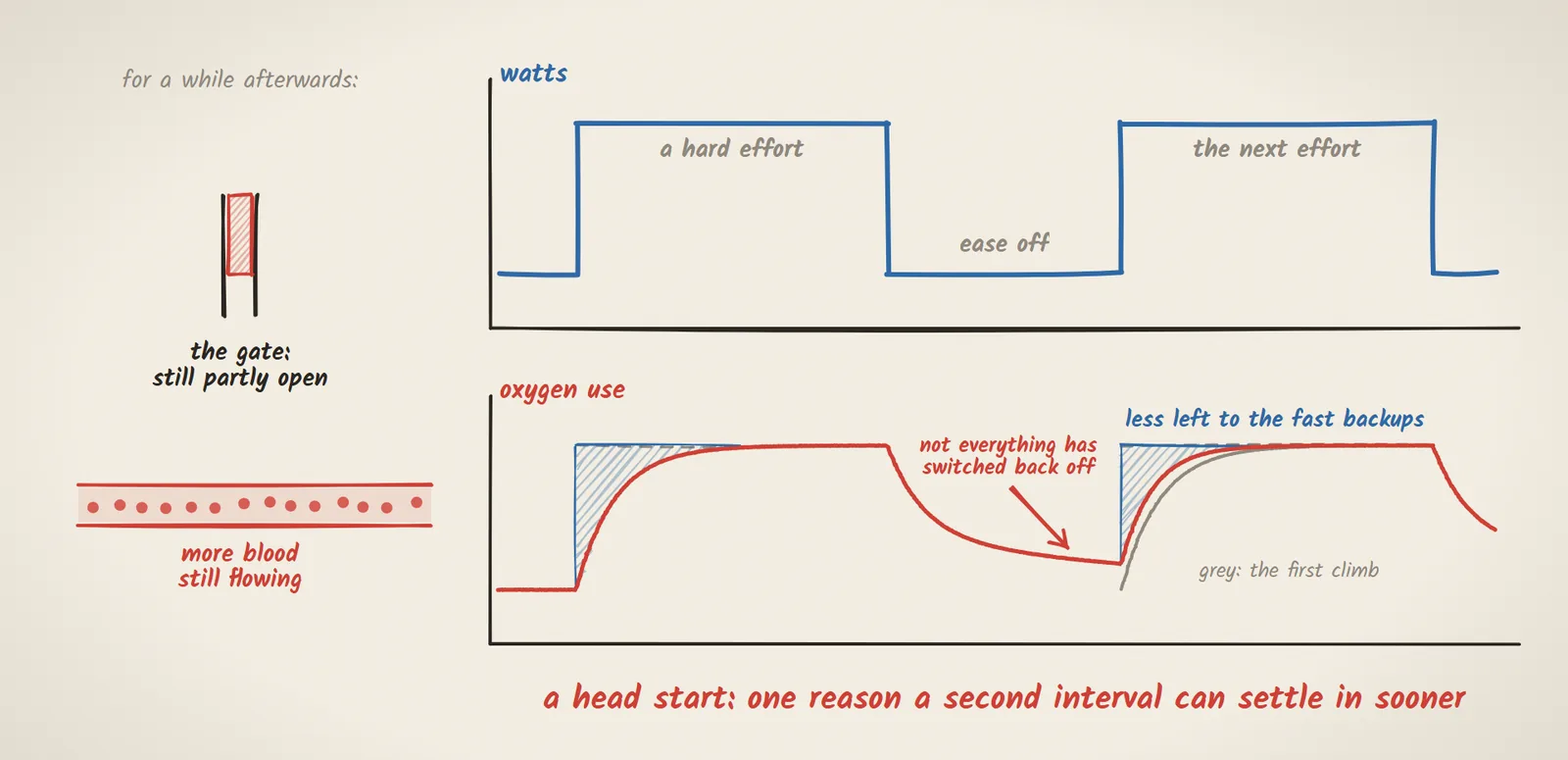
Partly because the first one got your aerobic engine going. At the start of an effort, the machinery in your muscles’ mitochondria that burns fuel with oxygen takes time to switch on. After a hard effort, some of it stays on for a while, and more blood is still flowing to your legs, so the next effort can start closer to ready.
The video version, 4:15, narrated by a synthetic voice. Watch on YouTube · Watch the Short
The rough first interval
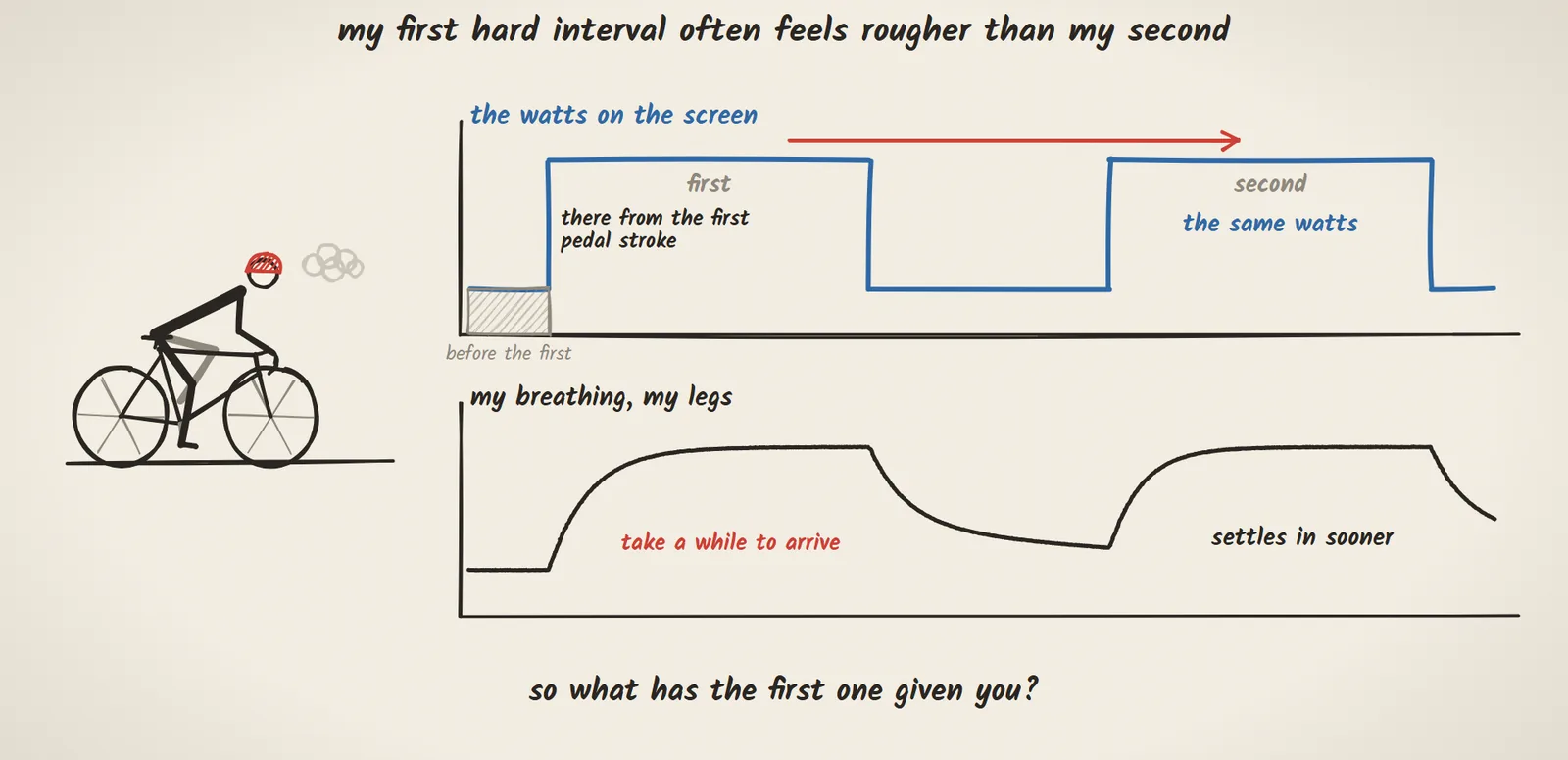
My first hard interval often feels rougher than my second. At the start of it, my breathing and my legs lag behind the power. If you ride intervals, you may know the feeling: the watts on the screen are there from the first pedal stroke, but the rest of you takes a while to arrive, and the second interval, at the same watts, settles in sooner. It’s tempting to read the rough start as a bad day. But you’ve done less work before the first interval than before any other, so if anything, it should be the easiest. So what has the first one given you that you didn’t have before it?
The start of any effort
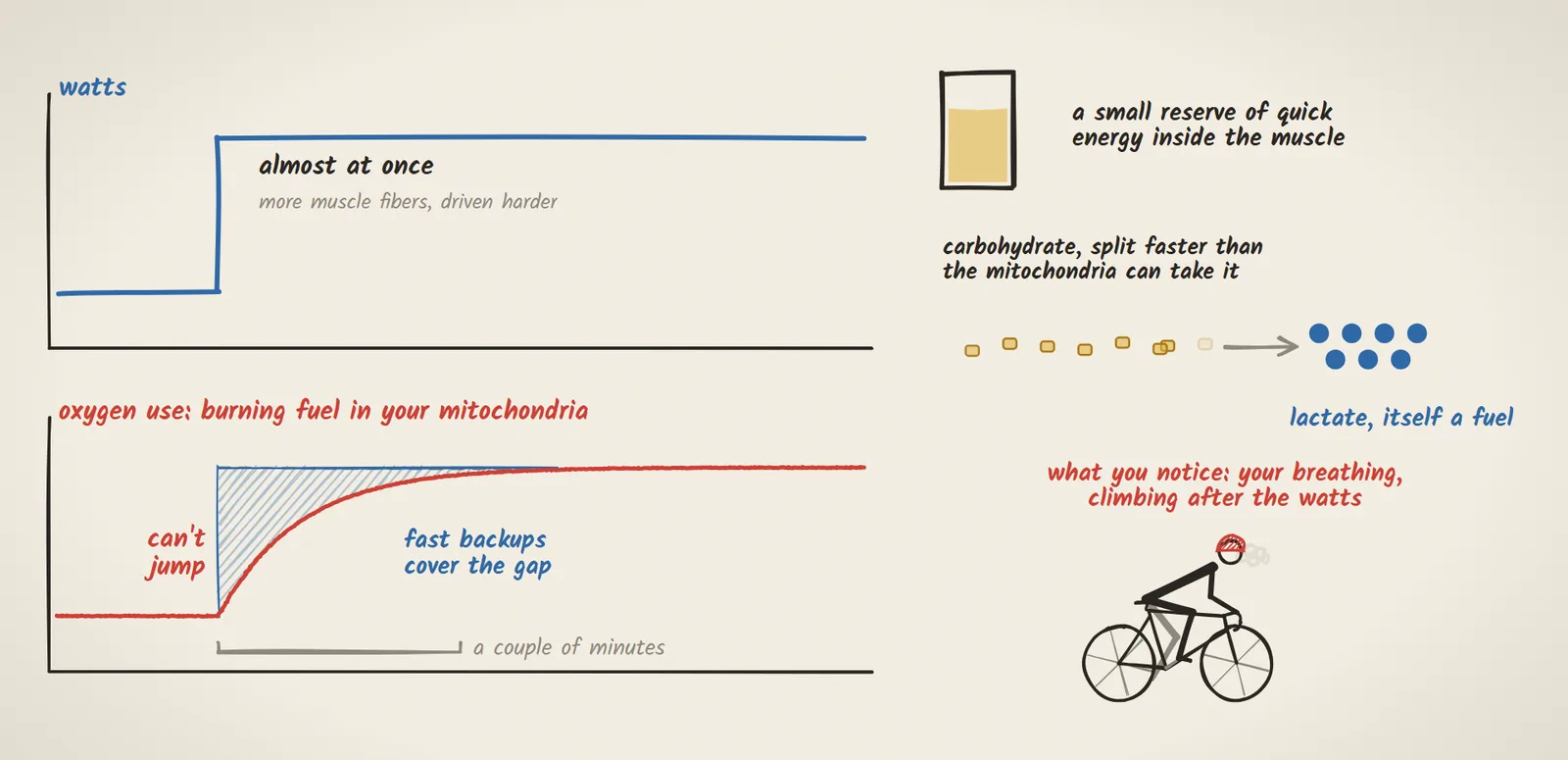
Start with what happens at the beginning of any effort. The watts come almost at once, because your legs bring in more muscle fibers and drive them harder. But most of the energy for an interval of several minutes comes from burning fuel with oxygen in your mitochondria, and that can’t jump. Your oxygen use needs a couple of minutes to make most of its climb, and until it catches up, fast backups cover the gap: a small reserve of quick energy inside the muscle, and carbohydrate being split faster than the mitochondria can take it, which makes lactate, itself a fuel. What you notice is your breathing, climbing after the watts.
A gate in your mitochondria
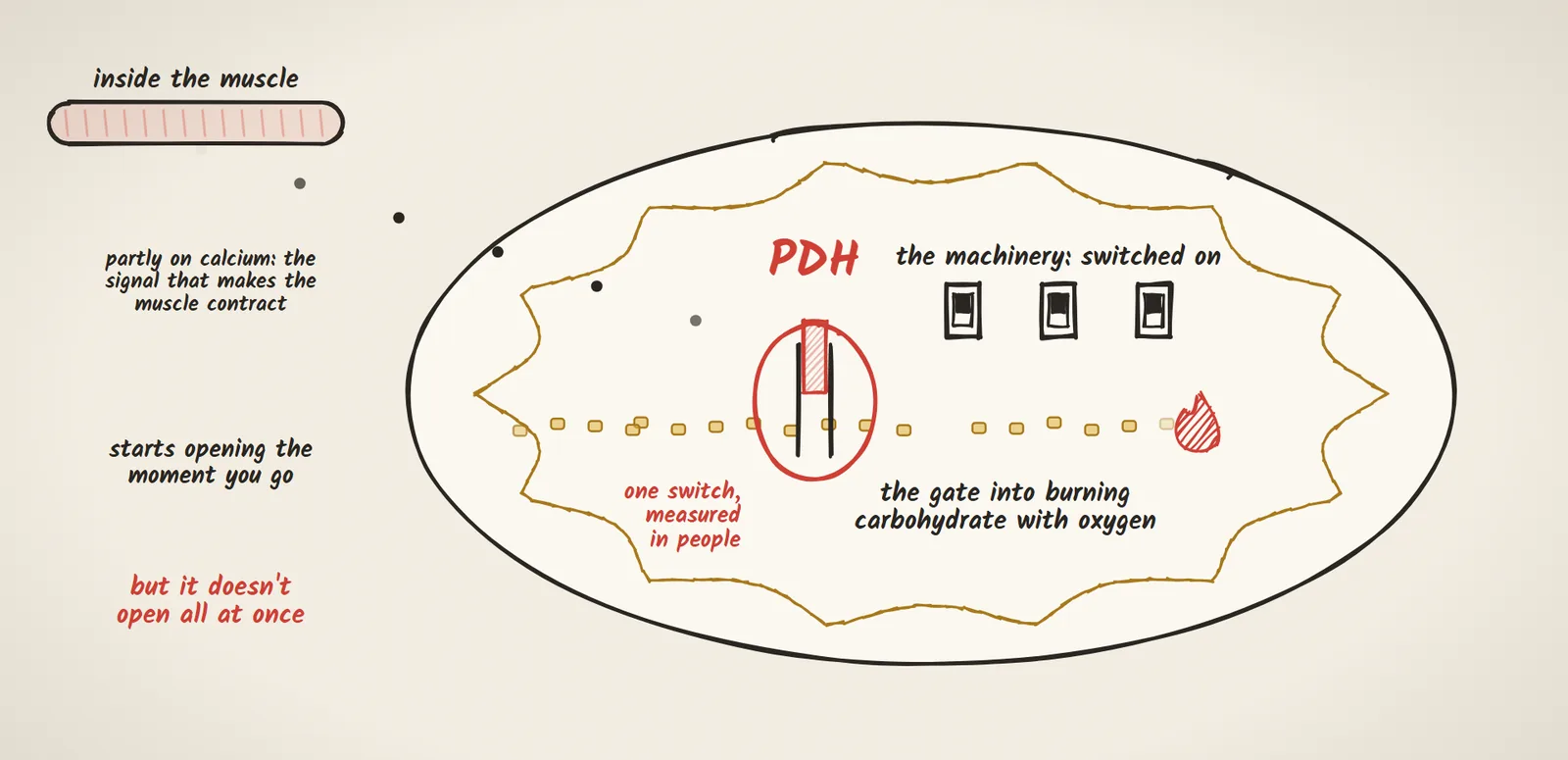
Part of the delay is inside the muscle, where the machinery in your mitochondria has to be switched on. One of its switches has been measured in people: an enzyme called PDH, the gate into burning carbohydrate with oxygen. It starts opening the moment you go, partly on the same calcium signal that makes the muscle contract, but it doesn’t open all at once.
The head start
Now ride a hard effort and ease off. For a while afterwards, not everything has switched back off. The gate is still partly open, and more blood is still flowing through the muscle. So when the next effort starts, your oxygen use can climb faster, leaving less of the start to the fast backups. That head start is one reason a second interval can settle in sooner.
The experiment
How do we know the gate stays partly open? In a study in Canada, 9 young men, active but not in training, rode a lab bike while the researchers took small samples of their thigh muscle. From easy pedalling, they stepped up to a moderate effort of about 100 W, and within 30 seconds, the gate’s activity had roughly doubled. Later, they rode 6 hard minutes at about 230 W, pedalled easily for 6, and stepped up to the same moderate effort again. This time the gate was already nearly as open as it had been 30 seconds into the first step, a sensor on the thigh read more oxygen-rich blood in the muscle, and their oxygen uptake rose to its new level about 20% faster.
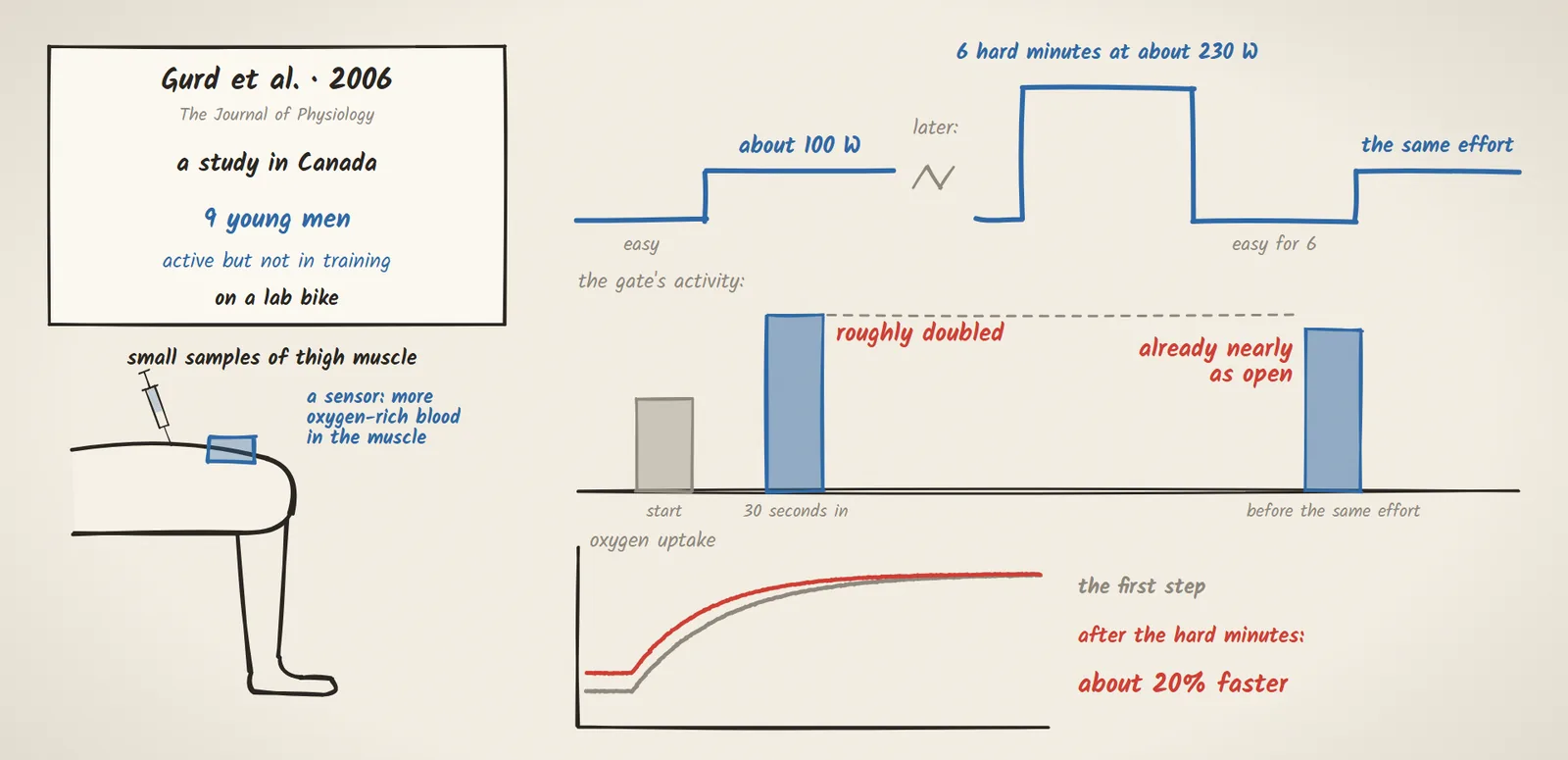
The authors suggest the open gate was part of the reason, and more blood flow another part. They tested a moderate effort, not a hard interval, and measured how fast the engine came up, not how hard anyone could ride or how it felt. But in that study, after a hard effort, the engine was already partly running before the next one began.
What it means for you
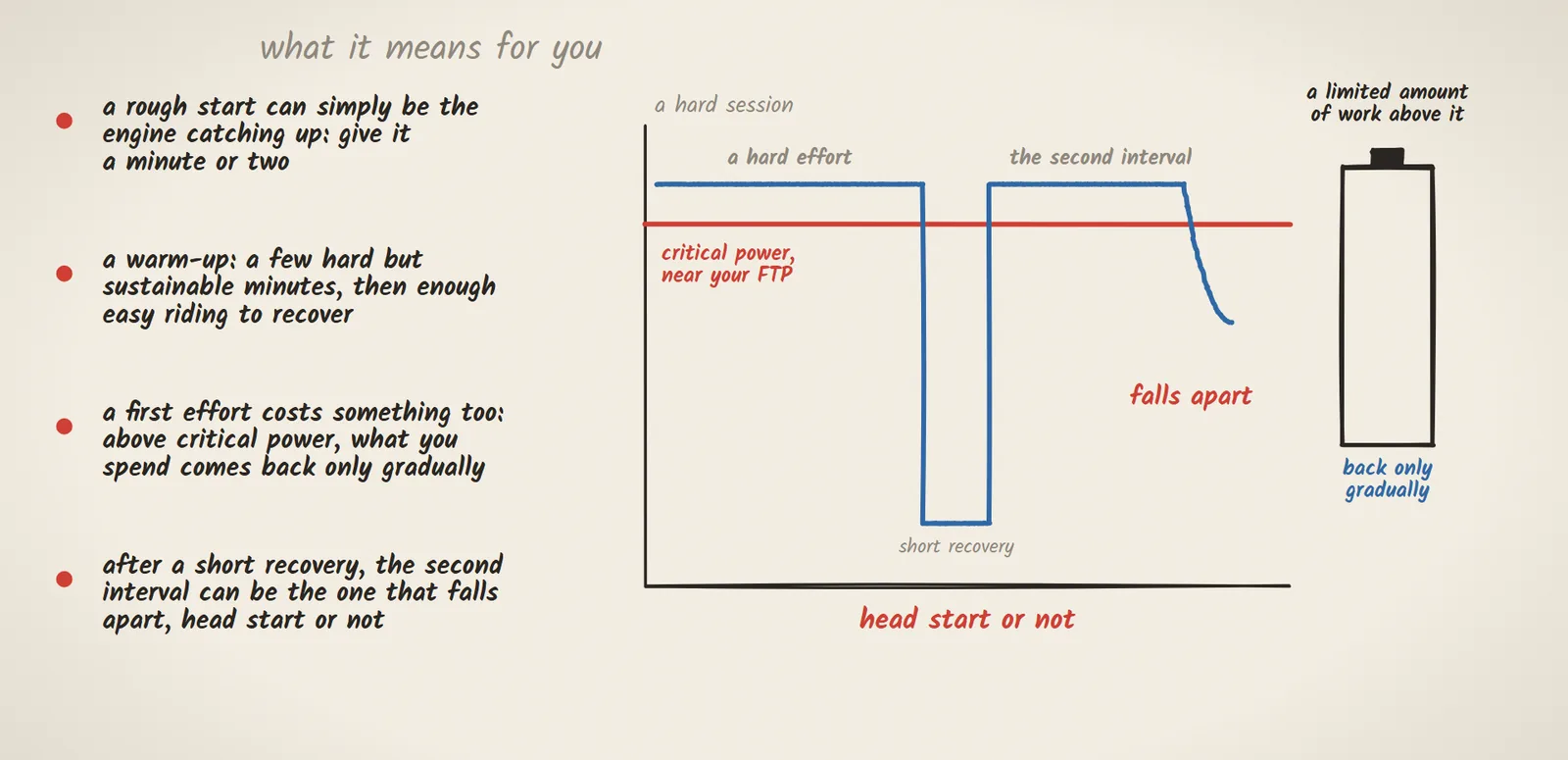
So what does this mean for you? A rough start to your first interval can simply be the engine catching up, so give it a minute or two before you judge the day. If you want the first interval that counts to start like a second one, that’s the case for a warm-up with a few hard but sustainable minutes in it, then enough easy riding to recover before the work begins. But a first effort costs something too. Above critical power, a line somewhere near your FTP, you can only do a limited amount of work, and what you spend comes back only gradually once you’re below it. So when a hard effort is followed by a short recovery, the second interval can be the one that falls apart, head start or not.
That’s what’s underneath the watts.
Sources
The study
- Gurd BJ, Peters SJ, Heigenhauser GJF, LeBlanc PJ, Doherty TJ, Paterson DH, Kowalchuk JM. Prior heavy exercise elevates pyruvate dehydrogenase activity and speeds O2 uptake kinetics during subsequent moderate-intensity exercise in healthy young adults. J Physiol. 2006;577(Pt 3):985-996. doi.org/10.1113/jphysiol.2006.112706
Also in this article
- How warming up with a hard effort speeds oxygen uptake, and why the mechanism is still argued (a review): Goulding RP, Burnley M, Wüst RCI. How priming exercise affects oxygen uptake kinetics: from underpinning mechanisms to endurance performance. Sports Med. 2023;53(5):959-976. doi.org/10.1007/s40279-023-01832-1
- A hard first effort with only 3 minutes to recover cut the next effort’s tolerance; with 9 or 20 minutes it improved it (8 men): Bailey SJ, Vanhatalo A, Wilkerson DP, DiMenna FJ, Jones AM. Optimizing the “priming” effect: influence of prior exercise intensity and recovery duration on O2 uptake kinetics and severe-intensity exercise tolerance. J Appl Physiol. 2009;107(6):1743-1756. doi.org/10.1152/japplphysiol.00810.2009
- The gate opens over seconds even in an all-out sprint, and stays partly open between repeated ones (6 people): Parolin ML, Chesley A, Matsos MP, Spriet LL, Jones NL, Heigenhauser GJF. Regulation of skeletal muscle glycogen phosphorylase and PDH during maximal intermittent exercise. Am J Physiol. 1999;277(5):E890-E900. doi.org/10.1152/ajpendo.1999.277.5.E890
Written and researched by Yarin Podoler, a cyclist who wanted to know what’s underneath the watts.