Why is my fifth attack weaker than my first?
Largely because the reserve that pays for the first seconds of an attack refills on oxygen, and a full refill takes minutes. When attacks come close together, it doesn’t get those minutes, so each attack after the first starts with the reserve only partly refilled.
The video version, 4:11, narrated by a synthetic voice. Watch on YouTube · Watch the Short
One surge, and then five
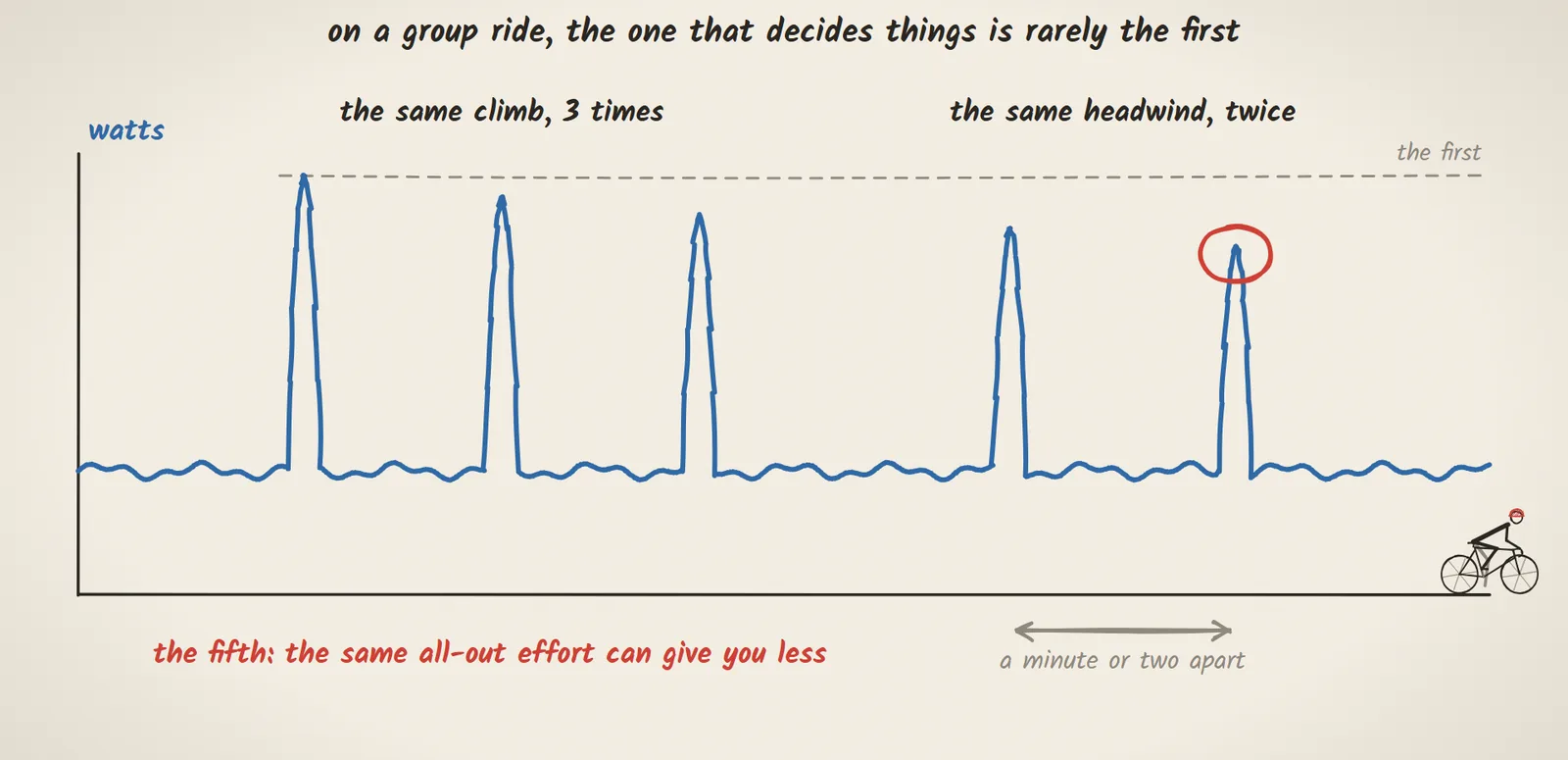
This is a ride of mine. A Saturday group ride, about 2 hours in, on a flat road. A gap opens in front of me, and without deciding to, I’m out of the saddle: 5 seconds, something like 1,300 W at the peak. I don’t train sprints, and it was so unremarkable that I only noticed it later, in the file. But on a group ride, the surge that decides things is rarely the first one. The pace goes up on the same climb three times, or into the same headwind twice, a minute or two apart, and when they come that close together, by the fifth time you stand up, the same all-out effort can give you less.
What pays for an attack
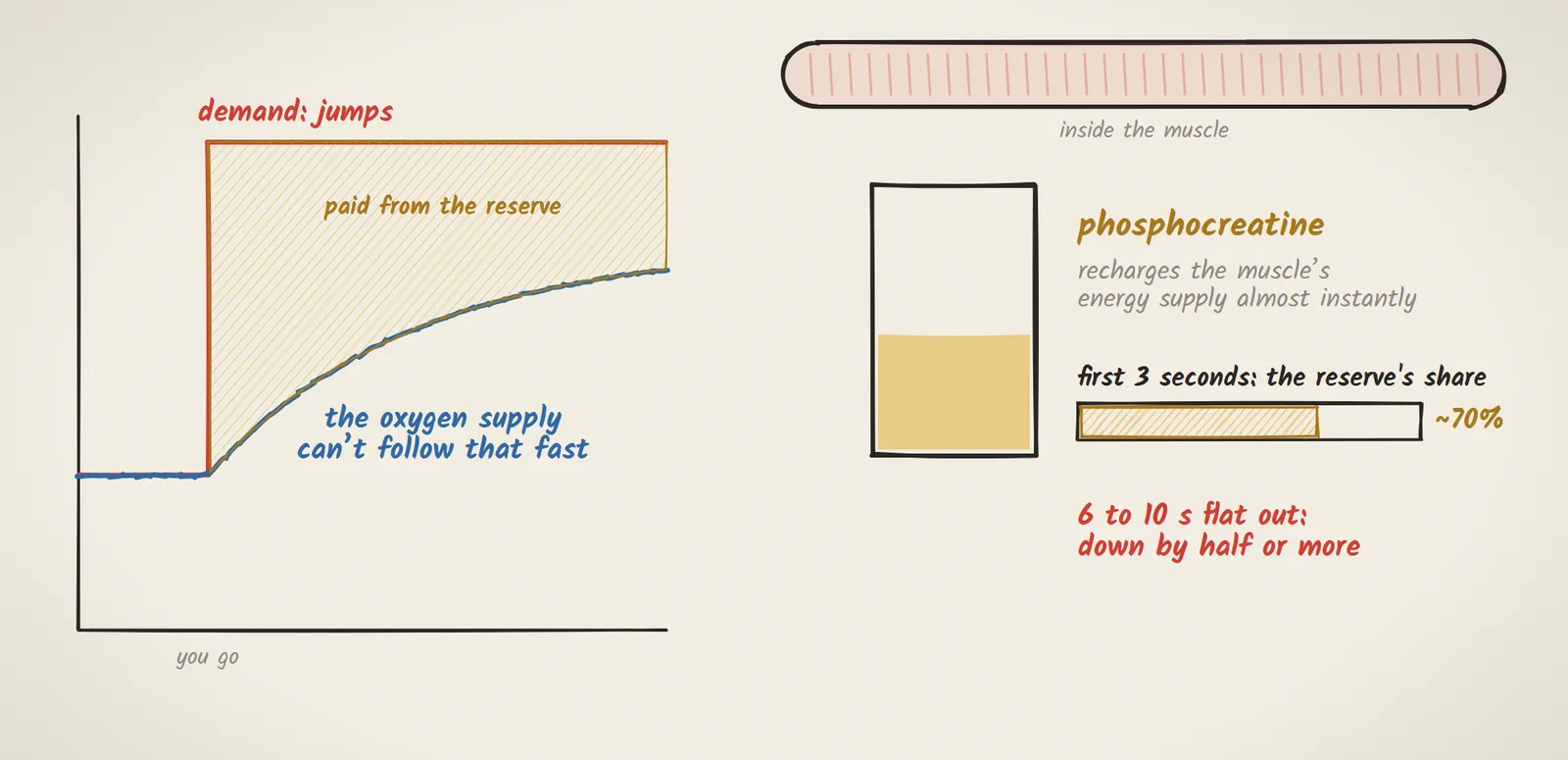
Here’s what pays for an attack. When you stand up and go, the muscle’s demand for energy jumps far faster than the oxygen supply can follow. For the first few seconds, most of that bill is paid by a small reserve inside the muscle called phosphocreatine, which recharges the muscle’s energy supply almost instantly. In the first 3 seconds of an all-out effort, it covers something like 70%. But it’s shallow: 6 to 10 seconds flat out takes it down by half or more.
The refill runs on oxygen
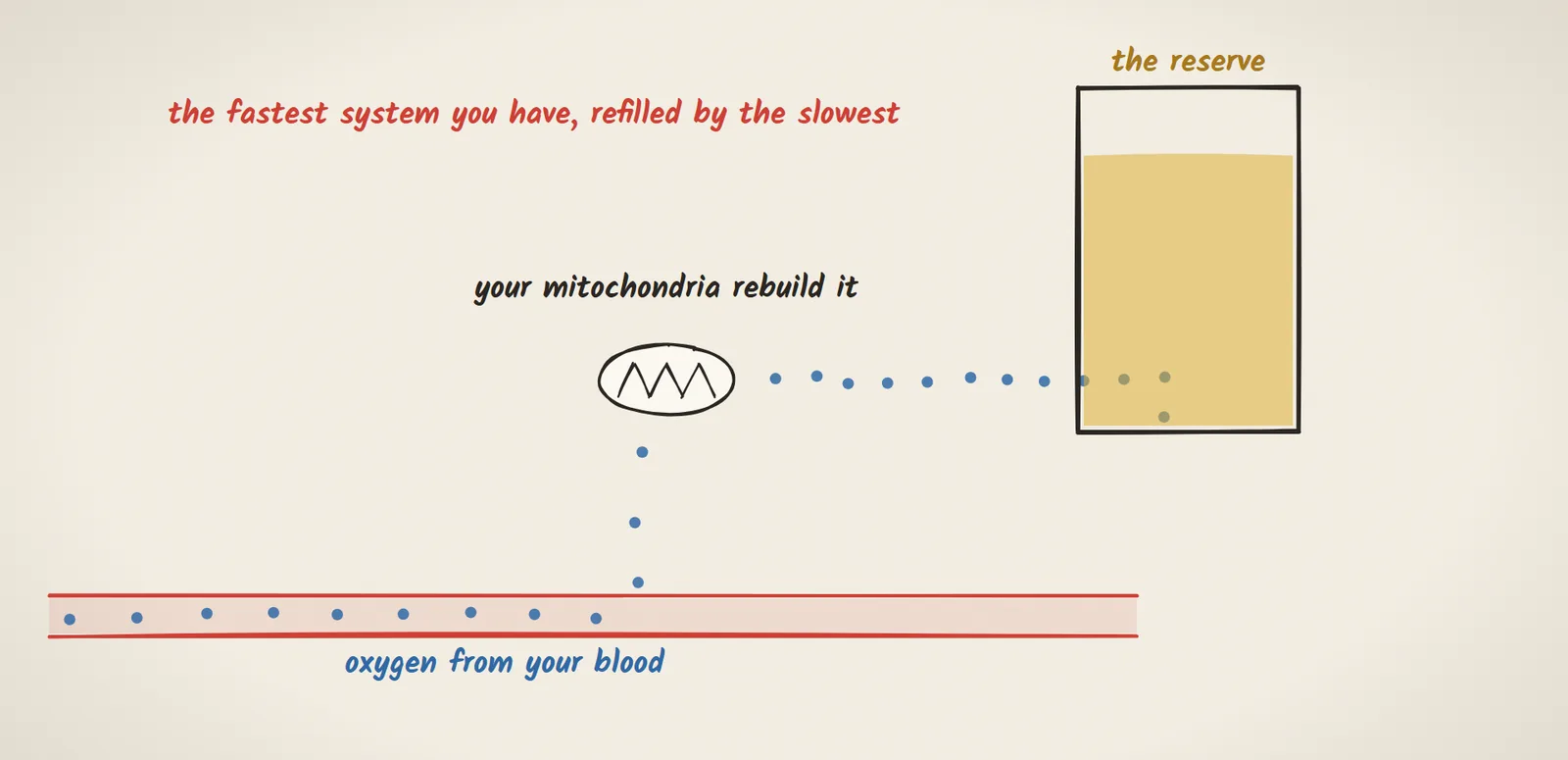
And here’s the part that decides the fifth attack: rebuilding it runs on oxygen. Your mitochondria recharge it, with oxygen your blood brings in. When researchers stopped the blood flow to the thigh after an exhausting effort, the refill stopped completely, and it started again only when the blood flowed back. So the fastest system you have is refilled by the slowest.
How long the refill takes
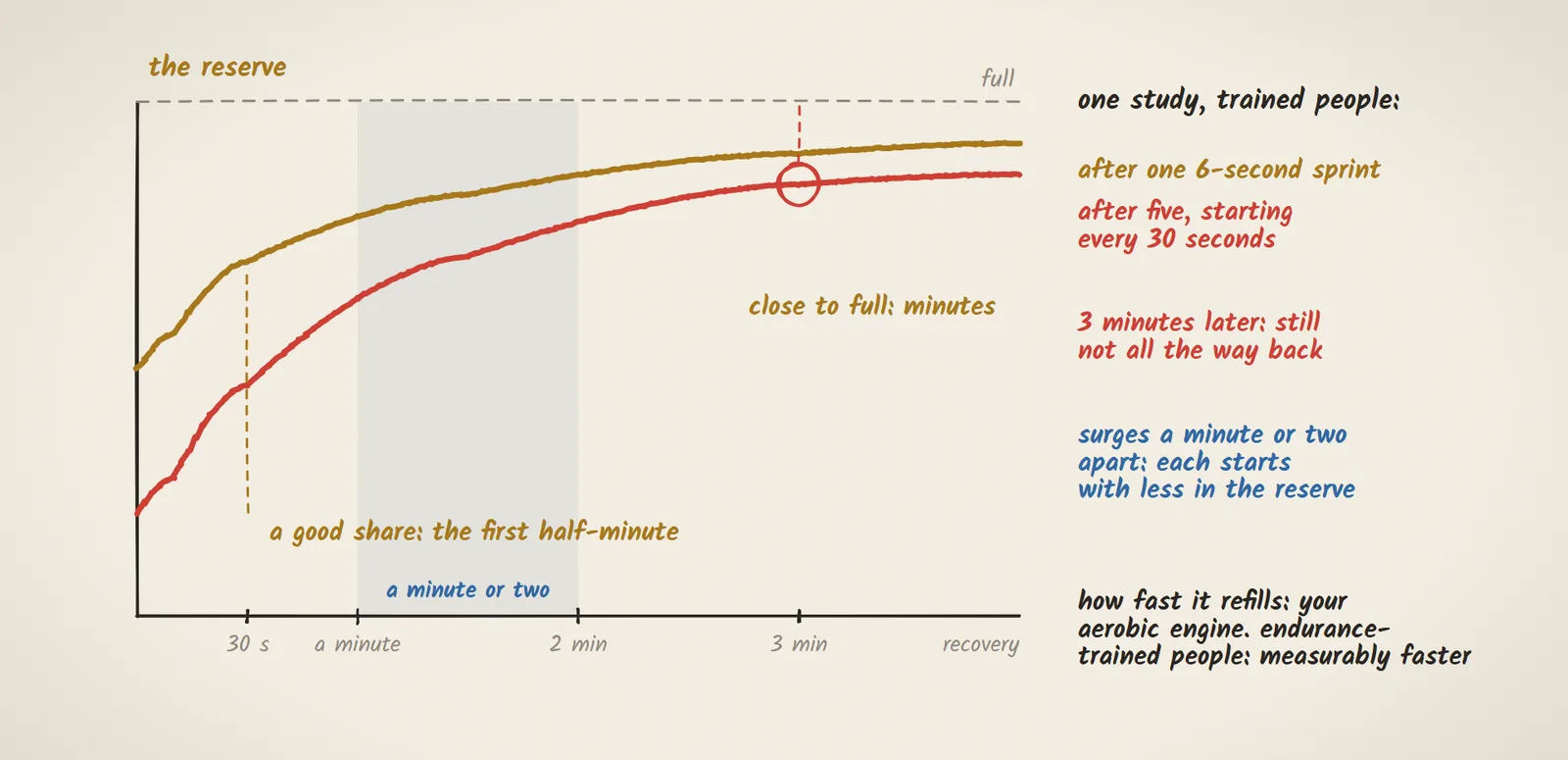
That refill takes time. A good share comes back in the first half-minute, but getting close to full takes minutes. In one study on trained people, five 6-second sprints, starting every 30 seconds, left the reserve far lower than a single one did, and 3 minutes later, it still wasn’t all the way back. Surges a minute or two apart don’t give you those minutes, so each one after the first starts with less in the reserve than the first did. And because the refill runs on oxygen, its speed depends on your aerobic engine: people with endurance training refill measurably faster than people without.
The experiment
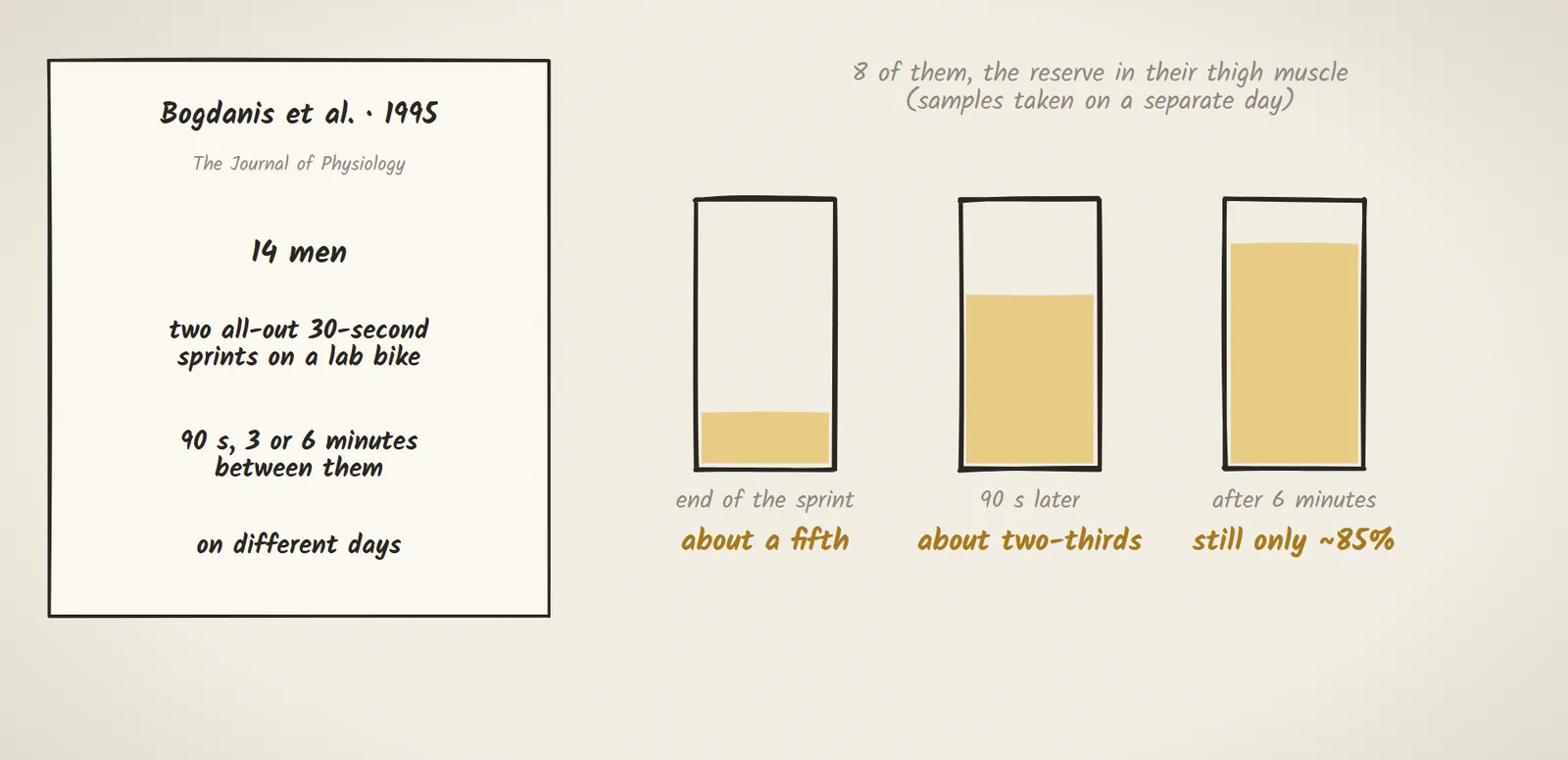
Does your power really come back with the refill? In one study, 14 men did two all-out 30-second sprints on a lab bike, with a minute and a half, 3 minutes or 6 minutes between them, on different days. In 8 of them, muscle samples from the thigh, taken on a separate day, showed the reserve down to about a fifth of its resting level at the end of the sprint. A minute and a half later, it was back to about two-thirds, and after 6 minutes, still only about 85%.
What they found
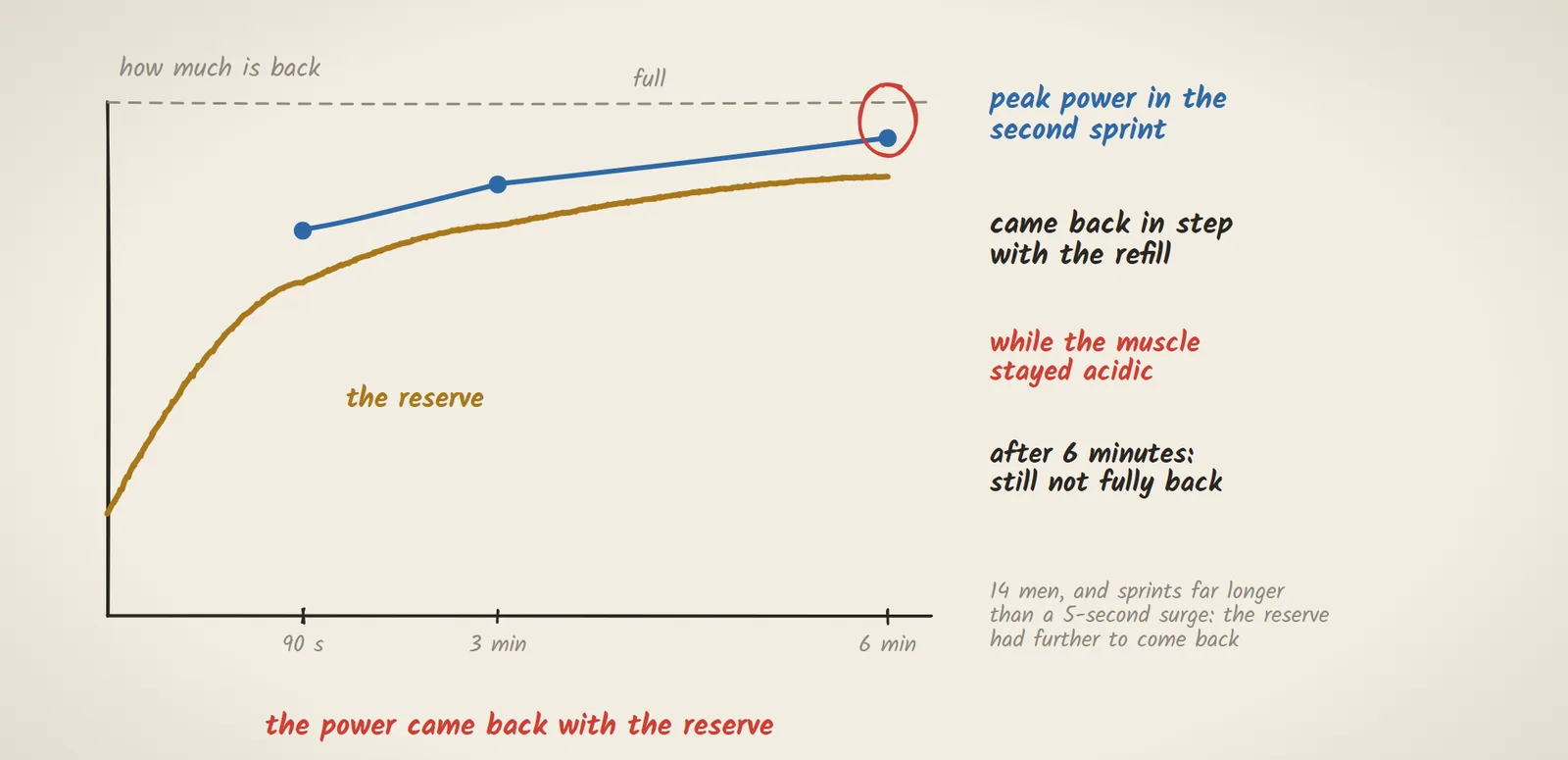
Their peak power in the second sprint followed the same path. It came back in step with the refill, while their muscle stayed acidic, and even after 6 minutes it hadn’t fully returned. Fourteen men, and sprints far longer than a 5-second surge, so the reserve had further to come back, but the power came back with it.
What it means for you
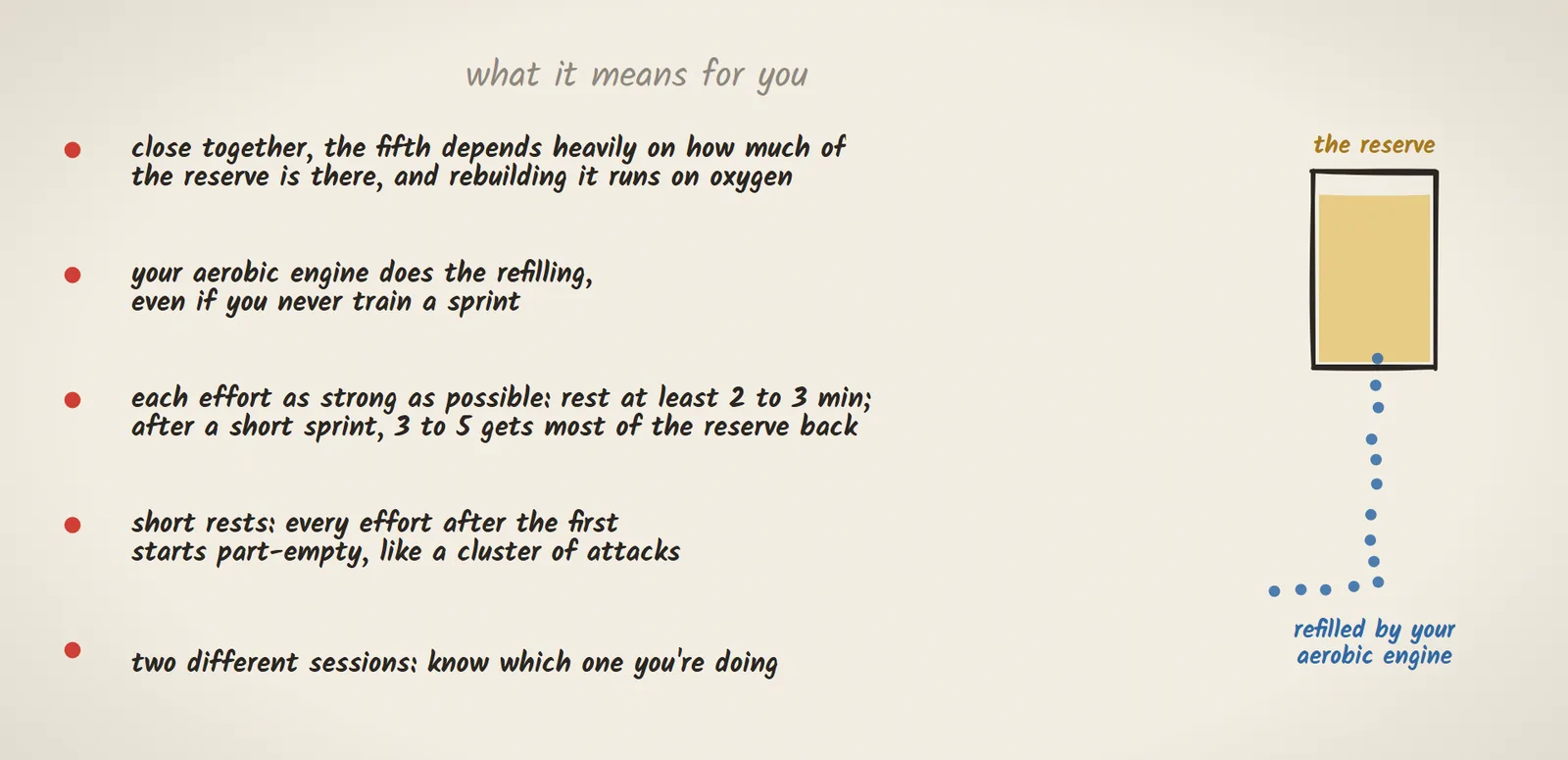
So what does this mean for you? When surges come close together, the fifth one depends heavily on how much of the reserve is there when you go again, and rebuilding it runs on oxygen. So your aerobic engine is part of your fifth attack, because it does the refilling, even if you never train a sprint. In training, pick the rest by what you want from the efforts. If each one should be as strong as possible, rest at least 2 to 3 minutes. After a short sprint, 3 to 5 minutes gets most of the reserve back, and after longer or repeated efforts, it takes longer. Short rests start every effort after the first with the reserve part-empty, which is what a cluster of attacks does. Those are two different sessions, so know which one you’re doing.
That’s what’s underneath the watts.
Sources
The study
- Bogdanis GC, Nevill ME, Boobis LH, Lakomy HK, Nevill AM. Recovery of power output and muscle metabolites following 30 s of maximal sprint cycling in man. J Physiol. 1995;482(Pt 2):467-480. doi.org/10.1113/jphysiol.1995.sp020533
Also in this article
- Stopping the blood flow stops the refill: Harris RC, Edwards RH, Hultman E, Nordesjö LO, Nylind B, Sahlin K. The time course of phosphorylcreatine resynthesis during recovery of the quadriceps muscle in man. Pflügers Arch. 1976;367(2):137-142. doi.org/10.1007/BF00585149
- One sprint versus five in a row: Dawson B, Goodman C, Lawrence S, Preen D, Polglaze T, Fitzsimons M, Fournier P. Muscle phosphocreatine repletion following single and repeated short sprint efforts. Scand J Med Sci Sports. 1997;7(4):206-213. doi.org/10.1111/j.1600-0838.1997.tb00141.x
Written and researched by Yarin Podoler, a cyclist who wanted to know what’s underneath the watts.